
Nullam dignissim, ante scelerisque the is euismod fermentum odio sem semper the is erat, a feugiat leo urna eget eros. Duis Aenean a imperdiet risus.
Nullam dignissim, ante scelerisque the is euismod fermentum odio sem semper the is erat, a feugiat leo urna eget eros. Duis Aenean a imperdiet risus.
The upper liner is an interior component mounted in the upper area of a vehicle cabin, where it covers and protects the underlying structure while forming a visible trim surface that passengers see every day. Molding this part in glass-fiber reinforced PA66 raises the difficulty level: the filled material is strong and dimensionally stable, but it is also more sensitive to warpage and shrinkage control than unfilled resins, and any deviation shows up directly on the visible surface or at the mounting points.
This article describes our injection molding solution for a PA66 + fiber upper liner, from custom mold design through mass production, quality control and packaging. The same workflow applies to similar interior structural and trim parts molded in reinforced engineering plastics.
For this part the customer selected PA66 reinforced with glass fiber, and the material choice matches the working conditions of an interior upper component. The liner sits in a warm zone of the cabin where temperatures fluctuate between parking in summer sun and cold starts in winter, so the material has to keep its shape across the whole range. The glass-fiber reinforcement provides high strength and stiffness for a thin-walled structural cover, together with excellent wear resistance where the part may contact other interior components.
Two properties of the filled grade matter as much as its strength. Low shrinkage keeps the liner’s overall geometry and mounting positions stable from the first shot to the last, and stable performance over repeated thermal cycles means the part does not relax or distort after assembly. The trade-off is that glass-filled PA66 is anisotropic: it shrinks differently along and across the fiber orientation, which has to be compensated in the mold rather than corrected after molding.
The mold was developed around the part’s geometry and the fiber orientation. Filling simulations and gate placement were reviewed so that the visible surface would not show flow marks or fiber shadowing, and the cooling layout was designed to keep differential shrinkage across the part under control. These decisions were fixed at the DFM stage, before steel cutting, because warpage in a glass-filled part is nearly impossible to remove by adjusting process parameters alone.
In production the liner runs in a dedicated injection molding cell with automated take-out and a conveyor line, which keeps the molding cycle and part handling consistent from shot to shot. Process parameters for each cavity are recorded and kept with the batch, so any dimensional or appearance question can be traced back to the molding conditions of that specific production run.
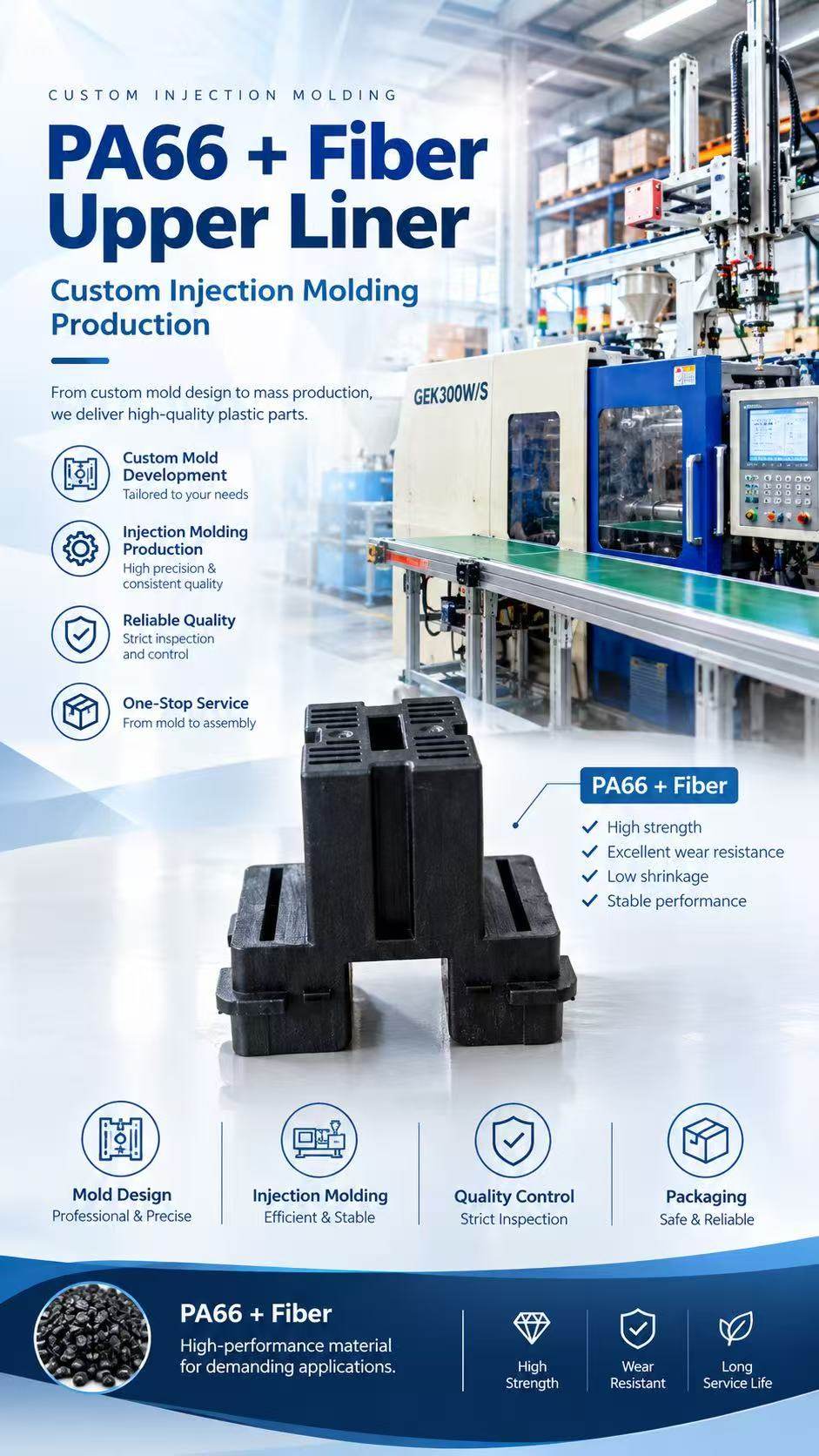
Quality control for this part focuses on two things: the visible surface and the mounting geometry. Every batch is checked against the agreed appearance standard for sink marks, gloss variation and fiber shadowing on visible areas, while key dimensions are measured to confirm that shrinkage and warpage stay inside the approved window. Because the material locks in fiber orientation, small process deviations show up quickly in the dimensions, and the reaction is to adjust the process rather than accept drift.
Batch consistency is what allows the customer to assemble the liners without rework. Parts molded today must fit the same way as parts molded months earlier, which is why the material grade, color masterbatch and process window are locked after approval and any change goes through a review before production continues.
The liner’s mounting points and clip features are defined against the mating interior parts, not only against the drawing. During sample evaluation the liner is assembled to its reference parts so that clip engagement, gaps and flushness are checked on the real assembly, and the dimensions that matter most are the ones that confirm this fit rather than the ones that are easiest to measure.
After final inspection the liners are packed in a way that protects the visible surfaces during transport, with parts separated and cushioned inside the carton. The packaging is designed for the delivery route, so the parts arrive in the same condition they left the production line.
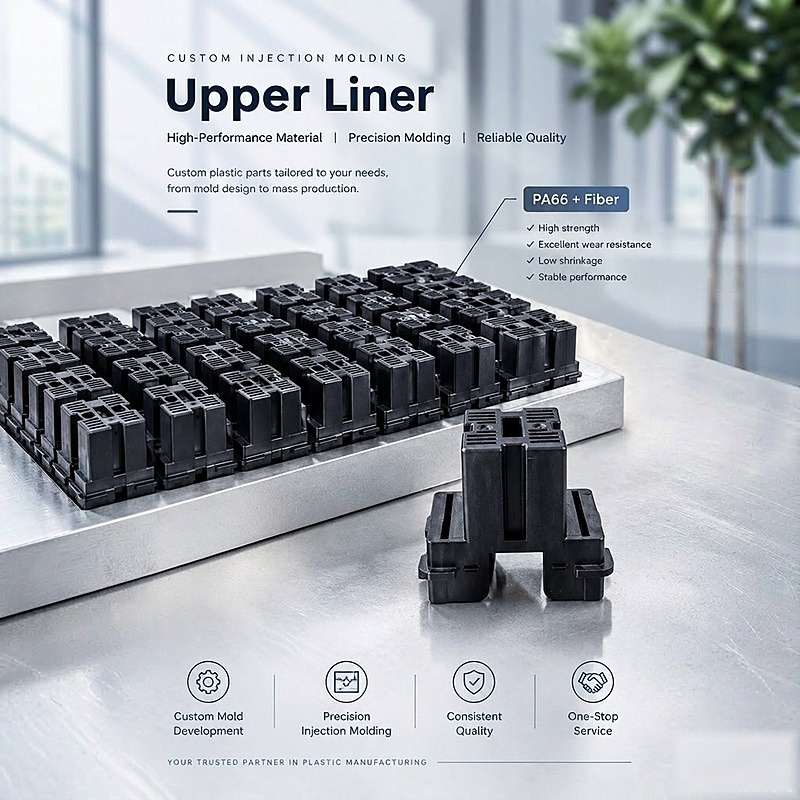
Kunshan Maifeng Precision covers the full scope for parts like this upper liner: product structure review, custom mold design and manufacturing, single- and dual-color injection molding on 36 machines from 90 to 700 tons, and product assembly. If you have drawings, mating parts or a target vehicle platform, send them over and we will review the part and provide a molding solution and quotation.
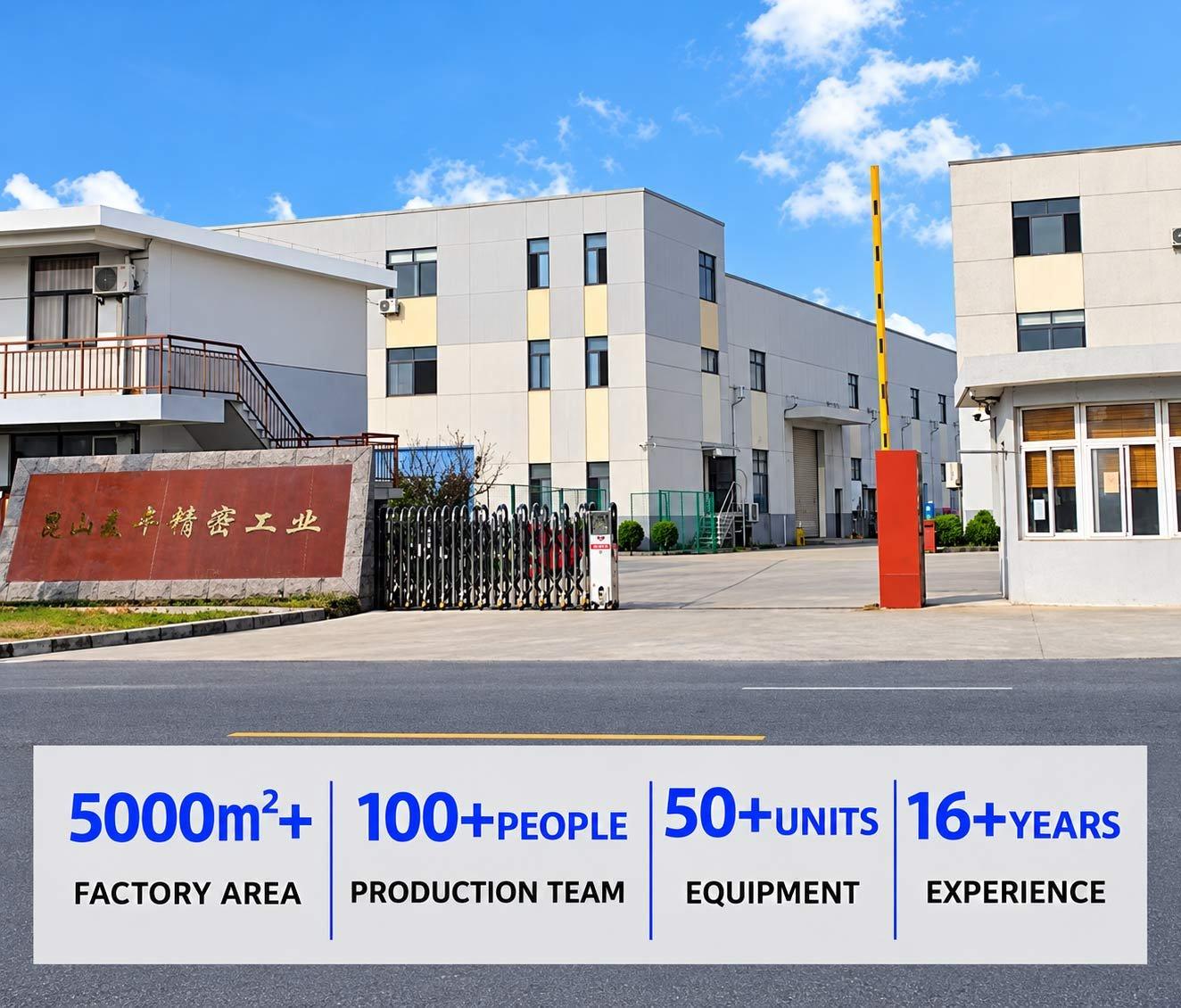
Kunshan Maifeng Precision Industry Co., Ltd. (MIF) has an investment of RMB 35 million and an independent factory of more than 5,000 m². Our manufacturing resources include 36 single- and dual-color injection molding machines from 90 to 700 tons and more than 50 sets of mold manufacturing and processing equipment. Supported by a service, management and production team of over 100 people, we provide product design, mold design and manufacturing, injection molding, and product assembly. Our parent company was established in 2008.
1. Product Design
Product structure design and optimization based on customer drawings and samples.
2. Mold Design
Mold concepts developed around product requirements, material and production needs.
3. Mold Manufacturing
Machining, polishing, assembly and related processes for custom molds.
4. Injection Molding
Single- and dual-color molding capabilities for custom production.
5. Product Assembly








 English
 Chinese