This cup lid is integrally formed by dual-color injection molding: a translucent blue body carrying the thread and sealing stack, and a light grey flip-tote that opens the drinking aperture, latches closed and doubles as the thumb grip. The two resins are chosen as a pair, with shrinkage read together so the interface stays locked and the color boundary stays sharp across the run. The hinge zone is gated to flow across it, and latch depth, hinge root and tab leverage are tuned together for a wet-hand grip. Hinge cycle life, interface integrity and hot-water seal are verified before shipping. Color split, thread form and tote geometry are built to the cup drawing.
two resins moulded in one process, with the color boundary locked mechanically at the interface
tote combines flip cover, carry grip and latch with leverage tuned for a wet hand
shrinkage of both resins read together so the joint never pulls open or bows the lid
Two colors on one lid are a statement the mould has to keep. The lid shown here pairs a translucent blue body with a light grey flip-tote assembly on top, moulded together in a dual-color process, so the boundary between the two sits exactly where the design put it and never migrates. The flip piece is the working part: it lifts to open the drinking aperture, closes to seal, and carries a small thumb tab that doubles as the grip.
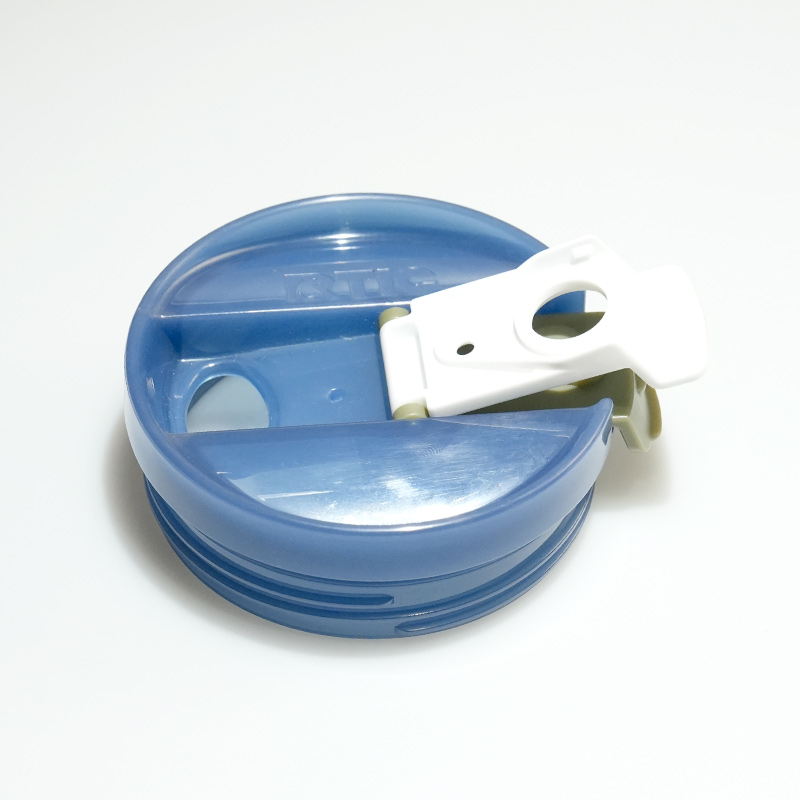
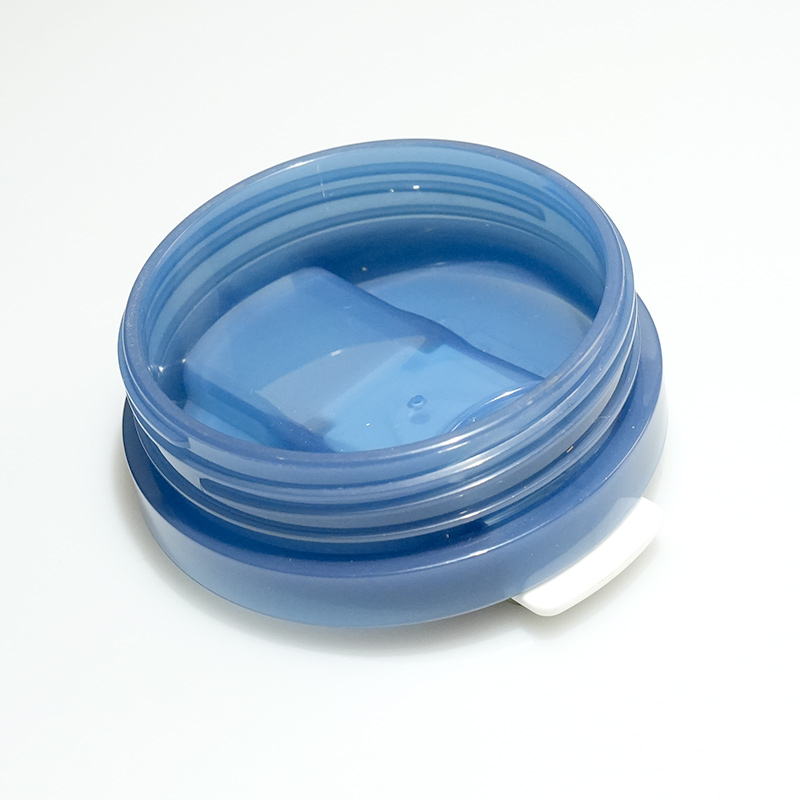
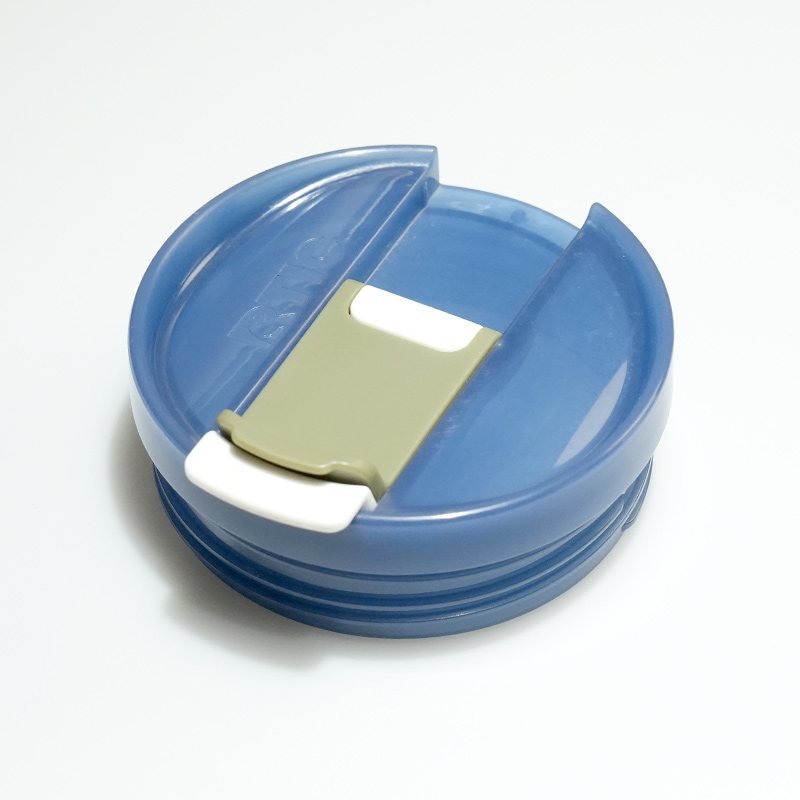
Three photographs show the tote lifted, the underside with the sealing stack, and the lid closed. The tote is where the design earns its keep, because it combines the flip cover, the carry grip and the latch in one moulded pair of shots.
Open. The grey tote lifts the flip cover while its thumb tab stays ready to grip.
What Dual-Color Buys Here
The tote could be a separate grey part snapped onto a blue lid. The failure modes of that route are familiar: the clip loosens, the joint line collects residue, the boundary wanders with every moulding variation. Moulding the two colors together in one process makes the interface a designed feature, locked mechanically, with the colour boundary as sharp in the ten-thousandth part as the first. On a lid that gets washed and flexed daily, that durability is the entire argument for the extra tooling.
The two resins are chosen as a pair. The blue body takes the thread and the sealing duty; the tote resin is picked for hinge flex and grip, stiffer where it latches, more forgiving where it flexes. Their shrinkage is read together, because a mismatch at the interface either pulls the joint open or bows the lid.
The underside. The sealing stack and thread are moulded into the blue body in the first shot.
The Flip-Tote Assembly
Lifting the tote rotates the cover off the drinking aperture through a moulded hinge, and closing seats it with a defined engagement. The thumb tab on the tote is sized for a wet hand, which is who uses these lids: a tab that needs a dry fingertip is a tab that gets forced, and a forced latch fatigues its hinge in months. Latch engagement depth, hinge root thickness and the tab’s leverage are read together, because each shifts the feel of the others.
That is a tooling-stage decision set. The hinge zone is gated to flow across it, never along it, and the first trials are measured for hinge flex before the production window is frozen.
Closed. The tote seats flush, the thumb tab ready, and the colour boundary stays exactly where the tool put it.
Thread and Leakproof Sealing
The thread stack around the skirt compresses the base seal against the cup mouth, and the aperture seal sits under the closed tote. Both are moulded features rather than glued or welded ones, and both are gauged with the actual mating parts: the thread with the cup mouth, the aperture seal by torque and by a tipped, filled test rather than a dry fit.
What Gets Checked Before Shipping
Hinge and latch cycle life, run past the rating on a fixture. Colour boundary sharpness and interface integrity between the two shots. Seal integrity with the lid torqued on, hot water, laid on its side. Thread torque window against the actual cup mouth, and surface appearance against the approved master.
Information to Confirm Before Starting a Dual-Color Lid Project
The cup mouth drawing, since thread and seal are built to it.
Which parts carry which color, and whether the tote contrast is a brand requirement.
Drink type and temperature range, which load both seals differently.
Resin pair specification, including shrinkage compatibility at the interface.
Annual volume, which decides whether dual-color tooling pays against an assembled design.
Kunshan Maifeng Precision Industry Co., Ltd. reviews dual-color closure designs before quoting, builds the injection molds in house, and molds single-color and dual-color parts on 36 machines from 90 to 700 tons. Send us the cup drawing and the color split, and we will come back with a feasibility comment and a tooling proposal.
Company Profile
About Us
Kunshan Maifeng Precision Industry Co., Ltd. (MIF) has an investment of RMB 35 million and an independent factory of more than 5,000 m². The company operates 36 single- and dual-color injection molding machines from 90 to 700 tons, together with more than 50 sets of mold manufacturing and processing equipment. Our service, management and production team includes over 100 people.
Our parent company was established in 2008. We provide product design, mold design and manufacturing, injection molding and product assembly services for custom plastic parts, supporting both domestic and international customers.
1. Product Design Product structure design and optimization based on customer drawings and samples.
2. Mold Design Mold design developed around product geometry, material and production requirements.
3. Mold Manufacturing Machining, polishing, fitting and assembly for custom injection molds.
4. Injection Molding Single- and dual-color injection molding for project and order requirements.
5. Product Assembly Supporting assembly services for molded plastic components.
Custom glossy black PC protective cover for lawn mowers: an open-ring shell with snap clips molded in one shot and a class-A face that survives stones, sun and cleaning.
Custom PC light-diffusion tail light grille for lawn mowers: an even light band, a ribbed outer face, a sealed fixing flange and an optical surface finished to the agreed polish.
Custom clear PC tail light strip for mowers and outdoor equipment: compound curve, uniform wall, polished optical face and colour matched to your chip.
PC+ABS automotive wireless charging housing with an open coil window, four mounting ears and a stiffening rib, molded, inspected and packed for console assembly.
PC lawn mower tail light grille produced through custom mold development, precision injection molding and strict quality control for demanding outdoor applications.
PP handles and plastic parts for a 3rd generation magnetic wall mounted toilet brush, produced at Maifeng Precision through custom mold design, injection molding and careful inspection.
ABS nasal irrigator outer housing produced with custom multi-cavity molds, precision injection molding, careful trimming and dust-free packaging for personal care brands.
ABS nasal irrigator base produced with custom mold design, precision injection molding, strict inspection and dust-free packaging for personal care and medical device assemblies.
No matter what your automotive needs may be, we’re here to help. Contact us today to learn more about our
services and how we can assist you with all of your needs.
ISO 13485-certified medical injection molding in Class 10,000/100,000 cleanrooms: 36 single and dual-color machines, proven medical cases and trusted partners.
One-stop cup and bottle molding: dual-color lids, tea-separation cups and handles, QS food-contact licensed production with proven cases for global brands.
Contact Us
To grow into a top global mold & injection molding supplier
To grow into a top global mold & injection molding supplier, specializing in differentiated custom parts. We focus on structural development, streamlined production and consistent quality supply.












 English
 Chinese



