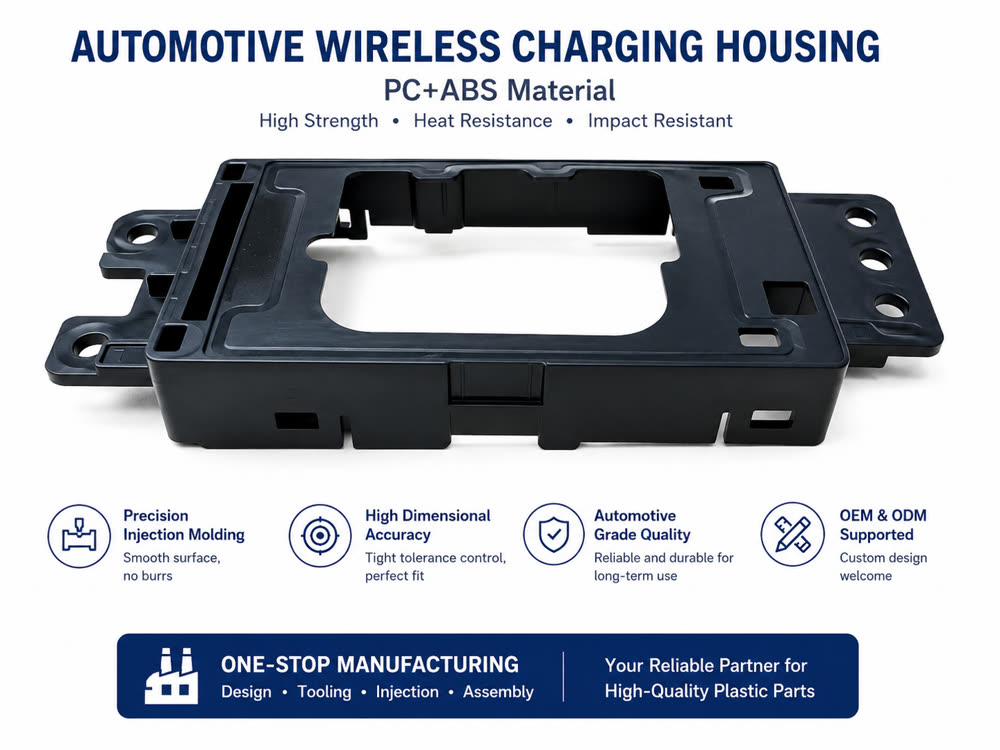
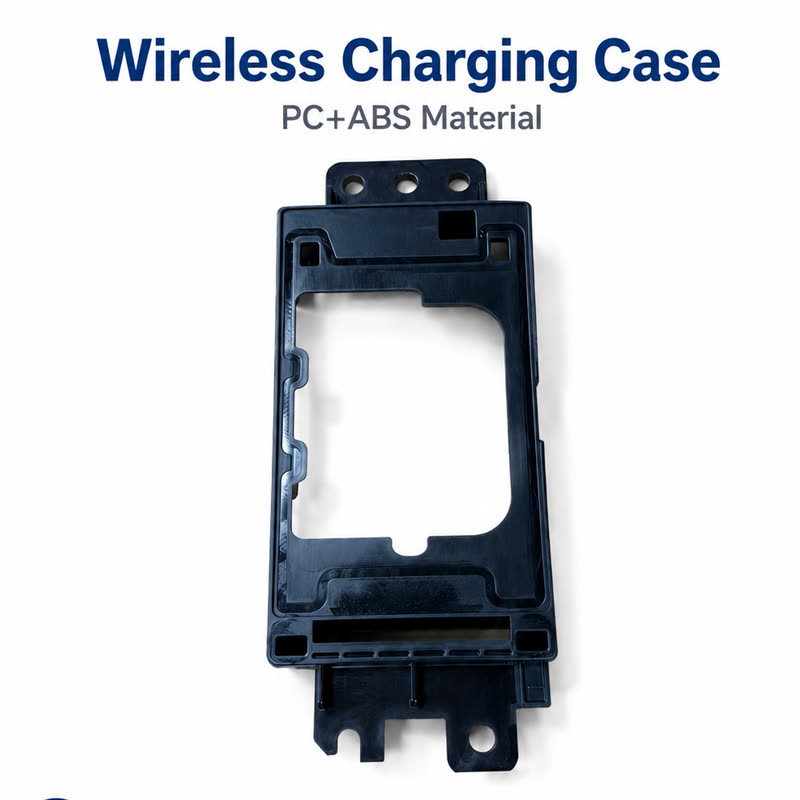
A black PC+ABS frame that carries the wireless charging coil in a car console: an open coil window, four mounting ears and a perimeter rib, molded on a polished tool and checked for window flatness, hole position and surface appearance before packing.
PC+ABS for impact strength, heat resistance and a stable black finish on a visible console part.
Coil window and fixing holes checked on a fixture, because that is what sets the gap between coil and phone.
Mold, molding, inspection and packing in house on 36 machines from 40 to 700 tons.
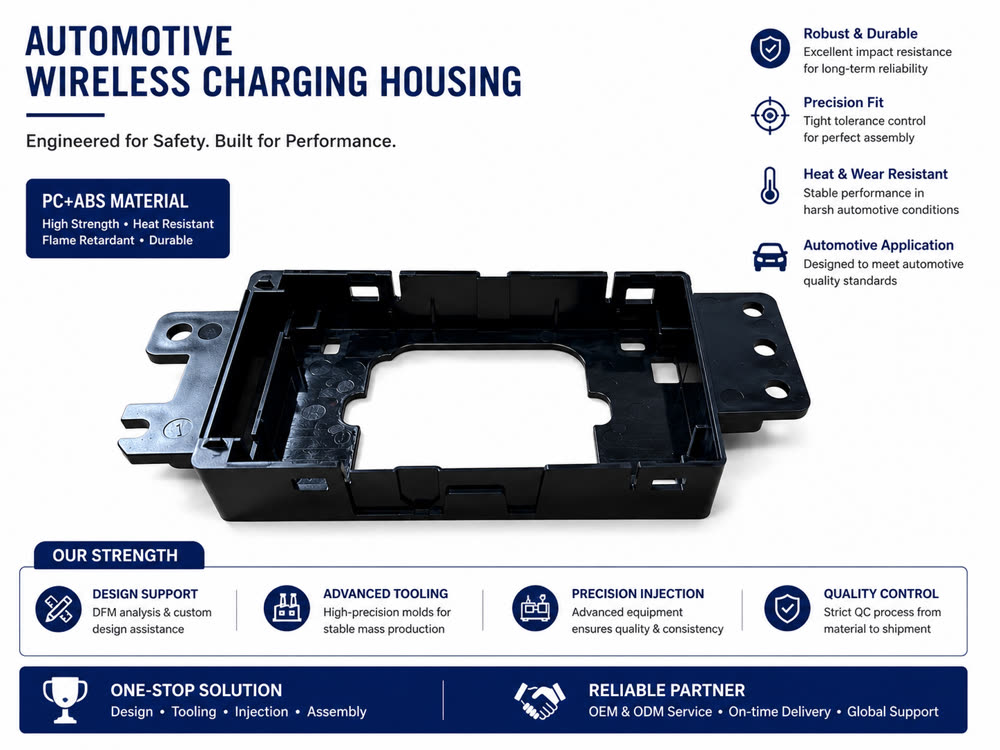
This is the frame that holds a wireless charging coil inside a car console. The phone lands on the trim above it, the coil sits underneath, and everything between the two lives in this one black moulding: an open window in the middle for the coil and the ferrite plate, four mounting ears with fixing holes, a perimeter rib that keeps the window edge from flexing, and a set of slots and steps that locate the assembly inside the console without a separate bracket.
It is moulded in PC+ABS, in black, on a polished tool, and it is a visible part in most builds — the customer sees the window edge and the surfaces around it every time the phone goes down. That combination, a structural frame that is also an appearance part, is what the rest of this page is about.
The housing as moulded: open coil window, mounting ears on both sides, and the step that seats it in the console trim.
Why PC+ABS, and What It Costs You
PC+ABS is the usual choice for a console part that sees sun load, knocks and a phone landing on it several times a day. The PC side gives impact strength and heat resistance — a closed car in summer is not a mild environment — and the ABS side gives the flow and the surface finish that a thin, ribbed frame with a large open window needs in order to fill and pack out. A straight PC would be tougher but harder to mould cleanly at this wall thickness; a straight ABS would fill easily but lose heat resistance and creep resistance under a constant spring load from the coil assembly.
The cost is in process discipline rather than in the resin price. PC absorbs moisture and hydrolyses if it is dried badly, which shows up as silver streaks on a black surface that cannot hide anything. It needs a higher melt temperature and a hotter tool than ABS, and the weld line that forms where the melt fronts meet around the window is a weak line both mechanically and visually. None of this is a reason to avoid the material; it is a reason to fix the drying, the gate position and the weld line location at the tool design stage rather than at the trial.
The Window, the Ears and the Rib
The window is the functional heart of the part. Its edge is what the coil assembly registers against, so the flatness of that edge and the squareness of the opening decide the air gap between coil and phone, and therefore the charging efficiency and how tolerant the system is to a phone laid down slightly off centre. A window edge that waves by a few tenths is invisible on a bench and very visible as a hot spot in a thermal test.
The four ears carry the fixing holes. Their positions matter more than their thickness: the housing is screwed into the console, and if the hole pattern drifts, the assembly either will not seat or seats under preload and distorts the window. Ears are also the first place a sink mark appears, because they are locally thick — the usual fix is to core them from the back rather than to thin them.
The perimeter rib around the window is what lets the frame be thin. It carries the stiffness so the wall between window and outer edge can stay at a nominal 2.0 to 2.5 mm, and its depth is set against sink: a rib thicker than about half the adjoining wall pulls a shadow onto the visible face, and on a gloss black surface that shadow is the first thing a customer sees.
From the side: the ears, the perimeter rib and the pocket the coil assembly sits in. The moulding is a frame, not a box — most of its stiffness comes from geometry.
Surface: Black, and Unforgiving
Black plastic shows everything. Silver streaks from wet resin, flow marks where the melt hesitates, a gate blush on a textured face, ejector pin witness marks on the inside of the window, a polished patch that catches the light differently from the rest of the part — all of it reads as a defect to the person fitting the console, even when the dimension is perfect.
Three decisions carry most of the risk. The gate goes on a face that is hidden after assembly, usually the underside or an end wall, so any blush or gate mark is out of sight. The tool steel is polished to match the drawing’s texture specification rather than to a generic “good finish”, because a texture and a polish that disagree produce a two-tone part. And the venting is cut generously around the window edge, since a large opening in the middle of the part is exactly where trapped air wants to burn.
The housing in hand after moulding: the surface is checked for streaks, sink and marks before anything is measured, because on a black part the eye finds what a gauge will not.
From the Press to the Carton
The part runs on a horizontal machine with a robot take-out, because a frame with an open window is awkward to catch by hand without flexing it. The robot lifts the moulding off the core, sets it down clear of the platens, and the operator checks the first pieces at the bench before the rest go into the carton with dividers. Runners are separated at the machine so that no gate stub travels to the customer.
For a part like this we normally quote one or two cavities. Two cavities halve the cycle cost per part but double the tool, and on a low-volume console variant the single-cavity tool is usually the better number; on a platform part running for several years the two-cavity tool pays back quickly. The deciding figure is the annual volume against the tool amortisation, not the unit price on its own.
Robot take-out, a bench check on the first parts, and the carton at the end of the line — the same route whether the order is a sample batch or a production lot.
What Is Checked Before Shipping
Window edge flatness and opening size, checked on a fixture rather than with a caliper across the corners.
Fixing hole positions against the drawing, since the hole pattern is what seats the housing in the console.
Ear flatness and overall length, because preload on a warped ear tilts the coil.
Wall thickness at the window frame and at the rib roots, sampled per cavity and per shift.
Appearance under a defined light source: streaks, flow marks, gate and ejector marks, texture match to the approved sample.
Burr at the window edge and at the slots, removed by hand where the assembly would feel it.
The short version of the specification: PC+ABS, precision moulding, dimensional control to the drawing.
What Can Be Customized
Within the same family of parts: the material grade, including flame-retardant PC+ABS where the console specification calls for it; the surface texture, from a fine matte to a defined grain, matched to a physical sample; the colour master; the window size and the coil pocket depth; the ear pattern and hole diameters; moulded bosses for heat staking the coil carrier or the ferrite plate; and the packing, from bulk cartons to divided trays for a line-side feed.
What we prefer not to change late is the wall section and the gate position. Both are set when the tool is designed, and moving either after the trial usually means a second tool rather than an adjustment.
Information to Confirm Before Starting a Housing Project
The drawing with the tolerances that actually matter — normally window flatness, hole position and overall length — rather than a general tolerance block alone.
The coil and ferrite assembly drawing, if the housing has to register against it, so the pocket and the window edge can be designed to the real stack.
The console fixing method: screws, clips or both, and the torque the ears will see.
The surface specification: texture number or a physical sample, and which faces are visible after assembly.
Material requirement, including any flame-retardant or low-odour grade, and whether the colour needs to match an existing trim.
Annual volume and expected life of the program, which is what decides the cavity count and the tool steel.
Kunshan Maifeng Precision Industry Co., Ltd. reviews the housing drawing and the mating stack before quoting, builds the injection mold in house, moulds single-colour and two-colour parts on 36 machines from 40 to 700 tons, and inspects and packs to the drawing and the carton specification. Send us a drawing, a sample or a console assembly, and we will come back with a tooling proposal, a material comment and a checking plan.
Contact Us
Betty — Kunshan Maifeng Precision Industry Co., Ltd.
Custom Mold. Precision Injection Molding. Reliable Production. Let us help turn your plastic component design into a high-quality manufactured product.
Company Profile
About Us
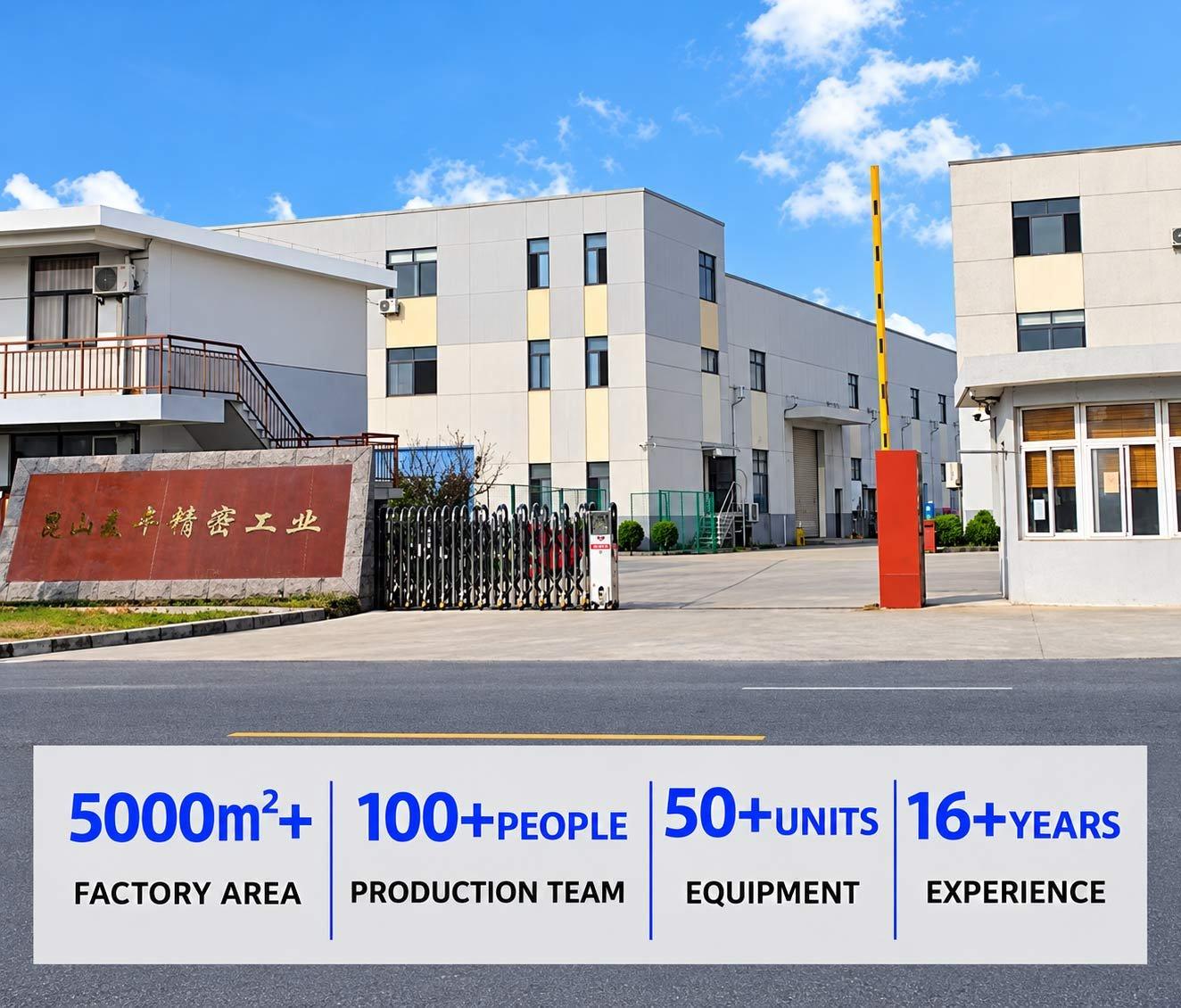
Kunshan Maifeng Precision Industry Co., Ltd. (MIF) has an investment of RMB 35 million and an independent factory of more than 5,000 m². The company operates 36 single- and dual-color injection molding machines from 40 to 700 tons, together with more than 50 sets of mold manufacturing and processing equipment. Our service, management and production team includes over 100 people.
Our parent company was established in 2008. We provide product design, mold design and manufacturing, injection molding and product assembly services for custom plastic parts, supporting both domestic and international customers.
1. Product Design Product structure design and optimization based on customer drawings and samples.
2. Mold Design Mold design developed around product geometry, material and production requirements.
3. Mold Manufacturing Machining, polishing, fitting and assembly for custom injection molds.
4. Injection Molding Single- and dual-color injection molding for project and order requirements.
5. Product Assembly Supporting assembly services for molded plastic components.
Custom glossy black PC protective cover for lawn mowers: an open-ring shell with snap clips molded in one shot and a class-A face that survives stones, sun and cleaning.
Custom PC light-diffusion tail light grille for lawn mowers: an even light band, a ribbed outer face, a sealed fixing flange and an optical surface finished to the agreed polish.
Custom clear PC tail light strip for mowers and outdoor equipment: compound curve, uniform wall, polished optical face and colour matched to your chip.
PC lawn mower tail light grille produced through custom mold development, precision injection molding and strict quality control for demanding outdoor applications.
PP handles and plastic parts for a 3rd generation magnetic wall mounted toilet brush, produced at Maifeng Precision through custom mold design, injection molding and careful inspection.
ABS nasal irrigator outer housing produced with custom multi-cavity molds, precision injection molding, careful trimming and dust-free packaging for personal care brands.
ABS nasal irrigator base produced with custom mold design, precision injection molding, strict inspection and dust-free packaging for personal care and medical device assemblies.
No matter what your automotive needs may be, we’re here to help. Contact us today to learn more about our
services and how we can assist you with all of your needs.
ISO 13485-certified medical injection molding in Class 10,000/100,000 cleanrooms: 36 single and dual-color machines, proven medical cases and trusted partners.
One-stop cup and bottle molding: dual-color lids, tea-separation cups and handles, QS food-contact licensed production with proven cases for global brands.
Contact Us
To grow into a top global mold & injection molding supplier
To grow into a top global mold & injection molding supplier, specializing in differentiated custom parts. We focus on structural development, streamlined production and consistent quality supply.













 English
 Chinese



