This DTRO circular flow guide disc is molded in POM for disc tube reverse osmosis equipment handling high-concentration wastewater and leachate. The central field carries the flow distribution pattern, moulded sharply because rib edges that round off defeat the hydraulic design. The annular band takes the stacking load and carries the seals, and flatness across the diameter is the acceptance dimension, since channel height variation is where flow concentrates and fouling starts. POM is specified for chemical resistance, dimensional stability in warm wet service and a particle-free moulded surface. Pattern dimensions, band thickness and flatness are reported per lot with cavity-to-cavity consistency checks.
POM chosen for chemical resistance, wet-service dimensional stability and a moulded particle-free surface
flatness treated as the acceptance dimension because channel height decides fouling
hydraulic pattern moulded sharply, with cavity condition maintained to the drawing
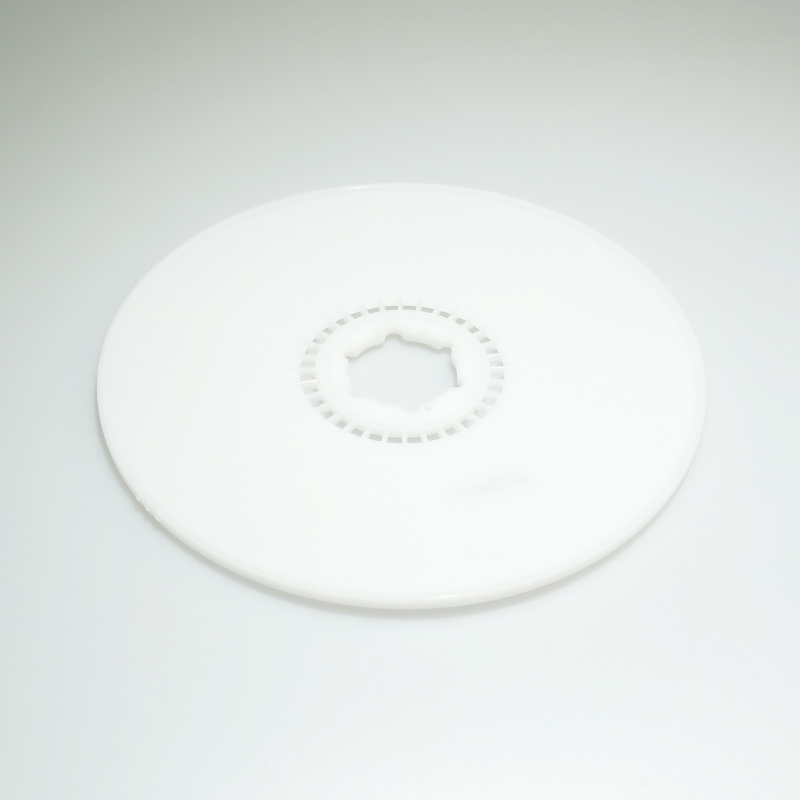
A disc tube reverse osmosis plant pushes high-concentration wastewater, often landfill leachate, through a stack of discs at pressure, and the spacer between those membranes decides whether the flow distributes evenly or channels and fouls. The disc shown here is that spacer: a moulded POM flow guide disc, flat and large in diameter, with the flow pattern cut into its central field.
The photograph shows the disc as moulded, with the central pattern of openings and the tight annular band that carries the stacking load. Everything about the part is dimensional discipline: a stack of hundreds of these discs only works if each one is the same.
The disc as moulded. The central opening pattern sets the flow distribution; the annular band carries the stack load.
Why POM
POM earns its place here through combination rather than any single property. It resists the chemicals carried in leachate, it holds its dimensions in warm, wet service where many resins creep, and it is slippery enough that surfaces contacting the membrane stack do not grab or shed particles. Its weakness is bonding and printing, which this part does not need; its strength is that a moulded disc comes out finished, with no machining and no secondary surface to contaminate the process stream.
The resin also moulds predictably in thin sections. A disc this diameter in a thin wall wants to warp, and POM’s crystallinity gives it enough stiffness after ejection to hold flat while it cools, provided the moulding gives it an even start.
Flatness Is the Product
The disc sits between membrane layers, and its whole function depends on presenting the same gap everywhere. A warp of a few tenths of a millimetre across the diameter changes the local channel height, and changed channel height is where flow concentrates, fouling starts and cleaning cycles shorten. Flatness is therefore the acceptance dimension, not a cosmetic one.
The tooling answers are the standard ones for a large thin part, applied without compromise: even wall, balanced cooling around the full diameter, generous cooling time before ejection, and an ejection layout that pushes on the stiff central field rather than the thin rim. Rushing any of these turns a good drawing into a stack of wobbly discs.
The Flow Pattern in the Centre
The central field carries the openings and ribs that distribute flow across the membrane face. The pattern is a hydraulic design decision, not a moulding one, and the mould has to reproduce it sharply: rib edges that come out rounded or flash-filled change the local flow and defeat the pattern the process was designed around. Cavity condition is maintained to the drawing because the steel is effectively the hydraulic profile.
The annular band outside the pattern is the mechanical half of the design. It takes the stacking load of the assembly, so its thickness and flatness hold the discs in register, and its surface is what the seals ride against. Where the band meets the patterned field, the section steps carefully, because a thick rim behind a thin field is where sink marks would appear on a part that cannot afford them.
Repeatability Across the Stack
A DTRO stack uses hundreds of identical discs, and the process performance depends on their similarity. Dimensional reports cover the pattern features, the band and flatness, sampled across each lot, with cavity-to-cavity consistency checked so that no one cavity drifts into producing discs that look fine alone and misbehave in a stack.
Information to Confirm Before Starting a Flow Guide Disc Project
The disc drawing with the hydraulic pattern, since the tool reproduces it exactly.
Stack pressure and temperature, which set the POM grade and the band thickness.
Chemical exposure profile of the feed stream, confirming resin compatibility.
Flatness tolerance and how it is measured, agreed before tooling rather than after.
Annual volumes, since stack replacement demand usually justifies multi-cavity tooling.
Kunshan Maifeng Precision Industry Co., Ltd. reviews industrial component designs before quoting, builds the injection molds in house, and molds single-color and dual-color parts on 36 machines from 90 to 700 tons. Send us the disc drawing and the process conditions, and we will come back with a feasibility comment and a tooling proposal.
Company Profile
About Us
Kunshan Maifeng Precision Industry Co., Ltd. (MIF) has an investment of RMB 35 million and an independent factory of more than 5,000 m². The company operates 36 single- and dual-color injection molding machines from 90 to 700 tons, together with more than 50 sets of mold manufacturing and processing equipment. Our service, management and production team includes over 100 people.
Our parent company was established in 2008. We provide product design, mold design and manufacturing, injection molding and product assembly services for custom plastic parts, supporting both domestic and international customers.
1. Product Design
Product structure design and optimization based on customer drawings and samples.
2. Mold Design
Mold design developed around product geometry, material and production requirements.
3. Mold Manufacturing
Machining, polishing, fitting and assembly for custom injection molds.
4. Injection Molding
Single- and dual-color injection molding for project and order requirements.
5. Product Assembly
Supporting assembly services for molded plastic components.
Custom glossy black PC protective cover for lawn mowers: an open-ring shell with snap clips molded in one shot and a class-A face that survives stones, sun and cleaning.
Custom PC light-diffusion tail light grille for lawn mowers: an even light band, a ribbed outer face, a sealed fixing flange and an optical surface finished to the agreed polish.
Custom clear PC tail light strip for mowers and outdoor equipment: compound curve, uniform wall, polished optical face and colour matched to your chip.
PC+ABS automotive wireless charging housing with an open coil window, four mounting ears and a stiffening rib, molded, inspected and packed for console assembly.
PC lawn mower tail light grille produced through custom mold development, precision injection molding and strict quality control for demanding outdoor applications.
PP handles and plastic parts for a 3rd generation magnetic wall mounted toilet brush, produced at Maifeng Precision through custom mold design, injection molding and careful inspection.
ABS nasal irrigator outer housing produced with custom multi-cavity molds, precision injection molding, careful trimming and dust-free packaging for personal care brands.
ABS nasal irrigator base produced with custom mold design, precision injection molding, strict inspection and dust-free packaging for personal care and medical device assemblies.
No matter what your automotive needs may be, we’re here to help. Contact us today to learn more about our
services and how we can assist you with all of your needs.
ISO 13485-certified medical injection molding in Class 10,000/100,000 cleanrooms: 36 single and dual-color machines, proven medical cases and trusted partners.
One-stop cup and bottle molding: dual-color lids, tea-separation cups and handles, QS food-contact licensed production with proven cases for global brands.
Contact Us
To grow into a top global mold & injection molding supplier
To grow into a top global mold & injection molding supplier, specializing in differentiated custom parts. We focus on structural development, streamlined production and consistent quality supply.












 English
 Chinese



