This terminal block marker strip is injection molded in white PA or PP as a long thin lattice. Transverse slot rows expose one marking position each, with moulded teeth along every slot that hold printed inserts or take direct laser marking, and the slot pitch is cut to match the terminal pitch along the full strip length. A continuous snap rail on the underside flexes over the marker carrier and locks behind its lip; the rail is thinner than the top rails so it takes the assembly load as the sacrificial feature. The lattice interrupts shrink to hold the strip straight, and both resins accept laser, insert and hand marking.
slot pitch held along the full length so the marked row reads straight at slot forty
snap rail thinner than the top rails by design, taking assembly load as the sacrificial feature
lattice slots interrupt shrink so a long thin strip stays straight enough to mount
This white marker strip clicks onto industrial terminal blocks and carries the circuit numbers. Maintenance staff read the marking through the slot array, so the strip does one job: present the numbers, stay put, and survive the panel environment for years.
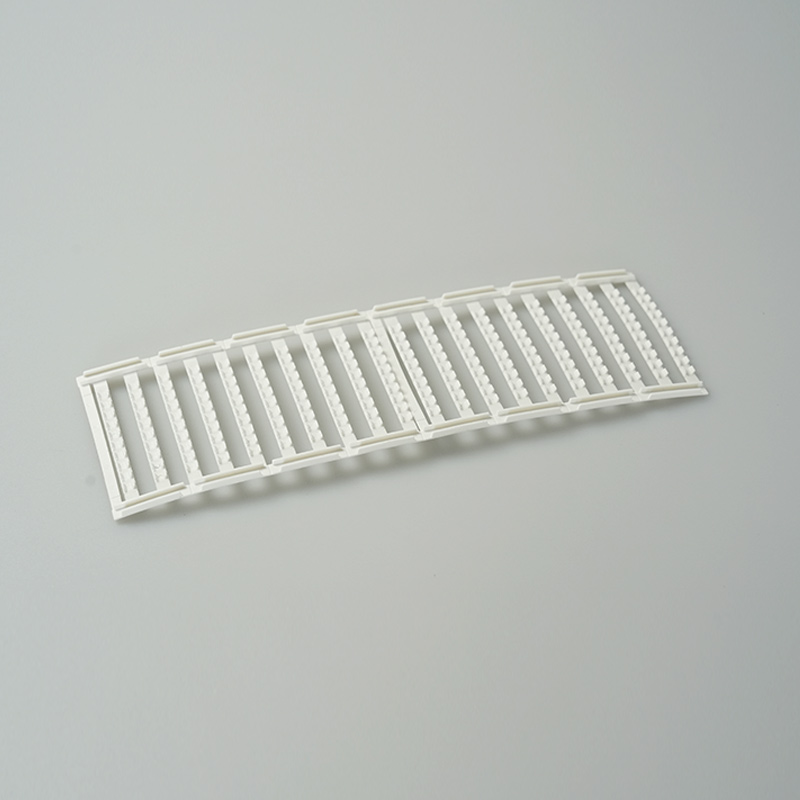
The strip is injection molded as a long thin lattice — two parallel rails joined by rows of transverse slots, with a snap profile on the underside that grips the terminal block’s marker carrier. It ships in strips that are cut or folded to length.
Single marker strip showing the parallel rails and the transverse slot rows.
The Slot Array
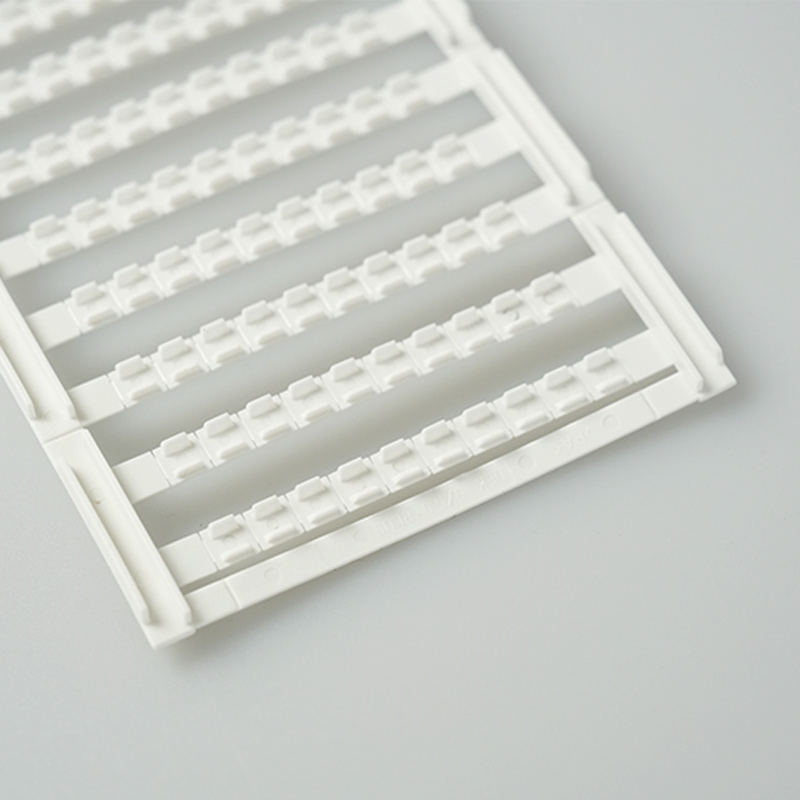
The slots are the product. Each transverse slot exposes one marking position and shields the rest: small teeth moulded along each slot edge hold a printed insert or receive direct marking, and the lattice keeps the marked faces aligned in a straight row even when the strip follows a rail that is not perfectly flat. Slot pitch follows the terminal block pitch, and the pitch has to hold along the full length — an accumulating error of half a millimetre by slot forty shows up as a visibly crooked row.
How the marking gets in is a workflow question, and the strip supports both answers. Panels that are wired and labelled in the shop run printed inserts: the plotter prints a reel of numbers, and assembly presses one into each slot during build. Panels that get reworked in the field lean on direct laser marking, because nobody wants to stock inserts for a machine that was commissioned five years ago. The teeth are profiled to retain an insert against vibration either way; an insert that works loose and slides along the slot is worse than no insert at all, because it lies about which circuit it names.
Close-up of the slot array showing the teeth that carry the marking positions.
Keeping a Long Thin Strip Straight
A strip like this wants to curve. Long, thin, full of slots — every factor pushes toward warp. The lattice actually helps here: the slots interrupt the shrink so the part cannot build up long-range stress the way a solid strip would. The mold is gated so flow travels down the rails, cooling is balanced on both sides, and strips are packed flat rather than coiled. Even then, the honest expectation is a strip that relaxes slightly out of the tool; the snap rails pull it straight the moment it clicks onto the block.
We still measure it. A strip is laid on a surface plate against a straightedge, and the gap at mid-length is recorded on the first-article report. What counts as acceptable is decided with the customer before the tool is cut, because a strip that mounts on a curved DIN rail carrier tolerates more relaxation than one that mounts on a flat adaptor. Arguing about straightness after the mold arrives costs everyone a week.
The Snap Profile
On the underside, a continuous snap rail runs the length of the strip. It flexes over the marker carrier on the terminal block and locks behind the carrier’s lip. The rail is thinner than the rails on top on purpose: it is the sacrificial feature, the one that takes assembly load every time an electrician re-marks a panel. Replacement is expected; fracture is not.
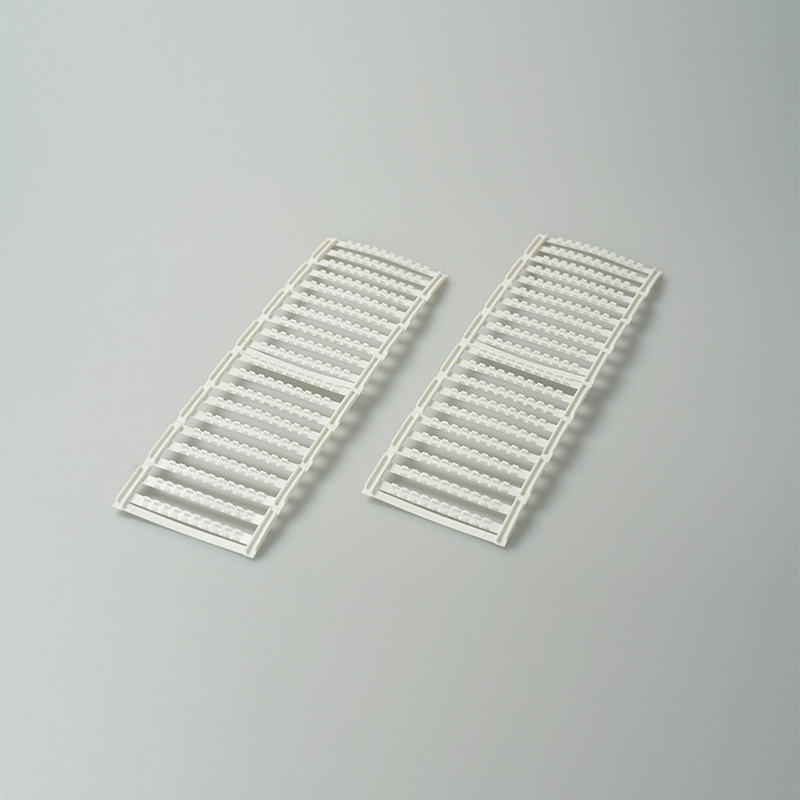
Two marker strips lying flat showing the snap rails and rail alignment.
Material and Marking
White PA or PP, decided by the panel environment. PA is stiffer and handles the temperatures found near panel heating elements; PP costs less and resists most panel cleaning agents. Both accept laser marking, plotter-printed inserts and hand marking. The white pigment is chosen for laser contrast rather than pure appearance — a cosmetic white that marks poorly is a failed part.
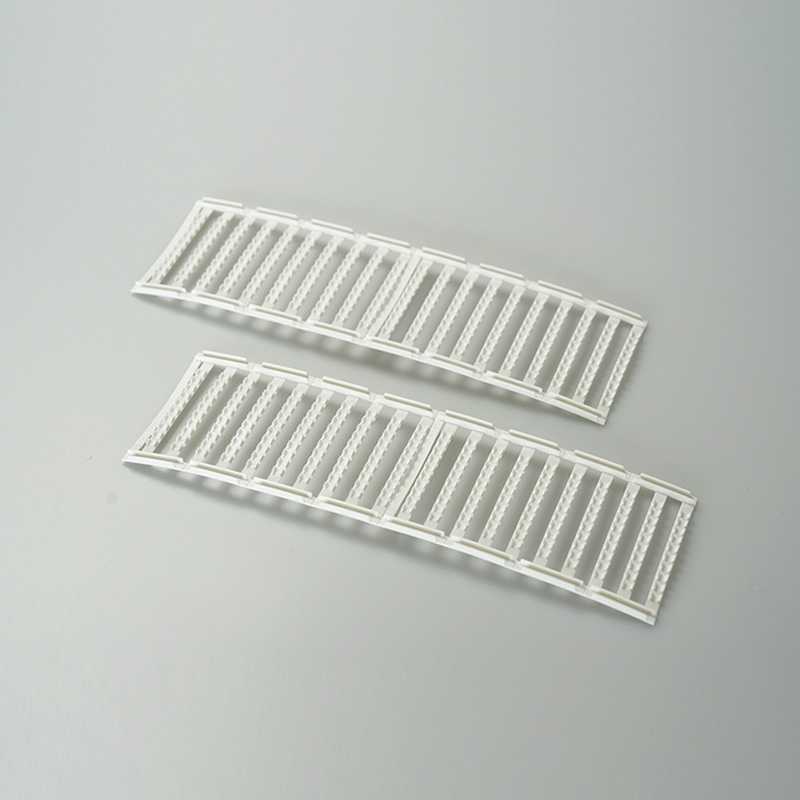
Second pair of strips showing pitch consistency along the slot rows.
Information to Confirm Before Starting a Terminal Marker Strip Project
The terminal block system and its marker carrier profile, since the snap rail follows it exactly.
Terminal pitch, so the slot array matches the row of connections.
The marking method: laser, printed inserts or hand marking.
Panel temperature range and any chemical exposure near the strip.
Strip length and whether it ships continuous, pre-cut or scored to fold.
Kunshan Maifeng Precision Industry Co., Ltd. reviews marker strip designs before quoting, builds the injection molds in house, and molds single-color and dual-color parts on 36 machines from 90 to 700 tons. Send us the terminal block profile and the pitch requirement, and we will come back with a feasibility comment and a tooling proposal.
Company Profile
About Us
Kunshan Maifeng Precision Industry Co., Ltd. (MIF) has an investment of RMB 35 million and an independent factory of more than 5,000 m². The company operates 36 single- and dual-color injection molding machines from 90 to 700 tons, together with more than 50 sets of mold manufacturing and processing equipment. Our service, management and production team includes over 100 people.
Our parent company was established in 2008. We provide product design, mold design and manufacturing, injection molding and product assembly services for custom plastic parts, supporting both domestic and international customers.
1. Product Design
Product structure design and optimization based on customer drawings and samples.
2. Mold Design
Mold design developed around product geometry, material and production requirements.
3. Mold Manufacturing
Machining, polishing, fitting and assembly for custom injection molds.
4. Injection Molding
Single- and dual-color injection molding for project and order requirements.
5. Product Assembly
Supporting assembly services for molded plastic components.
Custom glossy black PC protective cover for lawn mowers: an open-ring shell with snap clips molded in one shot and a class-A face that survives stones, sun and cleaning.
Custom PC light-diffusion tail light grille for lawn mowers: an even light band, a ribbed outer face, a sealed fixing flange and an optical surface finished to the agreed polish.
Custom clear PC tail light strip for mowers and outdoor equipment: compound curve, uniform wall, polished optical face and colour matched to your chip.
PC+ABS automotive wireless charging housing with an open coil window, four mounting ears and a stiffening rib, molded, inspected and packed for console assembly.
PC lawn mower tail light grille produced through custom mold development, precision injection molding and strict quality control for demanding outdoor applications.
PP handles and plastic parts for a 3rd generation magnetic wall mounted toilet brush, produced at Maifeng Precision through custom mold design, injection molding and careful inspection.
ABS nasal irrigator outer housing produced with custom multi-cavity molds, precision injection molding, careful trimming and dust-free packaging for personal care brands.
ABS nasal irrigator base produced with custom mold design, precision injection molding, strict inspection and dust-free packaging for personal care and medical device assemblies.
No matter what your automotive needs may be, we’re here to help. Contact us today to learn more about our
services and how we can assist you with all of your needs.
ISO 13485-certified medical injection molding in Class 10,000/100,000 cleanrooms: 36 single and dual-color machines, proven medical cases and trusted partners.
One-stop cup and bottle molding: dual-color lids, tea-separation cups and handles, QS food-contact licensed production with proven cases for global brands.
Contact Us
To grow into a top global mold & injection molding supplier
To grow into a top global mold & injection molding supplier, specializing in differentiated custom parts. We focus on structural development, streamlined production and consistent quality supply.












 Chinese
 English



