Car Ambient Light Light Guide Strip, Auto Interior Decor Light Structural Part
This automotive ambient light guide strip is injection molded in high-clarity resin as one piece: a long body, a sawtooth face along one edge, and clips moulded at the ends. The teeth are the working feature — each one turns a slice of the travelling light out through the surface, and their pitch is graded along the strip so the output stays even from the LED end to the far end instead of fading. Tooth pitch, angle and depth are held to the drawing, and the lit strip is measured on a luminance meter against the uniformity band the customer specifies before parts ship. The end clips are moulded integral with the strip and sized to the real trim feature. Resin is PMMA or PC per specification.
sawtooth face graded along the strip so light leaves evenly instead of fading toward the far end
lit output measured on a luminance meter against the customer's uniformity band before shipping
end clips moulded integral with the strip and sized to the actual trim feature
This clear strip is the light guide for a car’s ambient lighting. It runs behind a trim seam in the door or across the instrument panel, an LED fires into one end, and the fine teeth moulded along one face strip the light out evenly so the seam glows as one line instead of a bright point at the LED. The end clip moulded into the strip is what holds it in the trim.
The strip is injection molded in high-clarity resin as one piece: a long body, a sawtooth face along one edge, and a clip at the end. This page covers what the teeth do, how their geometry is set, what the tool has to survive to cut them, and how the strip mounts.
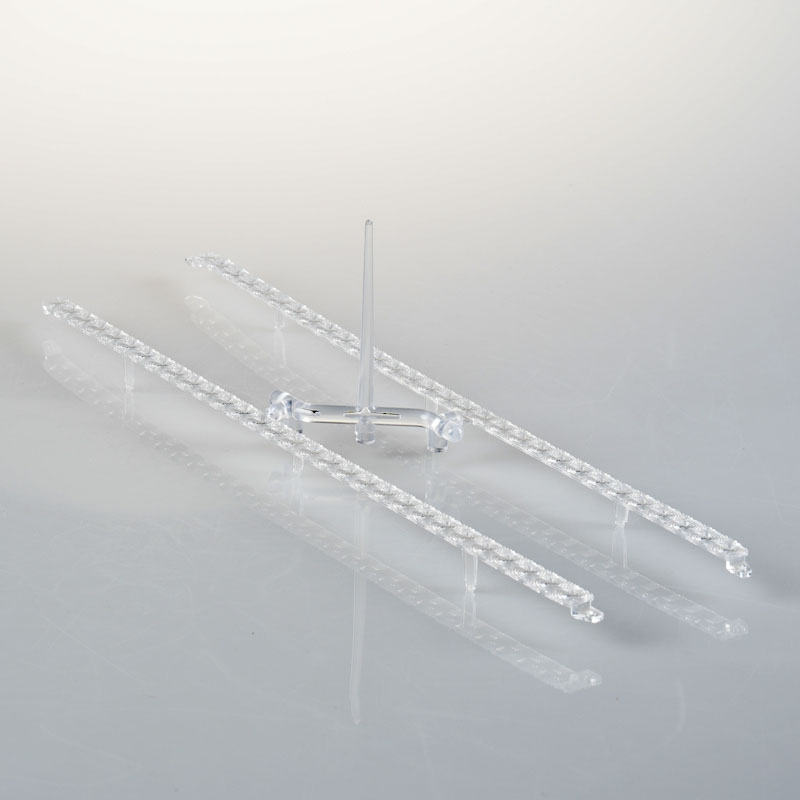
The strip on its clip feet, sawtooth face up.
What the Sawteeth Do
A plain light guide carries light end to end and lets almost none of it out along the way — the far end glows and the middle stays dark. The sawtooth face changes that. Each tooth is a small prism that turns a slice of the travelling light out through the surface, and thousands of them along the length turn the whole strip into an even line of light. The art is in the pitch: teeth too coarse and the light leaves in visible bands; too fine and everything leaves at the near end and the far half goes dark.
That is why the tooth pitch is usually graded along the strip — finer at the LED end where the light is strong, coarser toward the far end where it is weak — so the output stays level instead of fading. The customer’s LED and the strip length set the grading; the tool is cut to it.
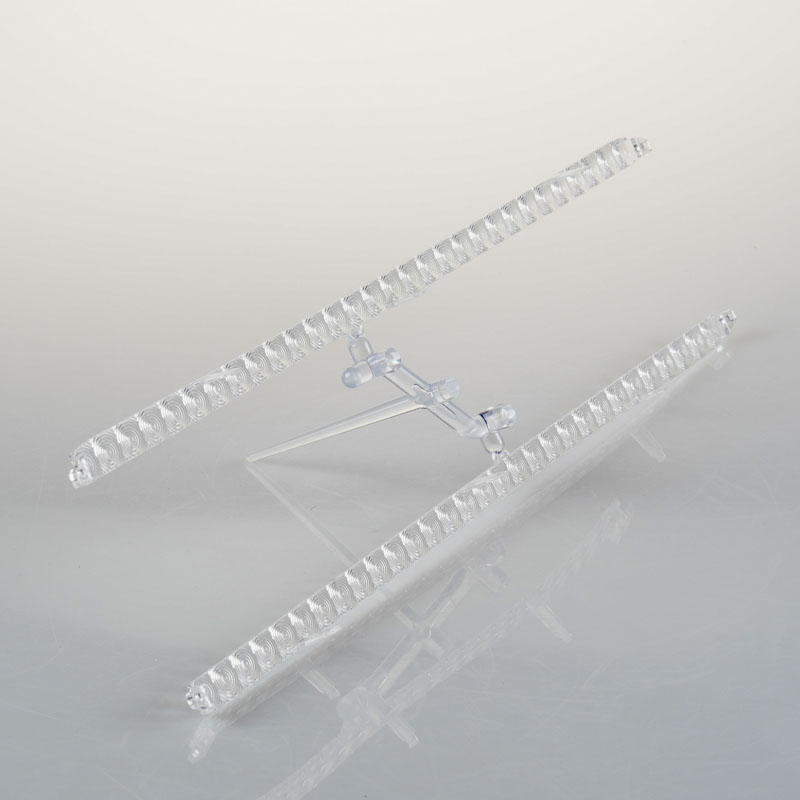
Dense, even teeth along the full length of the strip.
Tooth Geometry and Uniformity
Three numbers control the output: tooth pitch, tooth angle and tooth depth. Pitch sets how much light each tooth takes out; angle sets which way it leaves; depth sets how much surface area works. Change any one and the lit line changes visibly. The teeth are therefore held to the drawing on the first articles and checked with the LED lit — the strip is measured on a luminance meter along its length, and the reading has to sit inside the uniformity band the customer specifies before the parts ship.
Uniformity is where rejects concentrate. A strip that reads bright at the LED end and dim past the middle is a grading error; one that shows bands is a pitch error. Both are visible at a glance, which is why the lit check happens at the machine, not in a report.
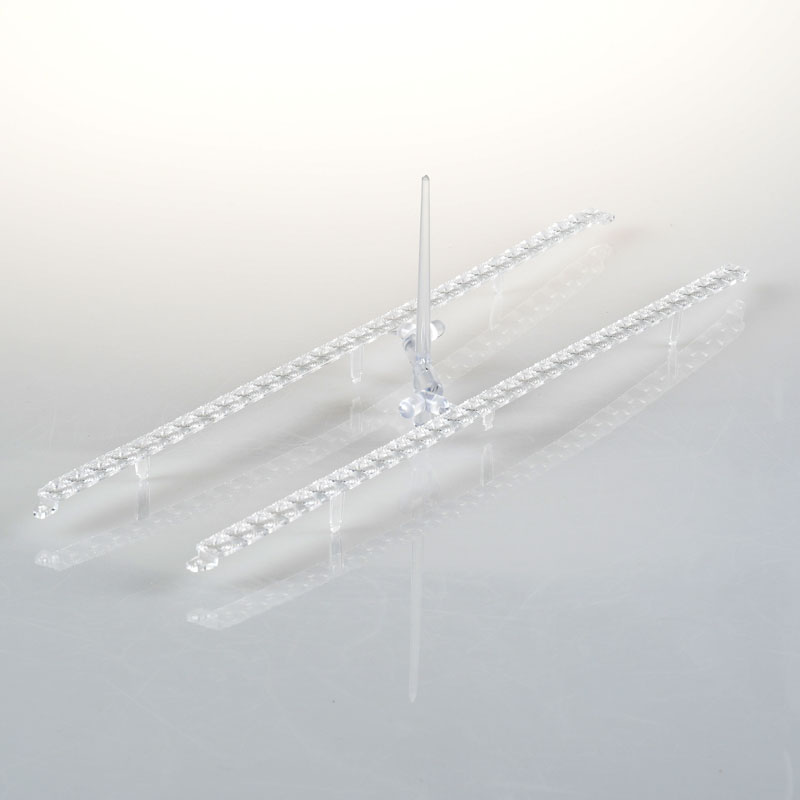
The central mounting clip holding the strip square.
Tooling Fine Teeth
Thousands of tiny prisms in a row is a tooling commitment. Each tooth is a steel feature with draft on both flanks, and the parting line is kept off the tooth face entirely — the teeth are formed in the cavity steel and polished with the grain of the flow, because any polish mark across a tooth shows as a dark line in the glow. The steel is inspected against a sample strip before production, and the tooth zone is a scheduled cleaning item: dust in one tooth valley is a dark dot in the lit line.
Gating matters as much as the steel. The strip is gated at one end so the flow front travels the full length without a weld line crossing the tooth field — a weld line under the teeth reads as a dark band exactly where the eye follows the light.
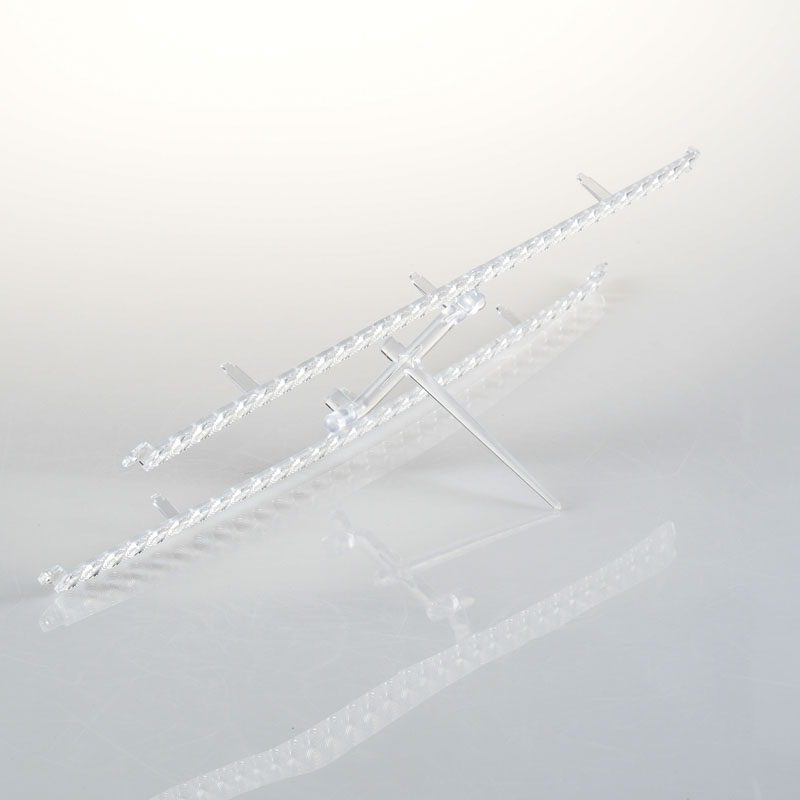
The end clip, moulded integral with the strip.
Mounting and the End Clip
The clip at the end does the installing. It flexes over the feature in the trim and locks behind it, so the strip is captured without screws or adhesive and the assembly takes seconds on the line. The clip is moulded integral with the strip — one part, one material, no assembly step — and its engagement depth is sized to the real trim feature measured on parts, not to the drawing alone.
The clip walls are thinner than the strip body on purpose: they are the sacrificial feature, the one that takes the load every time the strip is serviced. Replacement is expected; fracture is not. Resin is PMMA or PC per the customer’s specification — PMMA transmits best, PC takes impact at the clip.
Information to Confirm Before Starting a Light Guide Strip Project
The LED specification and its position, since the tooth grading follows the light input.
Strip length and the trim seam it must fill, which set the output band.
The uniformity requirement, measured with the LED lit on a luminance meter.
The trim feature the end clip engages, measured on real parts.
Resin preference — PMMA for transmission or PC for clip toughness.
Kunshan Maifeng Precision Industry Co., Ltd. reviews light guide strip designs before quoting, builds the injection molds in house, and molds single-color and dual-color parts on 36 machines from 90 to 700 tons. Send us the LED specification and the trim seam drawing, and we will come back with a feasibility comment and a tooling proposal.
Company Profile
About Us
Kunshan Maifeng Precision Industry Co., Ltd. (MIF) has an investment of RMB 35 million and an independent factory of more than 5,000 m². The company operates 36 single- and dual-color injection molding machines from 90 to 700 tons, together with more than 50 sets of mold manufacturing and processing equipment. Our service, management and production team includes over 100 people.
Our parent company was established in 2008. We provide product design, mold design and manufacturing, injection molding and product assembly services for custom plastic parts, supporting both domestic and international customers.
1. Product Design
Product structure design and optimization based on customer drawings and samples.
2. Mold Design
Mold design developed around product geometry, material and production requirements.
3. Mold Manufacturing
Machining, polishing, fitting and assembly for custom injection molds.
4. Injection Molding
Single- and dual-color injection molding for project and order requirements.
5. Product Assembly
Supporting assembly services for molded plastic components.
Custom glossy black PC protective cover for lawn mowers: an open-ring shell with snap clips molded in one shot and a class-A face that survives stones, sun and cleaning.
Custom PC light-diffusion tail light grille for lawn mowers: an even light band, a ribbed outer face, a sealed fixing flange and an optical surface finished to the agreed polish.
Custom clear PC tail light strip for mowers and outdoor equipment: compound curve, uniform wall, polished optical face and colour matched to your chip.
PC+ABS automotive wireless charging housing with an open coil window, four mounting ears and a stiffening rib, molded, inspected and packed for console assembly.
PC lawn mower tail light grille produced through custom mold development, precision injection molding and strict quality control for demanding outdoor applications.
PP handles and plastic parts for a 3rd generation magnetic wall mounted toilet brush, produced at Maifeng Precision through custom mold design, injection molding and careful inspection.
ABS nasal irrigator outer housing produced with custom multi-cavity molds, precision injection molding, careful trimming and dust-free packaging for personal care brands.
ABS nasal irrigator base produced with custom mold design, precision injection molding, strict inspection and dust-free packaging for personal care and medical device assemblies.
No matter what your automotive needs may be, we’re here to help. Contact us today to learn more about our
services and how we can assist you with all of your needs.
ISO 13485-certified medical injection molding in Class 10,000/100,000 cleanrooms: 36 single and dual-color machines, proven medical cases and trusted partners.
One-stop cup and bottle molding: dual-color lids, tea-separation cups and handles, QS food-contact licensed production with proven cases for global brands.
Contact Us
To grow into a top global mold & injection molding supplier
To grow into a top global mold & injection molding supplier, specializing in differentiated custom parts. We focus on structural development, streamlined production and consistent quality supply.












 English
 Chinese



