Gun Handle Housing for Ultrasonic Cutting Instrument, Medical Plastic Accessories
This gun handle housing set for ultrasonic surgical instruments is injection molded in medical-grade white resin, with two mirrored shells closing on a curved parting line and a green inner frame that carries the transducer stack and drive coupling on finished bearing seats. The soft grip and trigger are overmolded in a second shot, bonding through through-holes in the shell wall rather than adhesive. The set is molded on fixed machine allocation with one color masterbatch and inspected as a kit — shells closed around the frame, trigger pressed, cap fitted — because a part that passes alone but fails as a kit is still a reject.
soft grip and trigger overmolded through shell through-holes, so the joint is mechanical rather than glued
green inner frame locates the ultrasonic stack on finished bearing seats, checked with real stack parts
six-part kit inspected assembled, since color and flash must match across every piece
This is the full set of structural parts for a gun-type ultrasonic surgical instrument. The white shells close around the mechanics, a green inner frame carries the transducer and the drive components, and the soft blue grip and trigger are overmolded where the fingers actually land. The handpiece is held for an entire procedure, so every one of those parts earns its place.
The set molds in two shots on two tools: the rigid shells and frame in medical-grade white resin, and the grip and trigger in a soft polymer bonded to them in a second shot. This page covers the shell set, the overmolded grip, the inner frame and what it takes to keep six parts looking and fitting like one assembly.
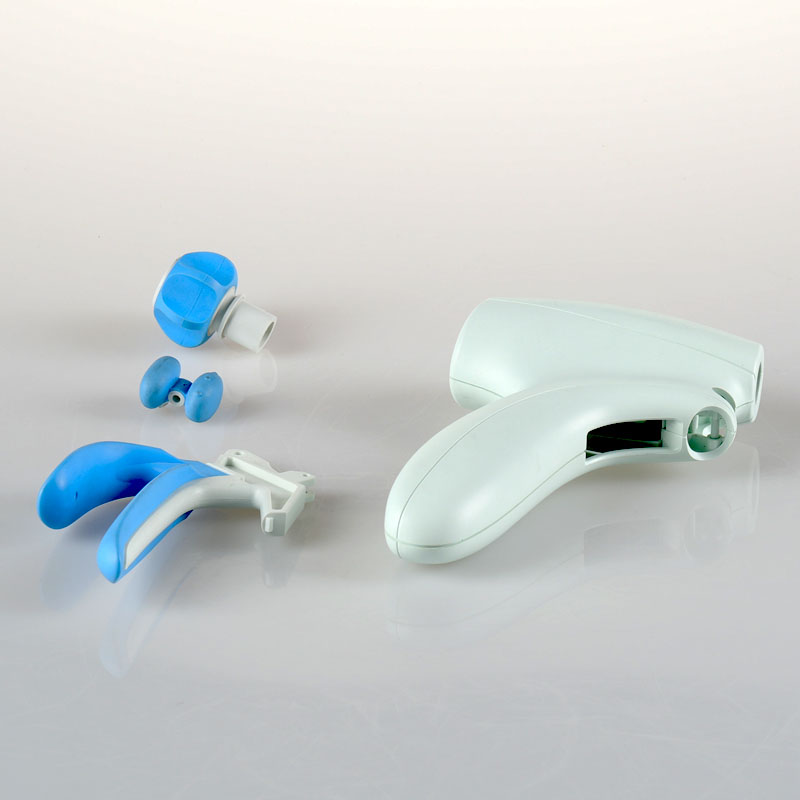
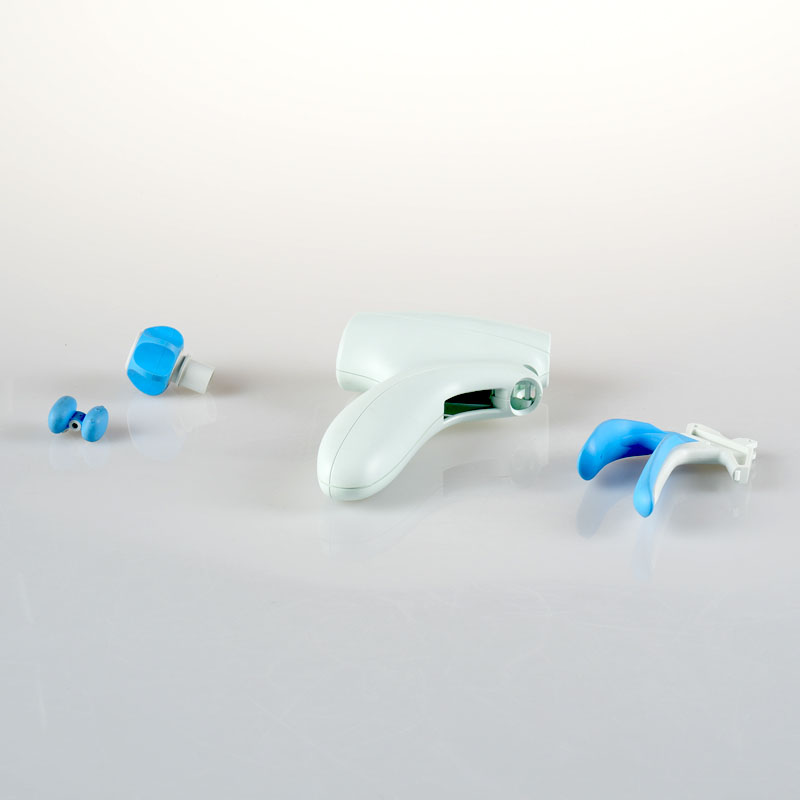
The assembled white handle, with the blue soft grip and cap beside it.
A Full Set of Shells for a Gun-Type Handpiece
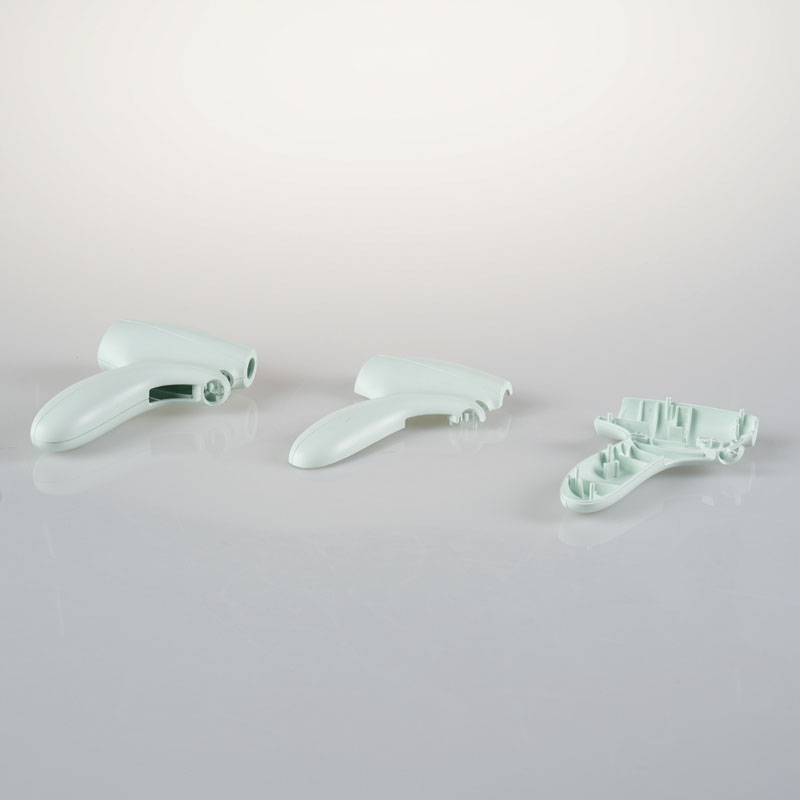
A gun-type handle is really two shells that mirror each other. The parting line follows the hand contour, which means it curves — and a curved parting line on a show surface is unforgiving. Any mismatch between the two halves shows as a step where the thumb rests. The shells are molded in the same tool, one cavity each side, so they share the steel and the shrink behavior; matching them is a tooling question, not an assembly question.
The white resin is a medical-grade compound chosen for repeated wipe-downs with the disinfectants a reprocessing department actually uses. Color match matters across the set: shells, frame, cap and trigger all sit within arm’s reach of each other, and a shade difference between lots reads as a defect even when nothing else is wrong.
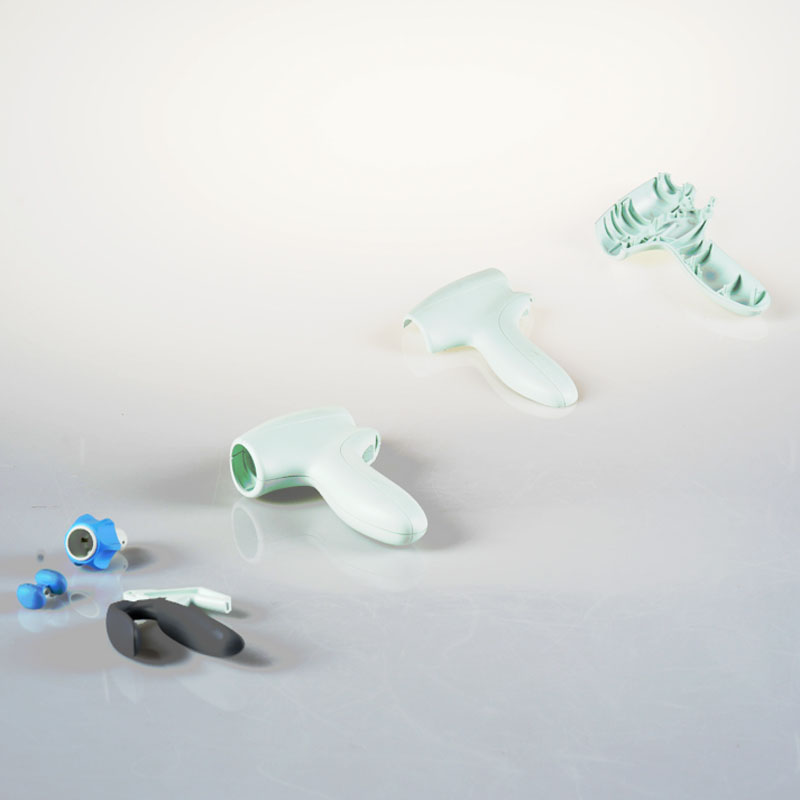
The exploded set: two shells, trigger, button and internal parts.
The Soft Grip and the Trigger
The blue grip and trigger are overmolded, not glued. The rigid shell is molded first, placed into a second tool, and the soft polymer is shot onto it, bonding mechanically through through-holes designed into the shell wall. Those through-holes are the whole joint: soft material flows through them and locks like a rivet. Without them, a soft grip peels off a hard shell eventually — the bond between dissimilar polymers is never trusted on its own.
The grip sits where the palm closes and the trigger sits under the index finger, and its durometer is a trade: softer feels better but tears at thin sections and molds slower; firmer lasts longer but reads as plastic. The overmold also adds a cycle, so the grip area is kept as small as the ergonomics allow.
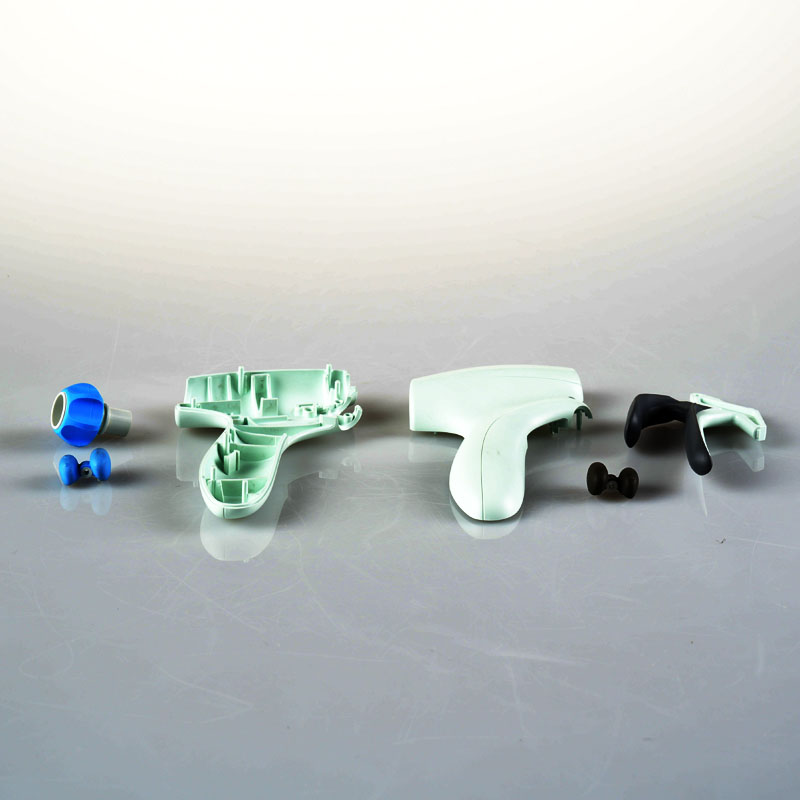
The shells opened around the green internal chassis frame.
The Inner Frame: Where the Mechanics Sit
The green frame inside is the spine of the instrument. The transducer, the drive coupling and the board all locate on it, and the shells only close around it. Its rib network is thicker than the shells allow on their show surfaces, because it is never seen — stiffness there costs nothing in appearance and buys alignment that survives a drop.
Alignment is the frame’s real job. The ultrasonic stack has to line up along the instrument axis within tight limits, or the cut performance drifts and the handpiece heats. The frame’s bearing seats are molded to position and finished to dimension, and they are checked with the actual stack components on first articles, not against the drawing alone.
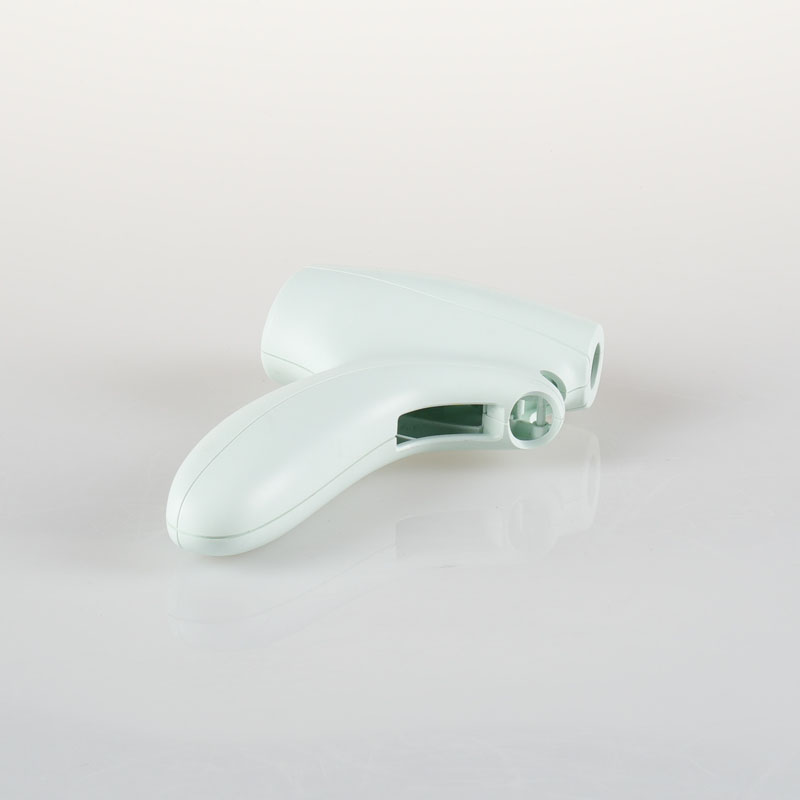
The fully assembled gun-type handle, seen from the side.
Molding a Matched Set
Six parts that assemble together also have to match each other — in color, in gloss and in flash. Each tool is a separate chance to drift. We mold the set on a fixed machine allocation, hold one color masterbatch for all the white parts, and inspect the parts as a kit: the shells are closed around the frame, the trigger is pressed, the cap is fitted, before anything ships. A part that passes alone but fails as a kit is still a reject.
Flash on the trigger seam deserves a note. The trigger moves against the shell every press, so a whisker of flash on its edge is felt by the surgeon on the first activation. The shut-off there is a maintenance item on a fixed schedule, not something discovered when a complaint arrives.
The complete kit laid out: shells, frame, trigger, button and cap.
Information to Confirm Before Starting an Instrument Handle Project
The full part list of the set, since shells, frame, trigger and cap must be quoted and tooled together.
The resin specification for rigid parts, including disinfectant compatibility for reprocessing.
Grip durometer target and the overmold boundary, which set the second tool’s cost.
The transducer or stack drawing, because the frame’s bearing seats follow it.
Annual volume, which decides whether the soft grip is two-shot overmolding or a bonded sleeve.
Kunshan Maifeng Precision Industry Co., Ltd. reviews instrument handle designs before quoting, builds the injection molds in house, and molds single-color and dual-color parts on 36 machines from 90 to 700 tons. Send us the 3D models of the full part set and the stack interface, and we will come back with a feasibility comment and a tooling proposal.
Company Profile
About Us
Kunshan Maifeng Precision Industry Co., Ltd. (MIF) has an investment of RMB 35 million and an independent factory of more than 5,000 m². The company operates 36 single- and dual-color injection molding machines from 90 to 700 tons, together with more than 50 sets of mold manufacturing and processing equipment. Our service, management and production team includes over 100 people.
Our parent company was established in 2008. We provide product design, mold design and manufacturing, injection molding and product assembly services for custom plastic parts, supporting both domestic and international customers.
1. Product Design Product structure design and optimization based on customer drawings and samples.
2. Mold Design Mold design developed around product geometry, material and production requirements.
3. Mold Manufacturing Machining, polishing, fitting and assembly for custom injection molds.
4. Injection Molding Single- and dual-color injection molding for project and order requirements.
5. Product Assembly Supporting assembly services for molded plastic components.
Custom glossy black PC protective cover for lawn mowers: an open-ring shell with snap clips molded in one shot and a class-A face that survives stones, sun and cleaning.
Custom PC light-diffusion tail light grille for lawn mowers: an even light band, a ribbed outer face, a sealed fixing flange and an optical surface finished to the agreed polish.
Custom clear PC tail light strip for mowers and outdoor equipment: compound curve, uniform wall, polished optical face and colour matched to your chip.
PC+ABS automotive wireless charging housing with an open coil window, four mounting ears and a stiffening rib, molded, inspected and packed for console assembly.
PC lawn mower tail light grille produced through custom mold development, precision injection molding and strict quality control for demanding outdoor applications.
PP handles and plastic parts for a 3rd generation magnetic wall mounted toilet brush, produced at Maifeng Precision through custom mold design, injection molding and careful inspection.
ABS nasal irrigator outer housing produced with custom multi-cavity molds, precision injection molding, careful trimming and dust-free packaging for personal care brands.
ABS nasal irrigator base produced with custom mold design, precision injection molding, strict inspection and dust-free packaging for personal care and medical device assemblies.
No matter what your automotive needs may be, we’re here to help. Contact us today to learn more about our
services and how we can assist you with all of your needs.
ISO 13485-certified medical injection molding in Class 10,000/100,000 cleanrooms: 36 single and dual-color machines, proven medical cases and trusted partners.
One-stop cup and bottle molding: dual-color lids, tea-separation cups and handles, QS food-contact licensed production with proven cases for global brands.
Contact Us
To grow into a top global mold & injection molding supplier
To grow into a top global mold & injection molding supplier, specializing in differentiated custom parts. We focus on structural development, streamlined production and consistent quality supply.












 English
 Chinese



