Housing for Tissue Cutting & Hemostasis Surgical Handle
This handle housing set for ultrasonic tissue-cutting and hemostasis instruments consists of upper and lower shell halves moulded as a matched pair. The outer faces stay smooth for grip and cleaning; the inner faces carry the structure: ribs for stiffness, screw bosses for assembly, and moulded posts and guides that hold the mechanism in exact register along the seam. Locating posts and matching holes keep the halves aligned independently of the screws. Rib thickness is held against sink on the visible grip surfaces, and the resin is specified with the customer for the sterilization path the instrument follows.
matched shell pair with moulded locating posts, so register does not depend on screws alone
rib and boss network sized against sink on the grip surfaces the surgeon actually holds
boss and seam geometry repeat from the tool, keeping assembly fixtures valid lot to lot
The handle of a surgical instrument carries everything that matters: the trigger mechanism, the wiring path or the fluid path, the grip surfaces and the two halves that close around all of it. The housings shown here are the upper and lower shell halves of a handle for ultrasonic tissue-cutting and hemostasis equipment, moulded in a light medical-grade resin as a matched pair.
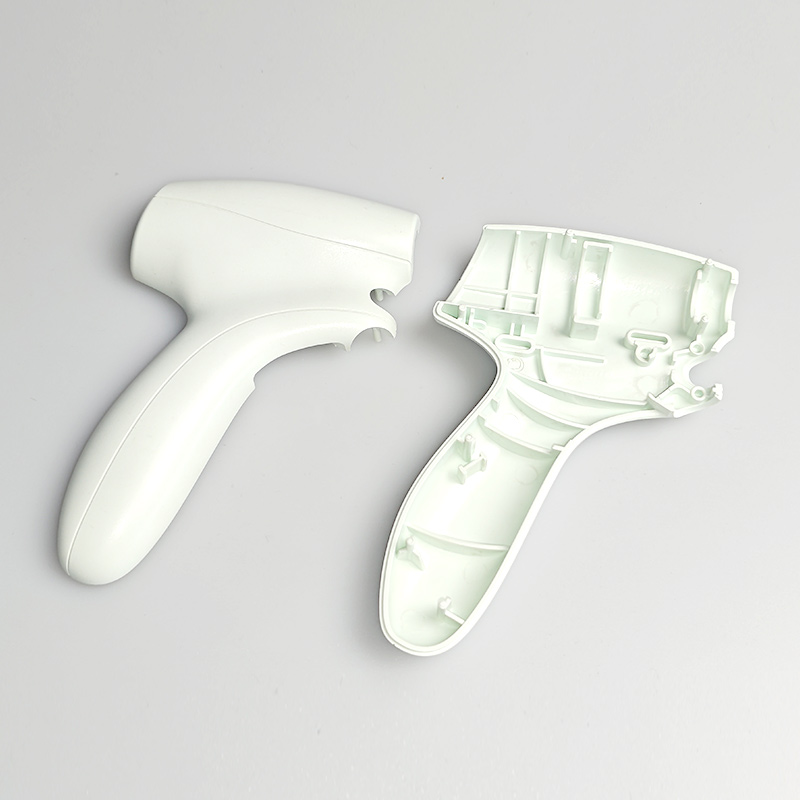
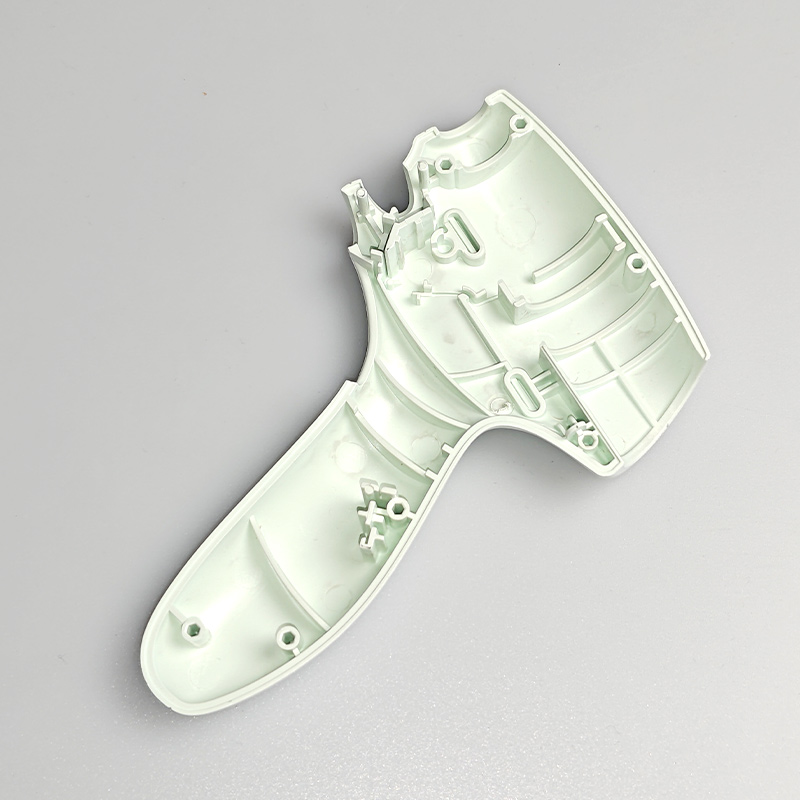
The photographs show the outer faces and the inner face of one shell. The outside is smooth and simple, because a handle is held and cleaned. The inside is where the work is: ribs, clip posts, screw bosses and guides that carry the mechanism and hold the two halves in exact register along the length of the grip.
The two shell halves. The outer face stays smooth for grip and cleaning; the mechanism lives between the halves.
Two Halves Around One Mechanism
Splitting a handle down its length is the standard answer to a mechanism that has to be assembled inside it. The split line runs along the grip, and everything on the inside, ribs, guides, bosses, is placed so the two halves clamp the mechanism rather than pinch it. The halves locate on each other with moulded posts and matching holes along the seam, so alignment does not depend on the screws alone.
Register matters more here than in a consumer handle. The trigger and the working element at the front of the instrument are aligned through these housings, and a fraction of a millimetre of mismatch between the halves shows up as a mechanism that binds or a control that feels loose at the tip.
The inner face. Ribs stiffen the shell, and the bosses and guides carry the mechanism in exact register.
The Rib and Boss Network
The inner face shows a dense structure of ribs and screw bosses. Each has a job: ribs give the thin shell its stiffness so the handle does not creak under grip load, bosses take the assembly screws in compression, and the guides position the mechanism parts during assembly rather than leaving alignment to the technician’s hands.
The constraints on this network are the classic ones for a two-shell part. Ribs are held to a fraction of the wall thickness so they do not sink the outer face, which is the surface the surgeon actually holds. Bosses get core pins and controlled depth so the screw bottoms without splitting the boss. And where ribs cross the seam, they are paired with the mating half so the joint closes flush rather than propping itself open.
Moulding for a Medical Application
The resin is specified for the sterilization and cleaning path the instrument follows, and that choice is made with the customer rather than assumed: different sterilization methods are hard on different resins, and a housing that survives one cycle type may craze under another. Surface finish on the visible faces is kept consistent because a handle is inspected as much as it is used.
Moulding itself is conventional; the discipline is in repeatability. Boss positions, rib depths and seam geometry repeat from the tool shot to shot, which is what lets the same assembly fixtures and the same screws work across every lot.
What Gets Checked Before Shipping
Screw boss integrity, sampled under load with the actual screws. Seam flushness when the halves are assembled, checked by feel and by measuring the witness line. Rib and guide positions against the mechanism drawing, verified with the real mechanism parts where the customer supplies them. Colour and surface finish against the approved master.
Information to Confirm Before Starting a Surgical Handle Project
The mechanism layout inside the handle, since ribs, guides and bosses exist to carry it.
Resin specification and the sterilization or cleaning cycles the housing must survive.
Assembly method, screw sizes and torque, so the bosses are designed for them.
Which surfaces are visible and what the surface finish requirement is on each.
Annual volumes, which decide the cavity count and the inspection intensity that makes sense.
Kunshan Maifeng Precision Industry Co., Ltd. reviews medical instrument housing designs before quoting, builds the injection molds in house, and molds single-color and dual-color parts on 36 machines from 90 to 700 tons. Send us the mechanism layout and the resin specification, and we will come back with a feasibility comment and a tooling proposal.
Company Profile
About Us
Kunshan Maifeng Precision Industry Co., Ltd. (MIF) has an investment of RMB 35 million and an independent factory of more than 5,000 m². The company operates 36 single- and dual-color injection molding machines from 90 to 700 tons, together with more than 50 sets of mold manufacturing and processing equipment. Our service, management and production team includes over 100 people.
Our parent company was established in 2008. We provide product design, mold design and manufacturing, injection molding and product assembly services for custom plastic parts, supporting both domestic and international customers.
1. Product Design Product structure design and optimization based on customer drawings and samples.
2. Mold Design Mold design developed around product geometry, material and production requirements.
3. Mold Manufacturing Machining, polishing, fitting and assembly for custom injection molds.
4. Injection Molding Single- and dual-color injection molding for project and order requirements.
5. Product Assembly Supporting assembly services for molded plastic components.
Custom glossy black PC protective cover for lawn mowers: an open-ring shell with snap clips molded in one shot and a class-A face that survives stones, sun and cleaning.
Custom PC light-diffusion tail light grille for lawn mowers: an even light band, a ribbed outer face, a sealed fixing flange and an optical surface finished to the agreed polish.
Custom clear PC tail light strip for mowers and outdoor equipment: compound curve, uniform wall, polished optical face and colour matched to your chip.
PC+ABS automotive wireless charging housing with an open coil window, four mounting ears and a stiffening rib, molded, inspected and packed for console assembly.
PC lawn mower tail light grille produced through custom mold development, precision injection molding and strict quality control for demanding outdoor applications.
PP handles and plastic parts for a 3rd generation magnetic wall mounted toilet brush, produced at Maifeng Precision through custom mold design, injection molding and careful inspection.
ABS nasal irrigator outer housing produced with custom multi-cavity molds, precision injection molding, careful trimming and dust-free packaging for personal care brands.
ABS nasal irrigator base produced with custom mold design, precision injection molding, strict inspection and dust-free packaging for personal care and medical device assemblies.
No matter what your automotive needs may be, we’re here to help. Contact us today to learn more about our
services and how we can assist you with all of your needs.
ISO 13485-certified medical injection molding in Class 10,000/100,000 cleanrooms: 36 single and dual-color machines, proven medical cases and trusted partners.
One-stop cup and bottle molding: dual-color lids, tea-separation cups and handles, QS food-contact licensed production with proven cases for global brands.
Contact Us
To grow into a top global mold & injection molding supplier
To grow into a top global mold & injection molding supplier, specializing in differentiated custom parts. We focus on structural development, streamlined production and consistent quality supply.












 English
 Chinese



