Industrial Control Panel Housing, Plastic Shell for Switch Mounting
This industrial control switch housing is injection molded as one piece in a dark grey engineering resin: a tall front plate with the operator cutouts, a lower tray behind it, and an internal rib frame that ties the two together. Cutout positions are dimensioned as a chain from one datum so every actuator lines up with its hole on assembly. Inside, ribs at roughly half the wall thickness form PCB slots and brace the plate against button-press flexing without sink on the textured outside faces. Resin is ABS or PC/ABS depending on the heat and creep requirement, colour matched to the customer's panel standard.
cutout positions toleranced as one chain from a single datum so actuators align on assembly
internal rib frame forms PCB slots and braces the operator plate against press flexing
ABS or PC/ABS resin with texture and colour matched to the customer's panel standard
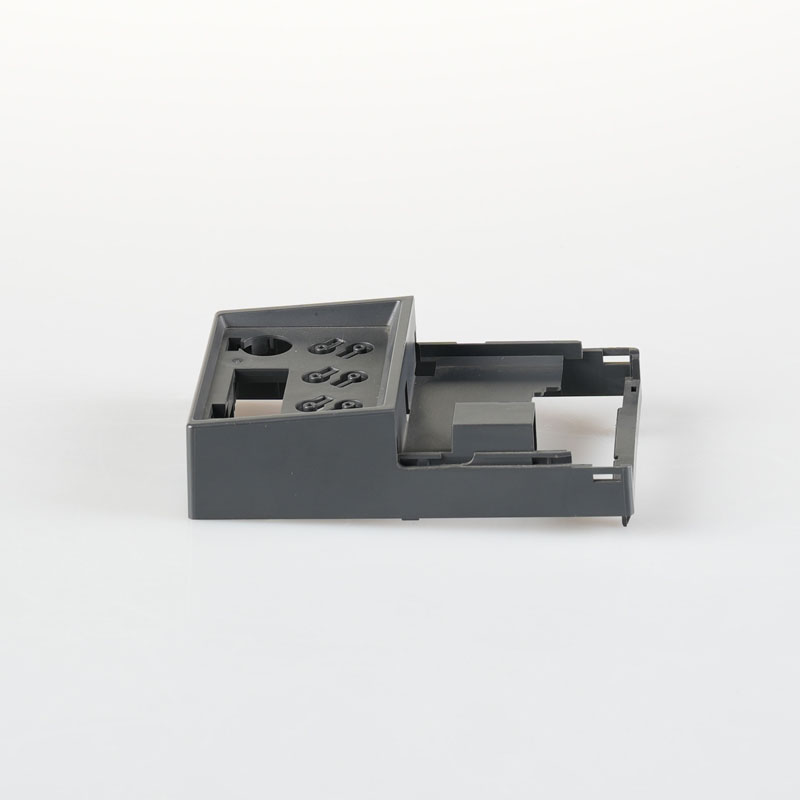
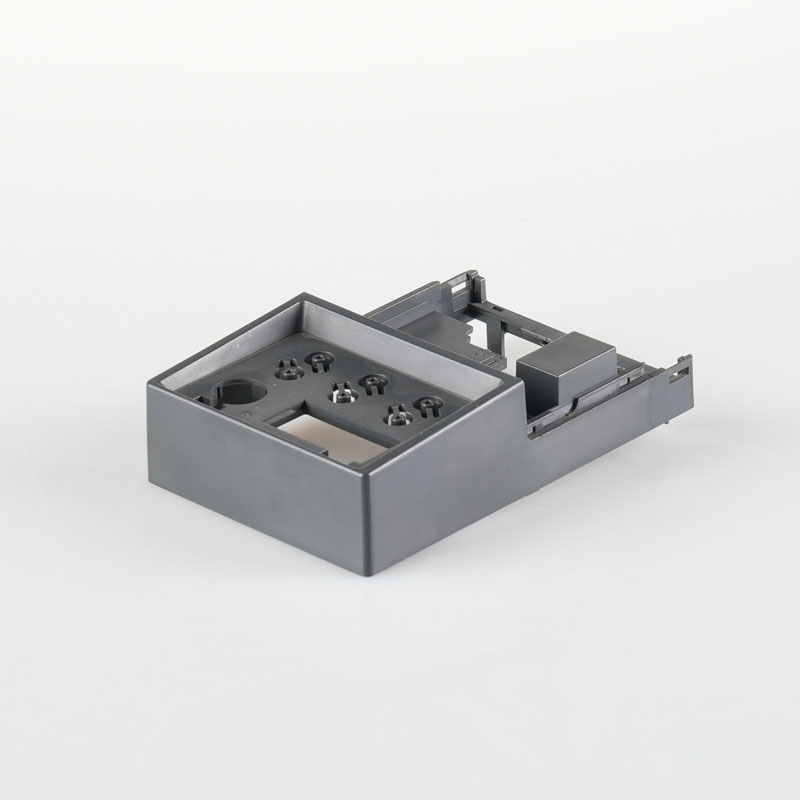
This grey housing is the shell of an industrial control switch. The front is a tall plate carrying the operator cutouts — one round hole for the selector or indicator, small rectangular windows for buttons, a slot for a display or rocker — and behind it steps down into a lower tray that carries the internal structure. The two levels are one molding: the plate, the tray, the walls between them, all from a single tool.
The housing is injection molded in a dark grey engineering resin with a fine matte texture on every outside face. This page covers how the cutouts are held to position, what the internal ribs do, how the walls carry load without creeping, and what we need from you before quoting.
The stepped profile: tall operator plate, lower rear tray.
Cutout Positions Are the Whole Part
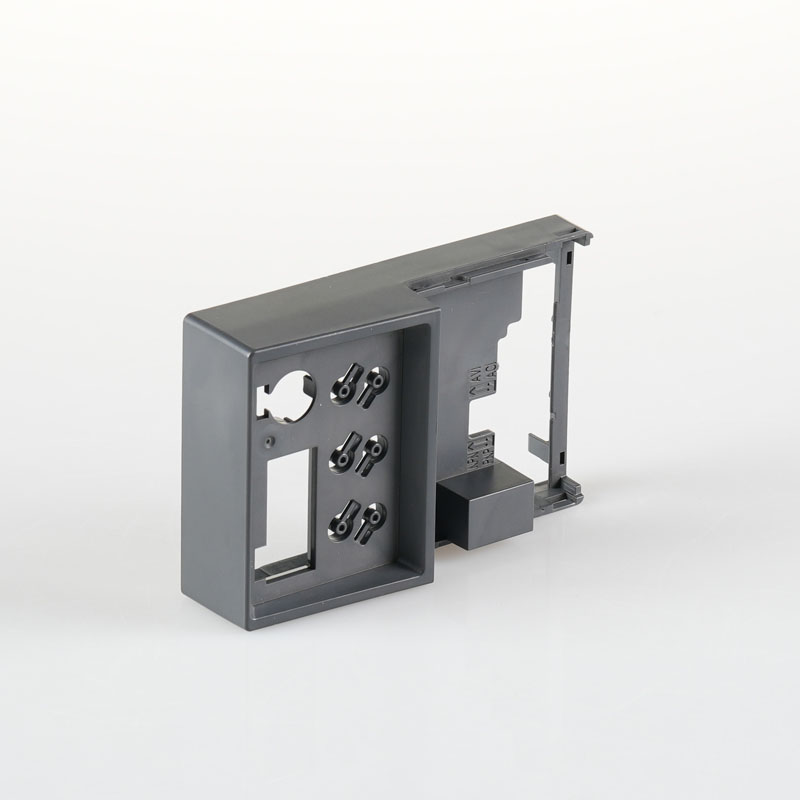
Every hole in the front plate has a partner inside the housing: the switch body, the lamp, the contact block. If a cutout is off by half a millimetre, the operator does not line up with its actuator and the assembly rework starts with a file. So the cutout pattern is treated as a dimension chain from one datum, not as a set of independent holes — each position is toleranced from the same corner, which keeps an accumulating error from spreading across the plate.
The larger round hole takes more care than it looks. It is the fit for the switch bezel, and its edge needs to be clean, with no sink around it. The wall thins locally behind it so the material displaced by the hole does not make a thick section, because a thick section there would sink and the bezel would sit proud.
Top face: button hole pattern, indicator hole and display window.
What the Internal Frame Does
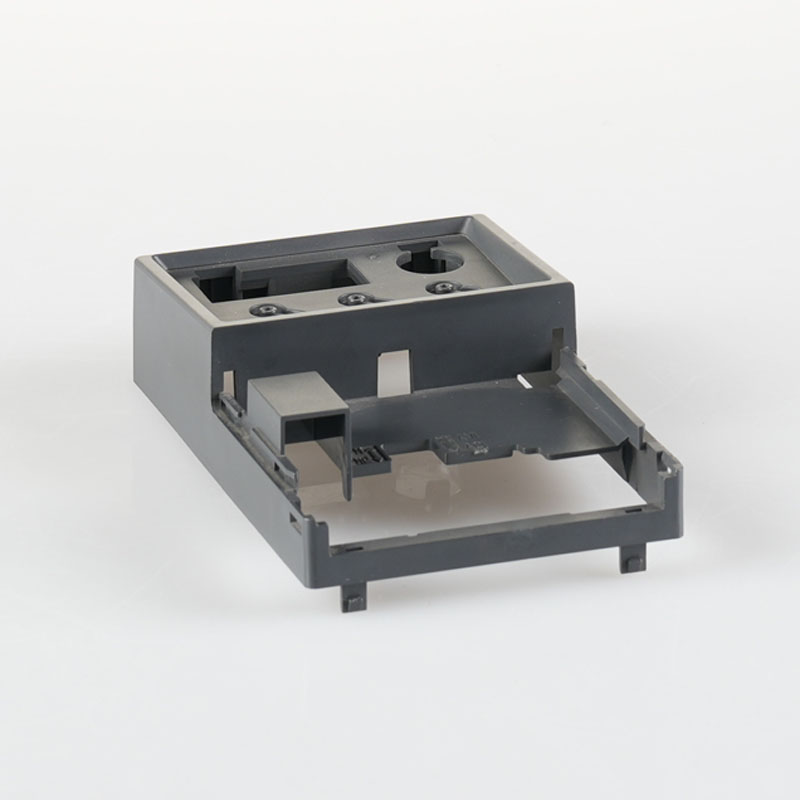
Open the housing up and the inside is mostly structure. Ribs run between the walls and form slots that carry the PCB — the board slides in, seats on the posts, and is held without a single screw in some versions. The ribs also do a second job: they tie the tall front plate to the tray floor, so the plate cannot flex when an operator presses a button. Without that bracing, every press would flex the plate and eventually crack the weld of the cosmetic surface around the holes.
Rib thickness is held to roughly half the wall. Thicker ribs than that sink on the outside face, and on a textured housing the sink shows as a dull patch exactly where the light rakes across it. This is the trade we watch on every shot — more rib for stiffness versus less rib for finish.
The internal frame: PCB slots, posts and bracing ribs.
Material Choice and Flatness
The resin is a glass-relevant decision more than a colour decision. Plain ABS moulds beautifully and finishes well but creeps under a permanently clamped switch; a PC/ABS blend holds the panel shape better over years of heat cycles in a control cabinet. The grey tone is matched to the customer’s panel standard so the housing sits next to other enclosures without a visible shade step.
Flatness on the mounting face matters more than it looks. The tray bolts down along its rim, and a warped floor twists the PCB in its slots — enough to stress solder joints on larger boards. Parts are checked flat on a surface plate after molding, and the packing routine is set so the parts cool in a restrained position rather than free in a box.
Tooling and Assembly Details
The tool is a straightforward two-plate mold with the parting line along the back rim, which keeps the front plate free of flash risk entirely — any witness line lands where the customer’s frame covers it. Slides are not needed because the cutouts are drafted through the plate rather than undercut. That simplicity matters for a housing that will run for years: fewer moving steel features means fewer scheduled mold repairs and a steadier part over the run.
On assembly, the housing takes screws through bosses in the tray floor or clips onto a mounting plate, depending on the version. The bosses are cored deep so the screw torque pulls the boss against the rib structure instead of bulging the outside wall — a common failure on housings where the bosses were treated as an afterthought. Both mounting options were built into this tool from the start, which is why the tray floor carries the pattern it does.
Side profile: operator cutouts and the wall behind them.
Information to Confirm Before Starting an Industrial Control Housing Project
The full cutout layout with tolerances referenced to one datum, not per-hole.
The switch and indicator models, since their bezels set the hole fits.
PCB outline and mounting points, which size the internal slots and posts.
Panel colour standard and texture grade for the outside faces.
Mounting method — screw bosses, DIN rail clips or panel flange.
Kunshan Maifeng Precision Industry Co., Ltd. molds industrial control housings like this one in house, from mold design through sampling to volume production on machines from 90 to 700 tons. Send us the cutout drawing and the switch models, and we will review the wall sections and come back with a tooling proposal.
Company Profile
About Us
Kunshan Maifeng Precision Industry Co., Ltd. (MIF) has an investment of RMB 35 million and an independent factory of more than 5,000 m². The company operates 36 single- and dual-color injection molding machines from 90 to 700 tons, together with more than 50 sets of mold manufacturing and processing equipment. Our service, management and production team includes over 100 people.
Our parent company was established in 2008. We provide product design, mold design and manufacturing, injection molding and product assembly services for custom plastic parts, supporting both domestic and international customers.
1. Product Design Product structure design and optimization based on customer drawings and samples.
2. Mold Design Mold design developed around product geometry, material and production requirements.
3. Mold Manufacturing Machining, polishing, fitting and assembly for custom injection molds.
4. Injection Molding Single- and dual-color injection molding for project and order requirements.
5. Product Assembly Supporting assembly services for molded plastic components.
Custom glossy black PC protective cover for lawn mowers: an open-ring shell with snap clips molded in one shot and a class-A face that survives stones, sun and cleaning.
Custom PC light-diffusion tail light grille for lawn mowers: an even light band, a ribbed outer face, a sealed fixing flange and an optical surface finished to the agreed polish.
Custom clear PC tail light strip for mowers and outdoor equipment: compound curve, uniform wall, polished optical face and colour matched to your chip.
PC+ABS automotive wireless charging housing with an open coil window, four mounting ears and a stiffening rib, molded, inspected and packed for console assembly.
PC lawn mower tail light grille produced through custom mold development, precision injection molding and strict quality control for demanding outdoor applications.
PP handles and plastic parts for a 3rd generation magnetic wall mounted toilet brush, produced at Maifeng Precision through custom mold design, injection molding and careful inspection.
ABS nasal irrigator outer housing produced with custom multi-cavity molds, precision injection molding, careful trimming and dust-free packaging for personal care brands.
ABS nasal irrigator base produced with custom mold design, precision injection molding, strict inspection and dust-free packaging for personal care and medical device assemblies.
No matter what your automotive needs may be, we’re here to help. Contact us today to learn more about our
services and how we can assist you with all of your needs.
ISO 13485-certified medical injection molding in Class 10,000/100,000 cleanrooms: 36 single and dual-color machines, proven medical cases and trusted partners.
One-stop cup and bottle molding: dual-color lids, tea-separation cups and handles, QS food-contact licensed production with proven cases for global brands.
Contact Us
To grow into a top global mold & injection molding supplier
To grow into a top global mold & injection molding supplier, specializing in differentiated custom parts. We focus on structural development, streamlined production and consistent quality supply.












 English
 Chinese



