Mini Air Purifier Casing, Plastic Enclosure Accessory
This mini air purifier casing is injection molded as a top cover and base in black or white PC/ABS, closing on a waist parting line where a thin accent band reads as one continuous feature. The band is available as a two-shot moulded feature or a separate trim ring, a trade between tooling cost and model-year flexibility. The vent field combines drafted holes and curved slots polished in the tool, gated so weld lines between cores stay short and uniform. The filter pocket is drafted for easy cartridge changes, and the fan mounts on cored bosses rather than the outer shell to keep vibration out of the panels. Wall thickness is held near nominal as a noise decision.
accent band at the waist available as two-shot molding or a separate trim ring, priced either way
vent pattern with drafted, polished cores kept clear of the parting line to avoid visible burrs
fan and filter mounted on moulded surfaces so nothing rattles against the outer wall
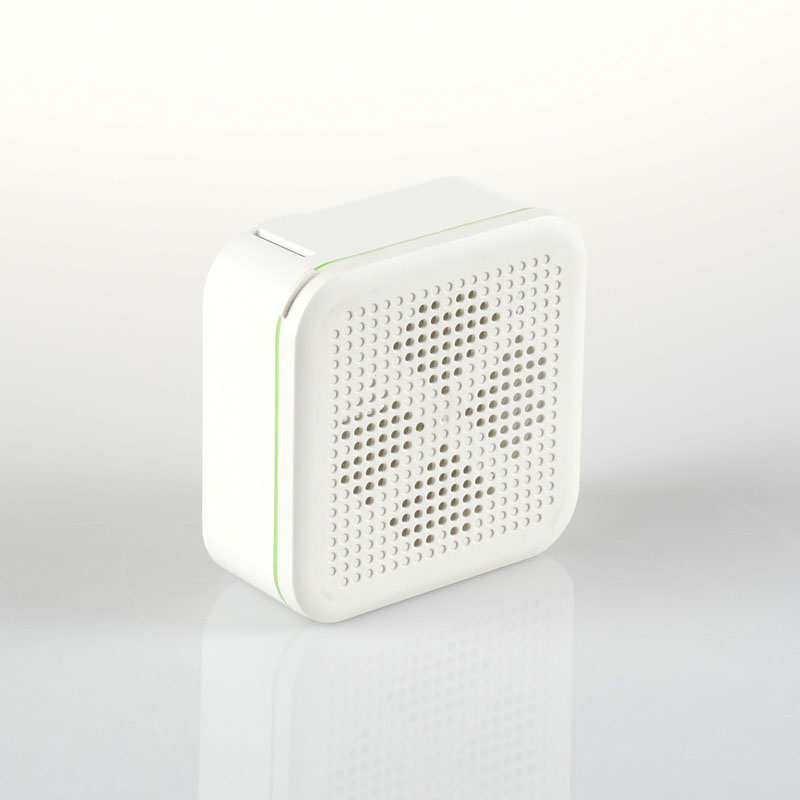
This is the outer housing of a desktop mini air purifier. It is a small box that sits on a desk, pulls room air through a hole field on the front and the top, passes it across a filter and a small fan, and pushes it back out. The housing is injection molded as two shells and finished in black or white, with a thin accent band running around the seam between them.
The top cover carries the vent pattern; the base carries the fan mount, the filter pocket and the feet. The two halves close on a parting line around the waist, and the accent band sits in that line, so the seam and the design feature are the same line. This page covers the color options, the air path, how the vent pattern is cut and how the two shells go together.
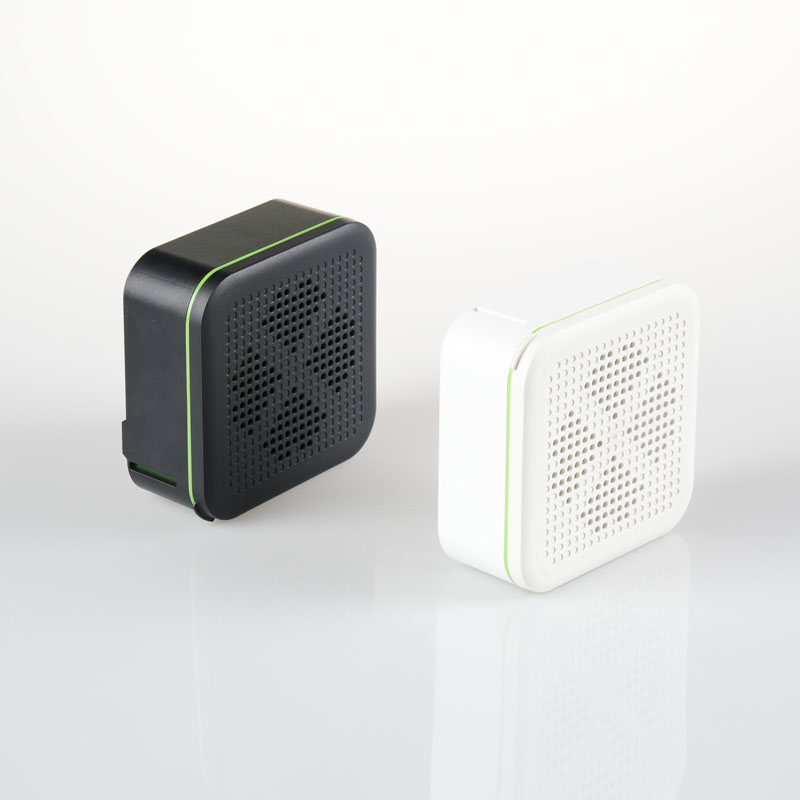
Black and white housings side by side, each with its moulded vent field.
Black, White and the Accent Seam
The housing runs in two colorways, and the thin band at the waist is the one place where a second color pays for itself. It can be produced in one of two ways. A two-shot molding builds the band into the part and gives the tightest possible joint, at the cost of a more complex tool and a longer cycle. A separate trim ring is cheaper to tool and easier to re-color for a new model year, but it is one more part to keep in stock and one more thing that can work loose in a bag. The choice follows the customer’s volume and how much the model line is expected to change.
Black and white also behave differently in the tool. Black hides flow marks and shows dust; white hides dust and shows flow marks and knit lines. The same mold, the same gate, two different sets of appearance problems. White is usually the harder one to get right, and it is worth saying so before the tool is cut rather than after.
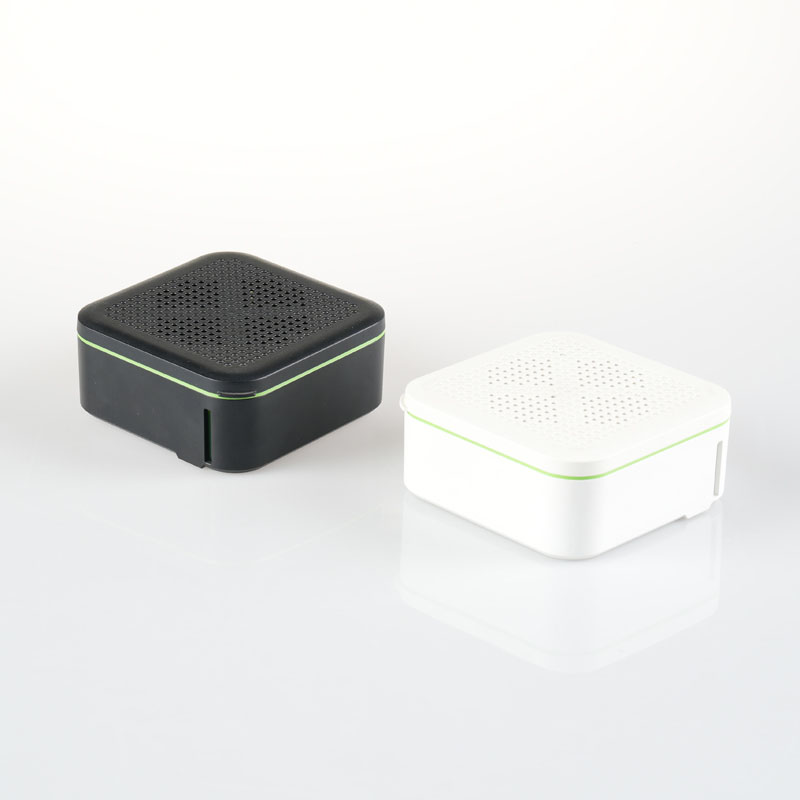
Two housings seen from above, showing the perforated top surfaces.
The Air Path and the Filter Pocket
Air has to enter, cross the filter and leave, and the housing is the duct. The intake field is large and low so it pulls air from desk level, the fan sits directly behind it, and the outlet is at the top where warm, cleaned air leaves without recirculating to the intake. The filter pocket is sized to the cartridge the customer specifies and is drafted so the cartridge slides in and out without scraping the wall; a pocket that grips too tightly is the fastest way to make an operator stop changing filters.
Wall thickness is a noise decision as much as a structural one. Thin walls amplify the fan and let the housing buzz; thick walls cost material, cool unevenly and add weight. The walls here stay near nominal and the fan mounts on cored bosses, not on the outer shell, so vibration goes into the mount rather than into the panel next to the user’s hand.
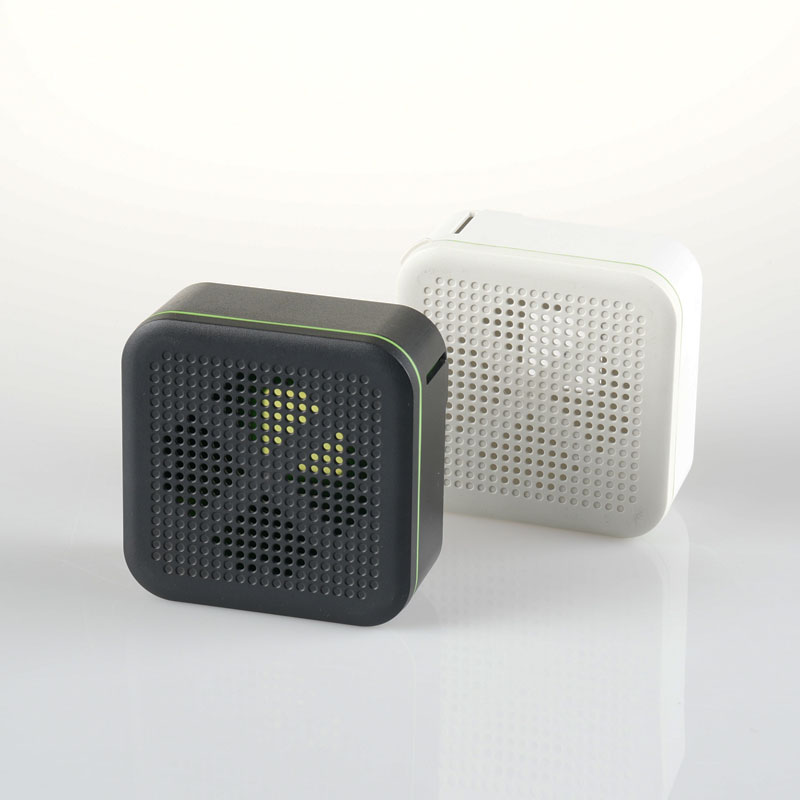
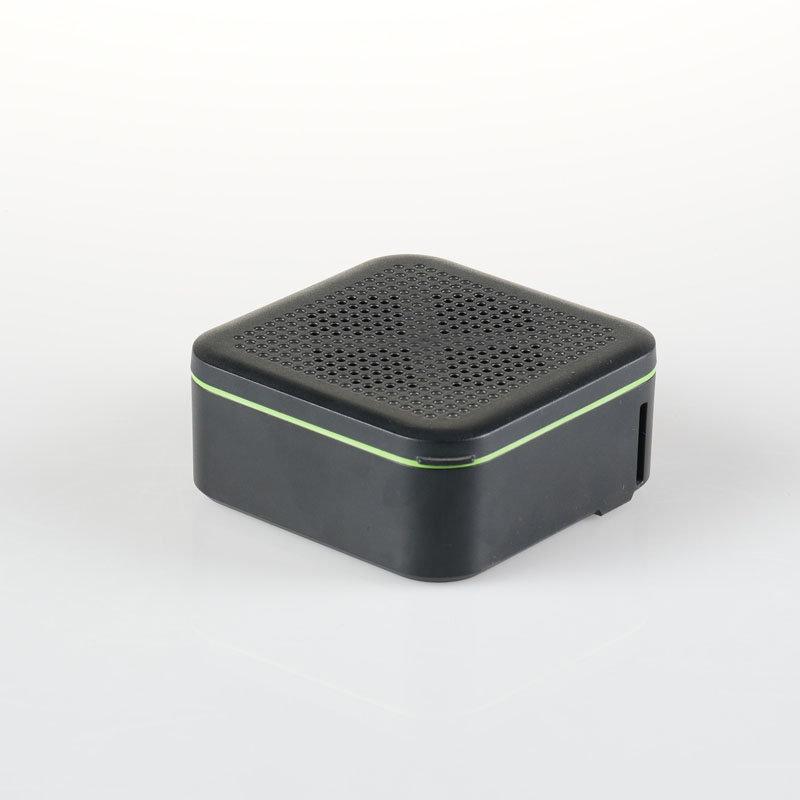
Black housing with the accent band and the curved vent slots.
Cutting the Vent Pattern
The hole field on this housing is more than a grid. The pattern includes curved slots and a repeating motif that has to read cleanly in both black and white, which means the cores are cut to a fixed draft and polished, and the pattern is held away from the parting line. A burr on one slot edge in a pattern like this is easy to spot and hard to fix after the tool is cut, so the steel is inspected against a sample part before production.
The pattern also constrains filling. Resin has to flow around a field of small cores without stalling, and the gate is placed so the flow front arrives at the far corner and the vent field together. Weld lines that form between adjacent cores are unavoidable; the job is to keep them short and uniform rather than to pretend they are not there.
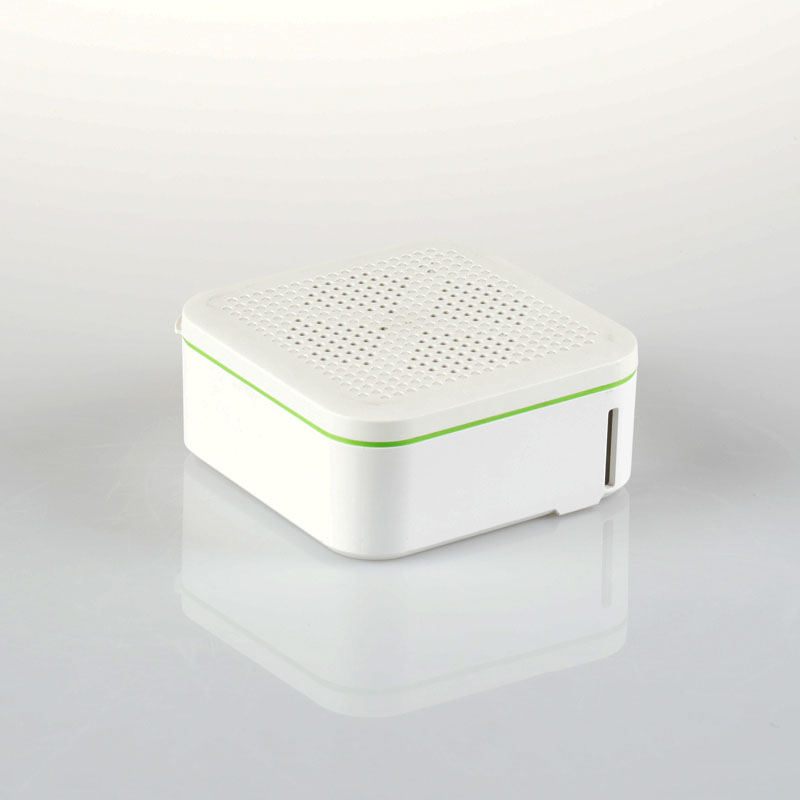
White housing seen from above, showing the cross-pattern vent field.
Assembling Two Shells Quietly
When the two halves close, the seam has to be tight enough that the accent band reads as one continuous line. Screw bosses pull the halves together at four points, and a shallow tongue-and-groove along the rim keeps the seam from opening between them. A split that steps or gaps under office light is the first thing a buyer notices, and on a white unit it is nearly impossible to hide.
Rattle is the other assembly concern. Anything loose inside a small enclosure buzzes against the wall at the fan’s running speed, so the filter pocket and the fan bosses hold their parts on the moulded surfaces rather than in air. That is a small detail during design and an obvious defect during use.
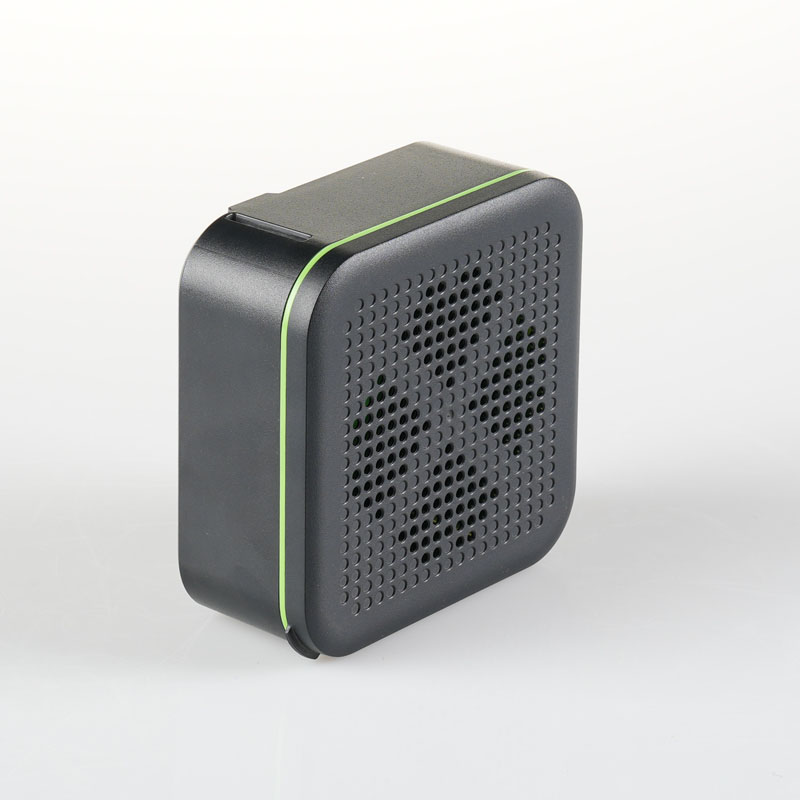
Black housing seen from the rear, showing the vent field and the accent seam.
Information to Confirm Before Starting a Purifier Casing Project
The filter cartridge and fan dimensions, since the pocket and mount bosses follow them.
Whether the accent band is a two-shot feature or a separate trim ring.
The color references for both colorways and the finish: matte, textured or gloss.
Airflow and noise targets, which decide vent area and wall thickness.
Annual volume and model-life expectations, which set cavity count and tool steel.
Kunshan Maifeng Precision Industry Co., Ltd. reviews enclosure designs before quoting, builds the injection molds in house, and molds single-color and dual-color parts on 36 machines from 90 to 700 tons. Send us the housing 3D model and the internal component layout, and we will come back with a feasibility comment and a tooling proposal.
Company Profile
About Us
Kunshan Maifeng Precision Industry Co., Ltd. (MIF) has an investment of RMB 35 million and an independent factory of more than 5,000 m². The company operates 36 single- and dual-color injection molding machines from 90 to 700 tons, together with more than 50 sets of mold manufacturing and processing equipment. Our service, management and production team includes over 100 people.
Our parent company was established in 2008. We provide product design, mold design and manufacturing, injection molding and product assembly services for custom plastic parts, supporting both domestic and international customers.
1. Product Design Product structure design and optimization based on customer drawings and samples.
2. Mold Design Mold design developed around product geometry, material and production requirements.
3. Mold Manufacturing Machining, polishing, fitting and assembly for custom injection molds.
4. Injection Molding Single- and dual-color injection molding for project and order requirements.
5. Product Assembly Supporting assembly services for molded plastic components.
Custom glossy black PC protective cover for lawn mowers: an open-ring shell with snap clips molded in one shot and a class-A face that survives stones, sun and cleaning.
Custom PC light-diffusion tail light grille for lawn mowers: an even light band, a ribbed outer face, a sealed fixing flange and an optical surface finished to the agreed polish.
Custom clear PC tail light strip for mowers and outdoor equipment: compound curve, uniform wall, polished optical face and colour matched to your chip.
PC+ABS automotive wireless charging housing with an open coil window, four mounting ears and a stiffening rib, molded, inspected and packed for console assembly.
PC lawn mower tail light grille produced through custom mold development, precision injection molding and strict quality control for demanding outdoor applications.
PP handles and plastic parts for a 3rd generation magnetic wall mounted toilet brush, produced at Maifeng Precision through custom mold design, injection molding and careful inspection.
ABS nasal irrigator outer housing produced with custom multi-cavity molds, precision injection molding, careful trimming and dust-free packaging for personal care brands.
ABS nasal irrigator base produced with custom mold design, precision injection molding, strict inspection and dust-free packaging for personal care and medical device assemblies.
No matter what your automotive needs may be, we’re here to help. Contact us today to learn more about our
services and how we can assist you with all of your needs.
ISO 13485-certified medical injection molding in Class 10,000/100,000 cleanrooms: 36 single and dual-color machines, proven medical cases and trusted partners.
One-stop cup and bottle molding: dual-color lids, tea-separation cups and handles, QS food-contact licensed production with proven cases for global brands.
Contact Us
To grow into a top global mold & injection molding supplier
To grow into a top global mold & injection molding supplier, specializing in differentiated custom parts. We focus on structural development, streamlined production and consistent quality supply.












 English
 Chinese



