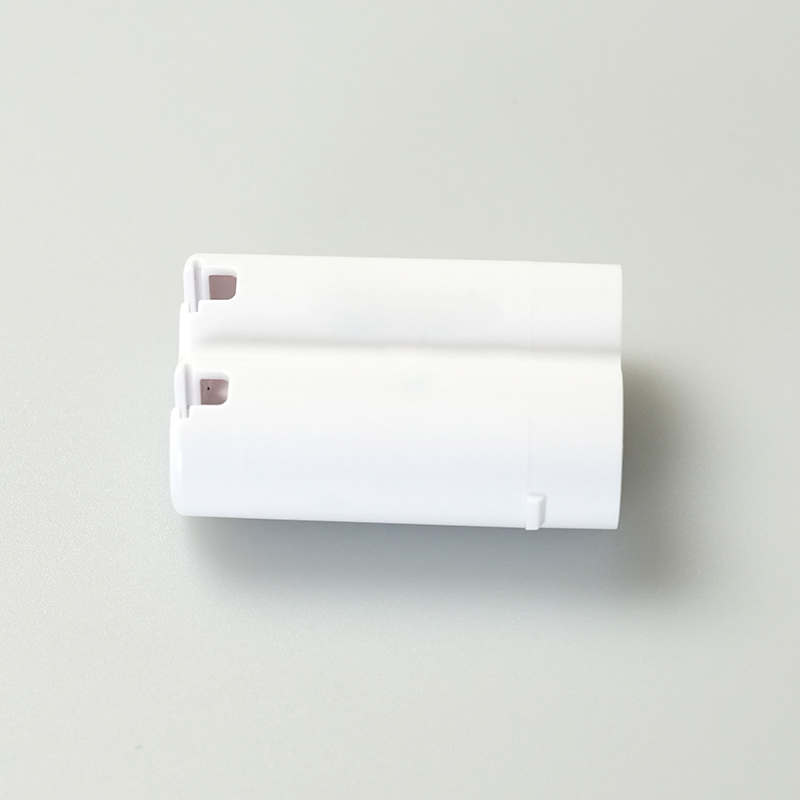
This battery protective sleeve for electric nasal irrigators is integrally injection molded with a figure-eight section carrying two cells side by side. The parallel bores are slip-fit to the actual cells with draft tuned against ejection gall, and the web between them is held to thickness where the cores nearly meet. The contact end locates, insulates and seals around the electrical apertures, with walls between contacts sized to the device's working voltage. Side mounting clips and fixing features are moulded on rather than added in assembly. Slip fit, web thickness and dielectric integrity are verified before shipping. Bore size and contact layout are built to the cell and contact drawings.
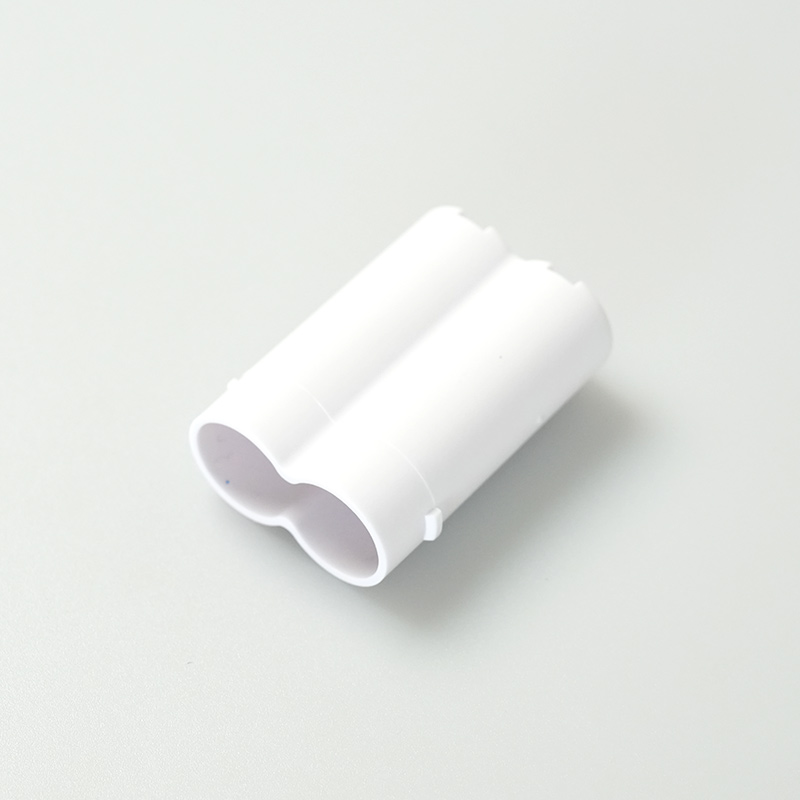
parallel bores slip-fit to the real cells, with draft tuned against ejection gall
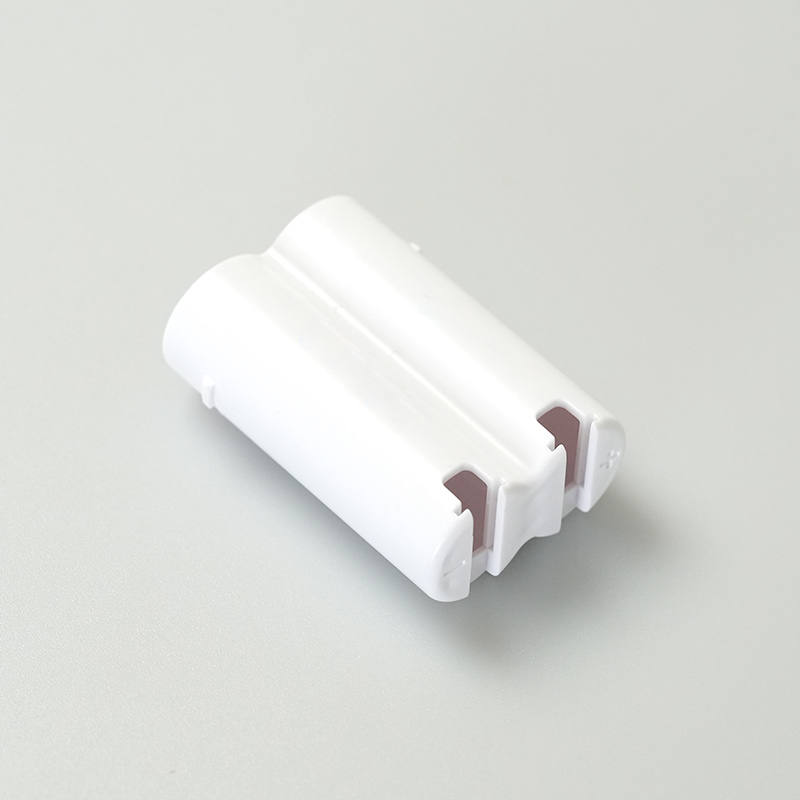
contact end locates, insulates and seals, with walls sized to the working voltage
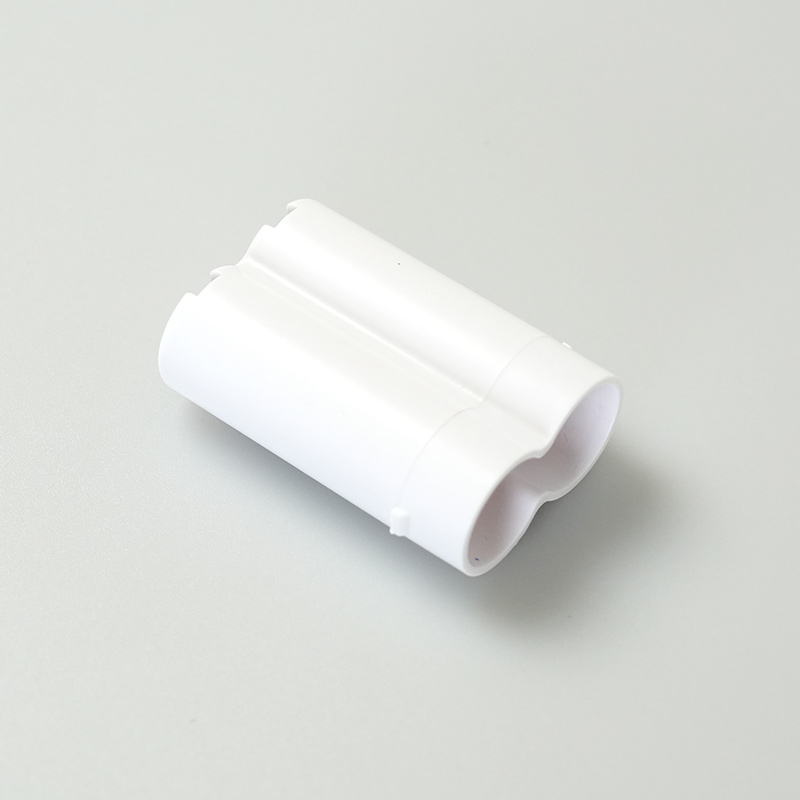
web between bores held to thickness where the two cores nearly meet
The battery compartment of an electric nasal irrigator is a wet-adjacent environment with electrical contacts in it, which is a combination worth engineering around. The sleeve shown here holds two cells side by side in a moulded enclosure whose figure-eight cross-section is dictated by the batteries it carries, with contact openings at one end and insulation everywhere the cells touch plastic.
Five views cover the sleeve from its open end, its contact end and its sides. The form looks simple; the mould that makes it is not, because two parallel cylinders joined along their length is a deep-draw core problem in both directions.
The open end. Two parallel bores joined along their length, sized to the cells with a defined slip fit.
Two Cylinders, One Core Pull
The figure-eight section is the moulding challenge. Each bore needs a core, and the cores run parallel down the full length of the part. Where the two cylinders join, the cores nearly touch, and the web between them is a thin bridge the melt has to reach from both sides. Get the cores slightly out of register and the web thins on one side, which shows up later as a weak point exactly where the two cells press against each other.
Draft on long parallel cores is a balance: too little and the cells gall on ejection, too much and the battery fit loosens. The draw is tuned with the actual cells, not a nominal diameter, because a slip fit that is half a percent off either way turns into rattling batteries or sleeves that split at the open end during assembly.
The outer contour follows the two bores, with ribs carrying the mounting features on the sides.
The Contact End
The closed end carries the openings where the electrical contacts pass through. These apertures are doing three jobs at once: locating the contacts so they land on the cell terminals every time, insulating them from each other and from the housing, and sealing against the splashes that a device used in a bathroom inevitably receives. Their positions come from the contact assembly drawing, and the walls between adjacent contacts are held wide enough to keep the insulation honest under the device’s working voltage.
The contact openings are also the smallest features on the part, which makes them the last to fill and the first to short. Gating is arranged so the melt arrives there with pressure to spare, and first-article inspection looks specifically at those corners.
The contact end. Apertures locate, insulate and seal around the electrical contacts.
Insulation as a Moulding Property
The resin is chosen so the part does its insulation job without a second thought: high resistivity, stable in humidity, and dimensionally steady across the temperature range of a device that gets charged and used warm. Because the sleeve also mechanically fixes the cells, its wall has to survive the insertion and removal loads of battery changes without cracking at the contact apertures, which is where the section is thinnest.
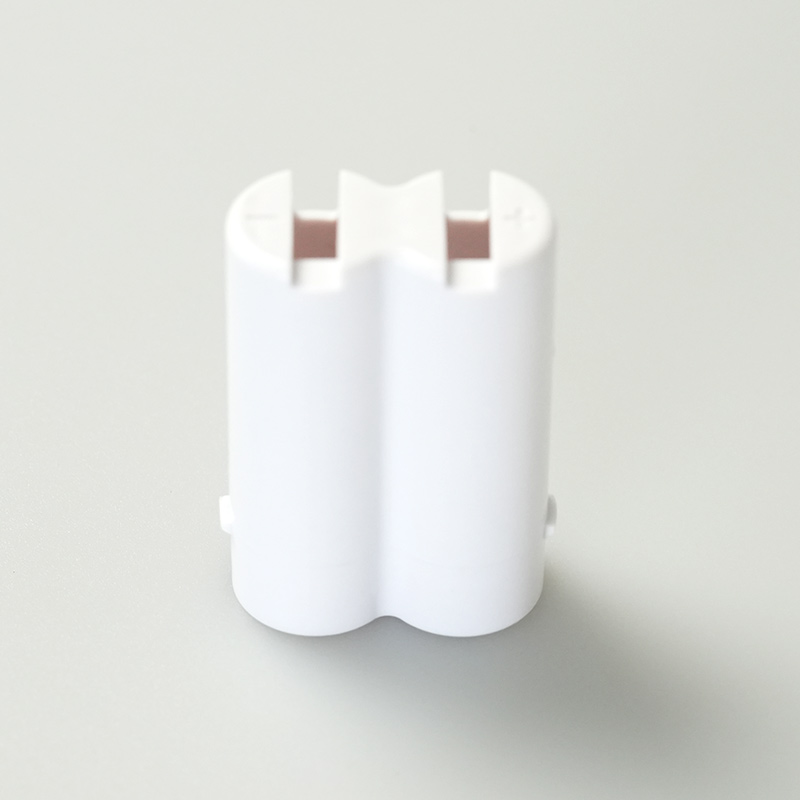
Upright. The side clips and mounting features are moulded on, not added in assembly.Lying flat. The parallel bores run the full length, with the web between them held to thickness.
What Gets Checked Before Shipping
Bore diameter and slip fit with the actual cells. Web thickness between the bores, since that is the structural weak point. Contact aperture positions against the contact assembly, and the insulation walls between them. Dielectric check on samples where the customer specification calls for it, and clip retention on the mounting features.
Information to Confirm Before Starting a Battery Sleeve Project
The cell specification, since bore diameter and slip fit are built around the real cells.
The contact assembly drawing, including working voltage, which sets the insulation walls.
Exposure conditions, humidity and splash, that the sealing geometry must answer.
How the sleeve mounts into the housing, since the side features are moulded on.
Annual volume, which decides the cavity count for a part this small running at scale.
Kunshan Maifeng Precision Industry Co., Ltd. reviews medical device component designs before quoting, builds the injection molds in house, and molds single-color and dual-color parts on 36 machines from 90 to 700 tons. Send us the cell and contact drawings, and we will come back with a feasibility comment and a tooling proposal.
Company Profile
About Us
Kunshan Maifeng Precision Industry Co., Ltd. (MIF) has an investment of RMB 35 million and an independent factory of more than 5,000 m². The company operates 36 single- and dual-color injection molding machines from 90 to 700 tons, together with more than 50 sets of mold manufacturing and processing equipment. Our service, management and production team includes over 100 people.
Our parent company was established in 2008. We provide product design, mold design and manufacturing, injection molding and product assembly services for custom plastic parts, supporting both domestic and international customers.
1. Product Design Product structure design and optimization based on customer drawings and samples.
2. Mold Design Mold design developed around product geometry, material and production requirements.
3. Mold Manufacturing Machining, polishing, fitting and assembly for custom injection molds.
4. Injection Molding Single- and dual-color injection molding for project and order requirements.
5. Product Assembly Supporting assembly services for molded plastic components.
Custom glossy black PC protective cover for lawn mowers: an open-ring shell with snap clips molded in one shot and a class-A face that survives stones, sun and cleaning.
Custom PC light-diffusion tail light grille for lawn mowers: an even light band, a ribbed outer face, a sealed fixing flange and an optical surface finished to the agreed polish.
Custom clear PC tail light strip for mowers and outdoor equipment: compound curve, uniform wall, polished optical face and colour matched to your chip.
PC+ABS automotive wireless charging housing with an open coil window, four mounting ears and a stiffening rib, molded, inspected and packed for console assembly.
PC lawn mower tail light grille produced through custom mold development, precision injection molding and strict quality control for demanding outdoor applications.
PP handles and plastic parts for a 3rd generation magnetic wall mounted toilet brush, produced at Maifeng Precision through custom mold design, injection molding and careful inspection.
ABS nasal irrigator outer housing produced with custom multi-cavity molds, precision injection molding, careful trimming and dust-free packaging for personal care brands.
ABS nasal irrigator base produced with custom mold design, precision injection molding, strict inspection and dust-free packaging for personal care and medical device assemblies.
No matter what your automotive needs may be, we’re here to help. Contact us today to learn more about our
services and how we can assist you with all of your needs.
ISO 13485-certified medical injection molding in Class 10,000/100,000 cleanrooms: 36 single and dual-color machines, proven medical cases and trusted partners.
One-stop cup and bottle molding: dual-color lids, tea-separation cups and handles, QS food-contact licensed production with proven cases for global brands.
Contact Us
To grow into a top global mold & injection molding supplier
To grow into a top global mold & injection molding supplier, specializing in differentiated custom parts. We focus on structural development, streamlined production and consistent quality supply.












 English
 Chinese



