Nasal Irrigator Outer Housing, White ABS Precision Injection Molded Shell
This outer housing for an electric nasal irrigator is molded in ABS as a thin-walled white shell, with the port collar recessed into the top face and a rectangular side window cut by a side action. The collar is a separately cooled core because the tank seats on it, and the slider that forms the window leaves its witness mark inside the recessed frame. A fine matte texture hides handling scratches and the sink that forms opposite internal bosses, and an insert is seated at a secondary press station before the part is bagged and packed.
port collar, side window and grip recess all formed in the tool, with no secondary cutting on visible surfaces
side action keeps the window corners clean and holds its witness mark inside the recessed frame
secondary press station seats the insert, then visual and dimensional checks before bagging
This white cylinder is the outer housing of a handheld electric nasal irrigator. It is the part the user actually holds: the tank sits in the collar at the top, the pump, battery and board live inside it, and the window on the side lets the user see what is going on without taking the device apart. Every visible surface of the machine that is not the tank is this one molding.
It is injection molded in ABS as a thin-walled shell, with the port collar, the side window and the grip recess formed in the tool rather than cut afterwards. This page covers the material choice, the three features that decide whether the tool works, what the white finish costs in process control, and what happens between the machine and the carton.
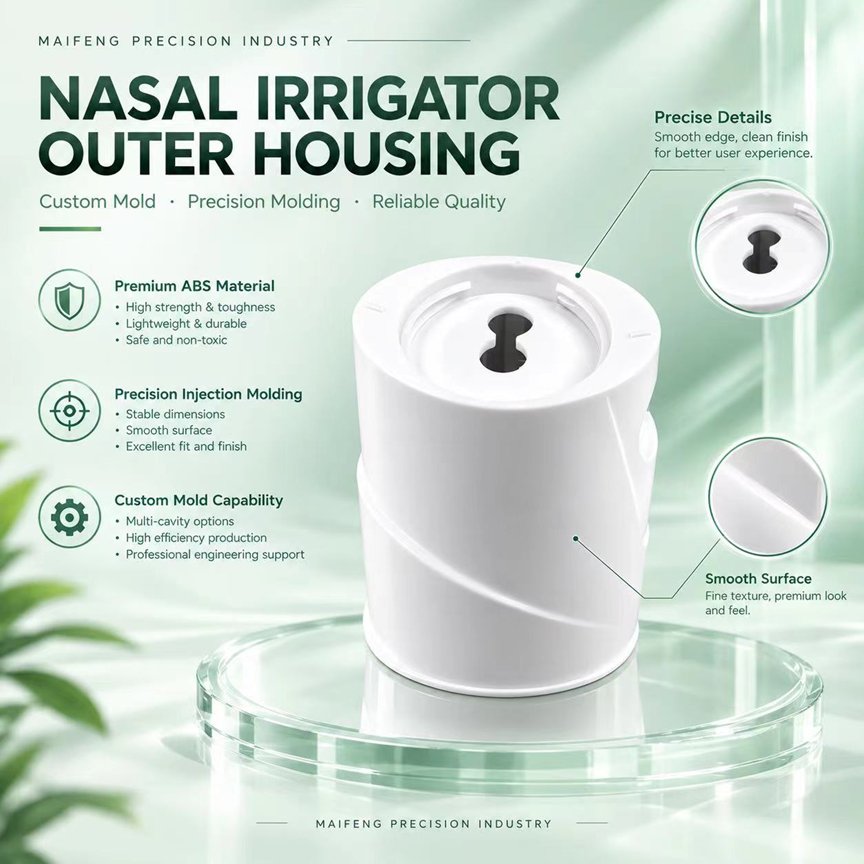
The housing as molded: a tapered white shell with the port collar recessed into the top face.
Why ABS, and Why White Is the Difficult Color
ABS is chosen here for three reasons that matter on a handheld device: it is stiff enough that a thin wall does not feel hollow, it takes a molded texture and holds a sharp edge, and it is dimensionally stable enough that the collar and the window stay where the assembly drawing puts them. It also bonds and prints easily, which matters if the customer adds a label or a pad-printed logo later. Compared with PP, it is the more expensive pellet and it has to be dried before molding — but it does not have PP’s soft, waxy surface, and on a device that is handled daily that difference is the first thing a buyer notices.
White is the hard part. A white shell shows every flow line, every weld line, every sink mark and every speck of contamination that a black or grey part would swallow. It also punishes a mold that runs hot in the afternoon: the same tool that produces a clean part at 8 a.m. can produce a faintly yellowish one at 4 p.m. if the barrel temperature and the residence time are not held. That is why the color is controlled against an approved master under a fixed light source, and why the grade is specified with a stabilizer rather than bought as a generic natural.
One point worth settling before the tool is cut: if the housing will be cleaned with alcohol or any other solvent on a routine basis, or if it counts as a patient-contact surface in the customer’s risk file, the grade and the documentation change. ABS can be supplied with biocompatibility and regulatory paperwork for that case, but it has to be chosen at the start, not swapped in after validation.
The Port Collar, the Window and the Grip Recess
Three features decide whether this tool is straightforward or difficult.
The port collar at the top is a recessed ring with an oval opening through it. In the mold it is a tall core standing in the middle of the cavity, and it is the last place to cool. If that core runs cold, the collar comes out oval instead of round, and the tank either will not seat or seats with a gap on one side. The core is baffled and cooled separately, and the collar diameter is checked on the first shots rather than assumed from the model.
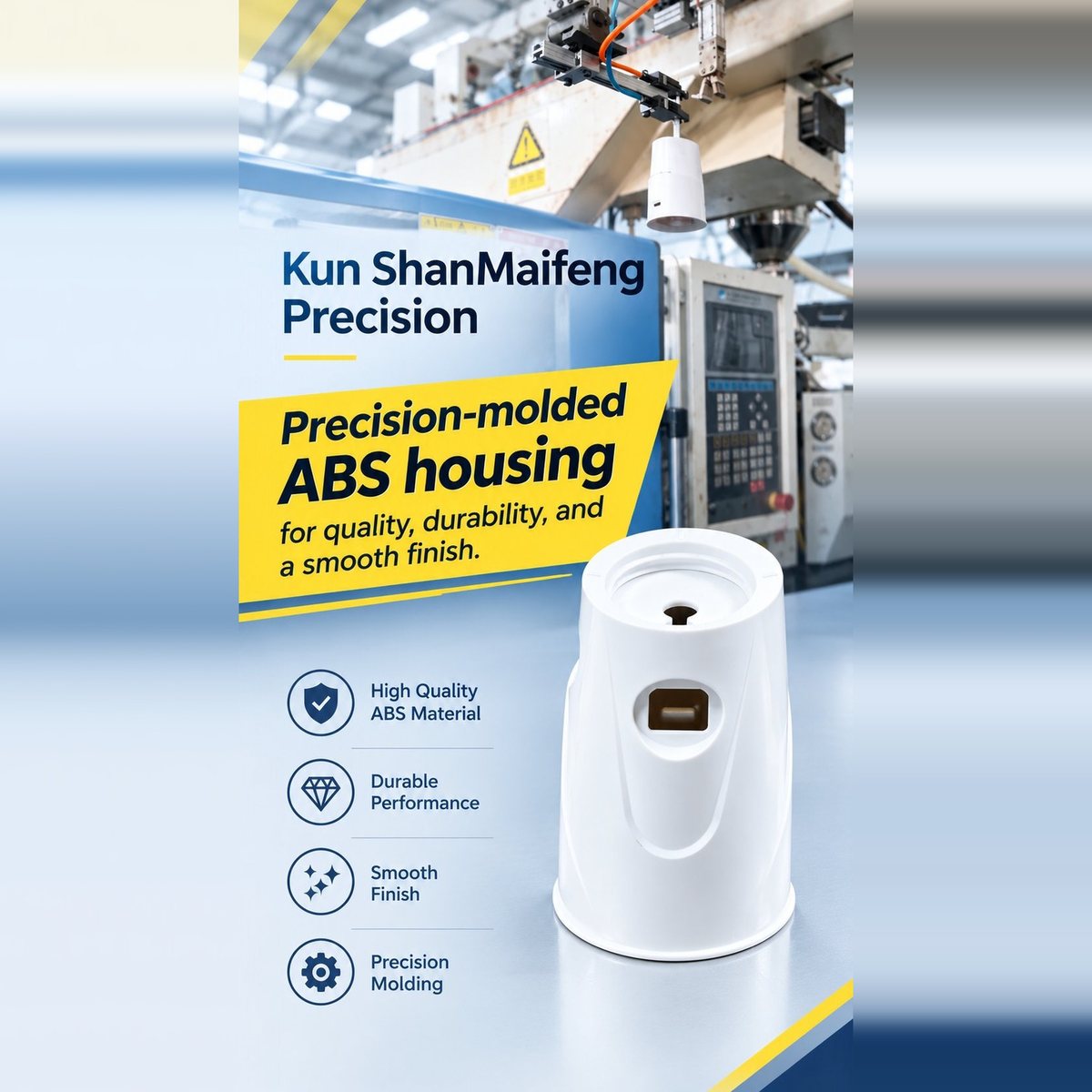
The side window is the feature that shapes the tool. A rectangular opening in a cylindrical wall cannot be molded with a simple two-plate tool; it needs a side action, and the slider has to shut off against steel on all four edges if the window is to have clean corners and no flash. The parting line of that slider leaves a witness mark, and where it lands is a design decision as much as a tooling one — on this part it is held inside the recessed frame so the mark reads as part of the feature rather than as a defect. The window also interrupts the flow front, so a weld line forms at its far edge; the gate position is chosen to keep that weld line in the shadow of the frame.
The grip recess on the opposite side is a shallow cored pocket with a generous draft. It looks cosmetic and is structural: it stiffens the wall exactly where a hand squeezes, which is what allows the rest of the shell to stay thin.
The side that shapes the tool: a framed window cut by a side action, and the curved grip recess opposite it.
Seam, Texture and a Surface That Has to Stay Clean
The shell closes on a line that runs around the body and up over the shoulder. On a two-plate tool that line is unavoidable; the job is to put it where the hand does not rest and where it reads as a molded feature. The tool is finished to a fine matte texture rather than a polish, for two reasons: a matte surface scatters light, so the small scratches a device collects in a bag do not show, and it hides the sink marks that form opposite the internal bosses. A gloss white shell of the same geometry would show both.
Sink is the other white-surface problem. Where a boss or a rib meets the wall, the thick section cools last and pulls the visible face in. The usual fix — thinning the rib and shortening the boss — is applied at the design stage, and the tool is then run with enough packing pressure and hold time that the face stays flat. On a white part this is checked visually under raking light, not just with a caliper.
From the Machine to the Secondary Press
The housing runs on a single cavity tool in ABS, dried to the grade’s specification and molded with a hot runner so there is no sprue to trim on a visible surface. Cycle time is set by the collar core; the rest of the part is thin and cools quickly.
The video below follows the part after the mold opens: the housing drops onto the conveyor, and the next station is a small press where an insert is seated into the shell by hand under a guided tool. That second operation is deliberately kept out of the mold. The insert varies — a seal, a plug or a foot depending on the customer’s bill of materials — and a mold that tried to overmold it would have to be rebuilt every time the BOM changed.
Molding the ABS housing, the part leaving the tool onto the conveyor, and the secondary press station where the insert is seated.
What Is Checked Before the Housing Is Packed
A white cosmetic shell is judged by eye before it is judged by a gauge, so the inspection starts there: color against the master, flow marks, sink on the shoulder, flash at the window frame and at the parting line, and the witness mark left by the slider. Anything that would read as a defect in a customer’s hand at arm’s length is a reject, whether or not it is inside the drawing tolerance.
The dimensional checks follow the assembly, not the drawing in isolation: collar diameter and roundness, window opening position relative to the collar, height from the base rim to the collar face, wall thickness at the collar root, and the seating depth of the insert after the press step. The collar and the base rim are the two faces the rest of the device is built from, so they carry the tightest tolerances; if they are right, the [waterway base](https://www.mold-mif.com/waterway-integrated-base-for-medical-nasal-irrigator/) and the upper assembly go together without shimming.
Parts are bagged individually and packed in cartons on a fixed count. On a white textured shell the bag is not decoration — it is what keeps the part from being scuffed by the one above it before it reaches the assembly line.
What Can Be Customized
Size and proportion — body diameter, height and taper, tooled around the internal stack rather than the other way round.
Window and ports — window size and position, collar diameter and port shape, additional openings for a button or a charging socket.
Color and texture — white as standard, with custom color matching and a matte, fine-texture or soft-touch-look cavity finish.
Branding — a molded-in logo in the tool, or pad printing and labels applied after molding.
Secondary operations — insert seating, ultrasonic welding, assembly with mating parts, and individual bagging or clean-room packing.
Information to Confirm Before Starting a Housing Project
The 3D model and the internal stack, since collar height and window position follow the assembly.
The resin grade, including color standard, any solvent or cleaning requirement, and whether regulatory documentation is needed.
The finish: texture number or a physical sample, and the gloss level the customer expects.
The insert that goes into the secondary press station, and how it is retained.
Annual volume, cavity count expectation, and the packing or clean-room requirement.
Kunshan Maifeng Precision Industry Co., Ltd. builds the mold in house, molds ABS on 36 machines from 40 to 700 tons, and runs the secondary press and packing operations in the same plant. Send the housing model with the internal layout and the color standard, and we will come back with a tooling proposal that names the side action, the gate position and the texture before any steel is cut.
Company Profile
About Us
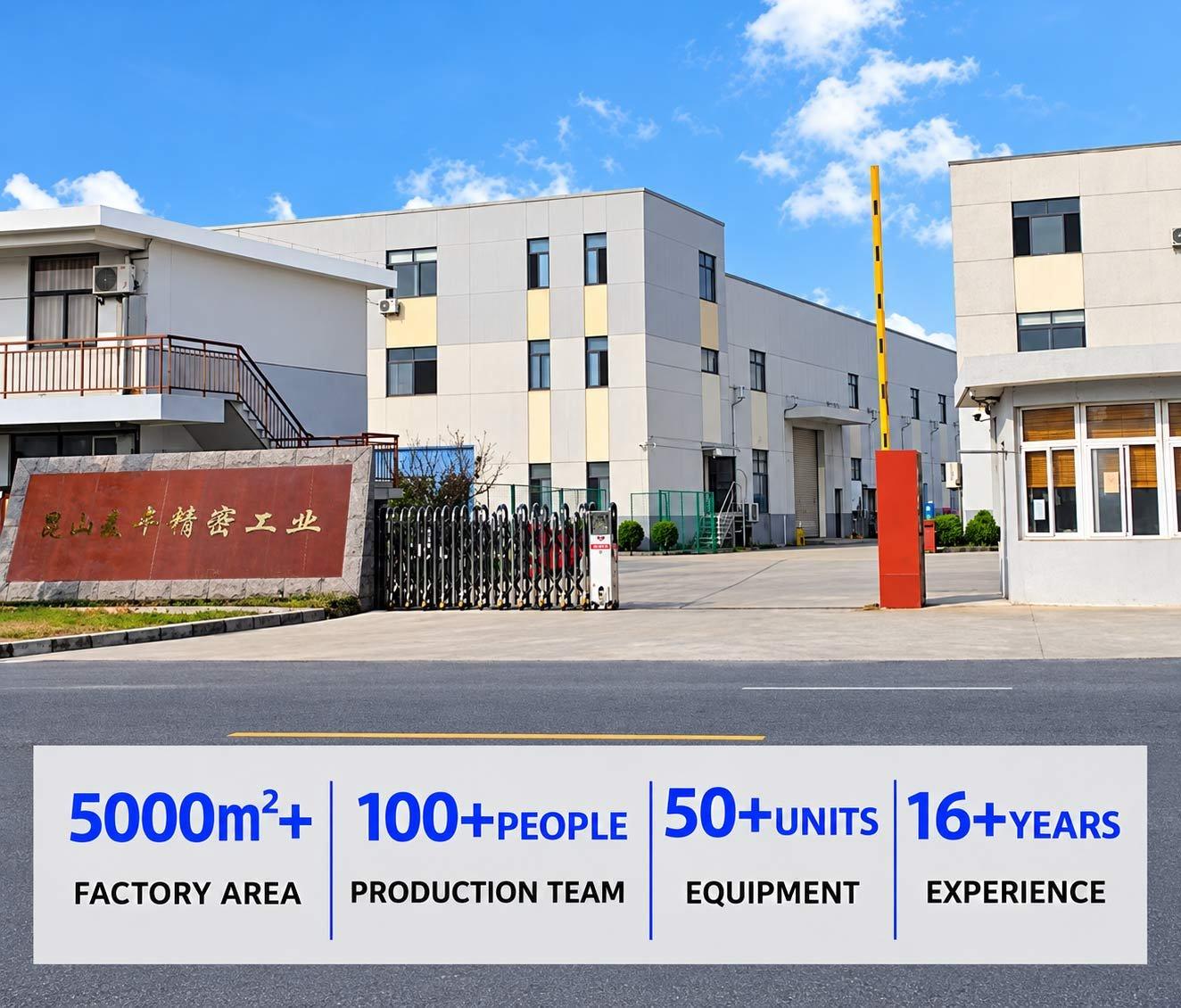
Kunshan Maifeng Precision Industry Co., Ltd. (MIF) has an investment of RMB 35 million and an independent factory of more than 5,000 m². The company operates 36 single- and dual-color injection molding machines from 40 to 700 tons, together with more than 50 sets of mold manufacturing and processing equipment. Our service, management and production team includes over 100 people.
Our parent company was established in 2008. We provide product design, mold design and manufacturing, injection molding and product assembly services for custom plastic parts, supporting both domestic and international customers.
1. Product Design
Product structure design and optimization based on customer drawings and samples.
2. Mold Design
Mold design developed around product geometry, material and production requirements.
3. Mold Manufacturing
Machining, polishing, fitting and assembly for custom injection molds.
4. Injection Molding
Single- and dual-color injection molding for project and order requirements.
5. Product Assembly
Supporting assembly services for molded plastic components.
Custom glossy black PC protective cover for lawn mowers: an open-ring shell with snap clips molded in one shot and a class-A face that survives stones, sun and cleaning.
Custom PC light-diffusion tail light grille for lawn mowers: an even light band, a ribbed outer face, a sealed fixing flange and an optical surface finished to the agreed polish.
Custom clear PC tail light strip for mowers and outdoor equipment: compound curve, uniform wall, polished optical face and colour matched to your chip.
PC+ABS automotive wireless charging housing with an open coil window, four mounting ears and a stiffening rib, molded, inspected and packed for console assembly.
PC lawn mower tail light grille produced through custom mold development, precision injection molding and strict quality control for demanding outdoor applications.
PP handles and plastic parts for a 3rd generation magnetic wall mounted toilet brush, produced at Maifeng Precision through custom mold design, injection molding and careful inspection.
ABS nasal irrigator outer housing produced with custom multi-cavity molds, precision injection molding, careful trimming and dust-free packaging for personal care brands.
ABS nasal irrigator base produced with custom mold design, precision injection molding, strict inspection and dust-free packaging for personal care and medical device assemblies.
No matter what your automotive needs may be, we’re here to help. Contact us today to learn more about our
services and how we can assist you with all of your needs.
ISO 13485-certified medical injection molding in Class 10,000/100,000 cleanrooms: 36 single and dual-color machines, proven medical cases and trusted partners.
One-stop cup and bottle molding: dual-color lids, tea-separation cups and handles, QS food-contact licensed production with proven cases for global brands.
Contact Us
To grow into a top global mold & injection molding supplier
To grow into a top global mold & injection molding supplier, specializing in differentiated custom parts. We focus on structural development, streamlined production and consistent quality supply.











 English
 Chinese



