This module housing is insert-overmolded in PP66+30GF — a PA66 base with 30% glass fiber, rated UL94 V0. Brass terminals are loaded into the tool on pins and wrapped by the shot in one cycle, so each contact is gripped over its full embedded length, cannot back out under vibration, and sits at a pitch held by the mold rather than an assembly fixture. Glass brings stiffness and heat stability but a warp tendency, countered by gate placement, uniform walls and balanced cooling, with flatness checked on a surface plate. Creepage paths between adjacent contacts are molded in as ribs and slots to meet the voltage requirement, and resin lots are verified against the V0 certificate on receipt.
terminals overmolded in one cycle, gripped full-length and pitched by the tool
PP66+30GF compound rated UL94 V0, lot-verified against the material certificate
creepage paths between contacts molded in as ribs and slots, not left to luck
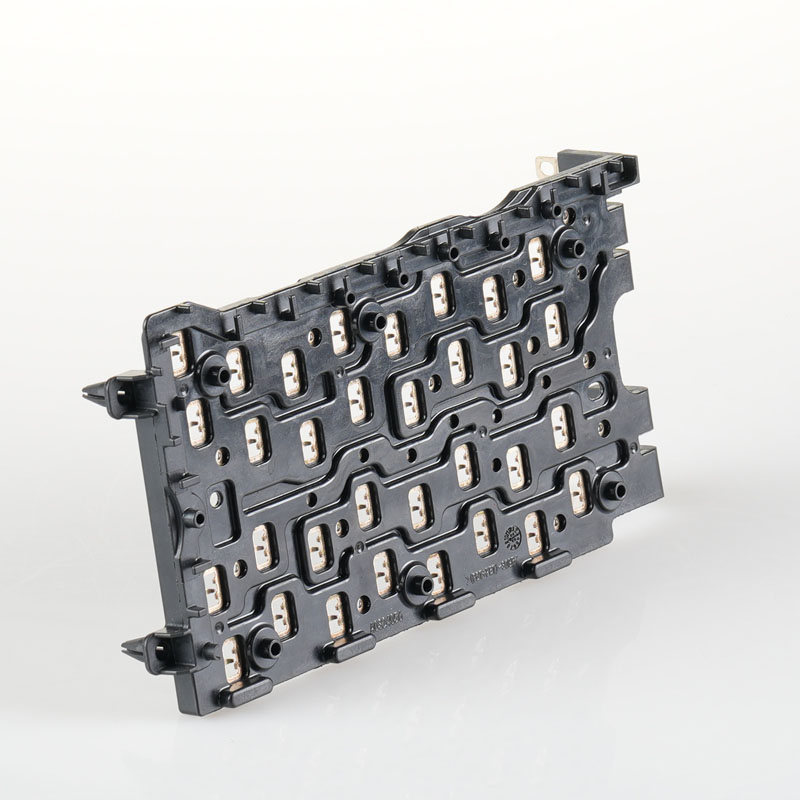
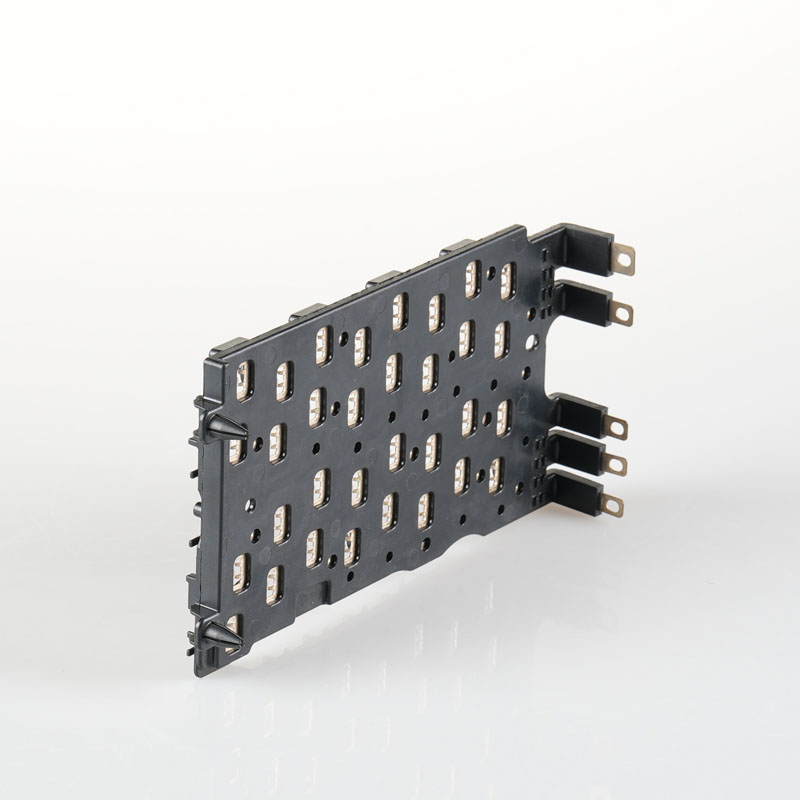
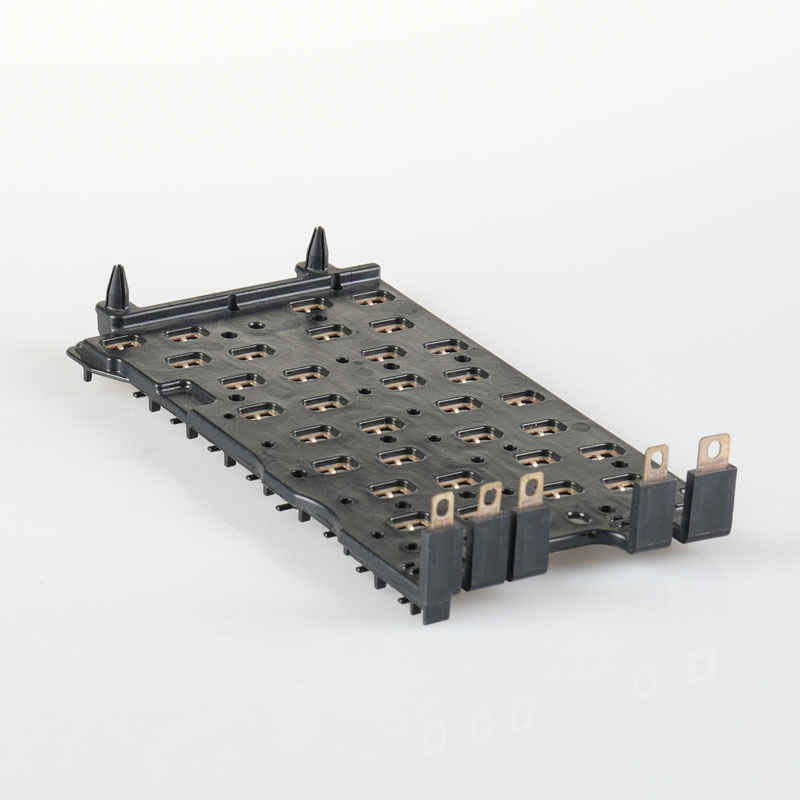
This black panel is the overmolded housing of a resistor and fuse module. Dozens of brass terminals sit in a grid across the face, each one overmolded in place so the plastic both holds them at pitch and isolates them from each other; the edges carry spade tabs and mounting feet, and the face is left with windows where the fuses and resistors seat. It is less a box than a rigid, insulated circuit board made by molding instead of etching.
The resin is a glass-fiber-reinforced polyamide — the PP66+30GF grade, a PA66 base with 30% glass — rated UL94 V0. This page covers insert overmolding, what glass does to a flat part, and the checks that matter.
The terminal grid, every contact overmolded at pitch.
Insert Molding Beats Assembly Here
The terminals could be pressed into a molded housing afterwards, and for low volumes they are. Overmolding them wins at volume for three reasons: the plastic grips each terminal over its full embedded length instead of relying on one knurl; the terminal cannot back out under vibration because it was set in melt, not friction; and the pitch between contacts is held by the tool, not by an assembly fixture that drifts. The terminals are loaded into the mold on pins, the tool closes on them, and the shot forms around them in one cycle.
The process demands discipline. A terminal seated wrong in its pocket gets molded over and scrapes a whole panel, so loading fixtures and vision checks sit in front of the press, and the first shots of every shift are sectioned to confirm the melt has wrapped every terminal completely.
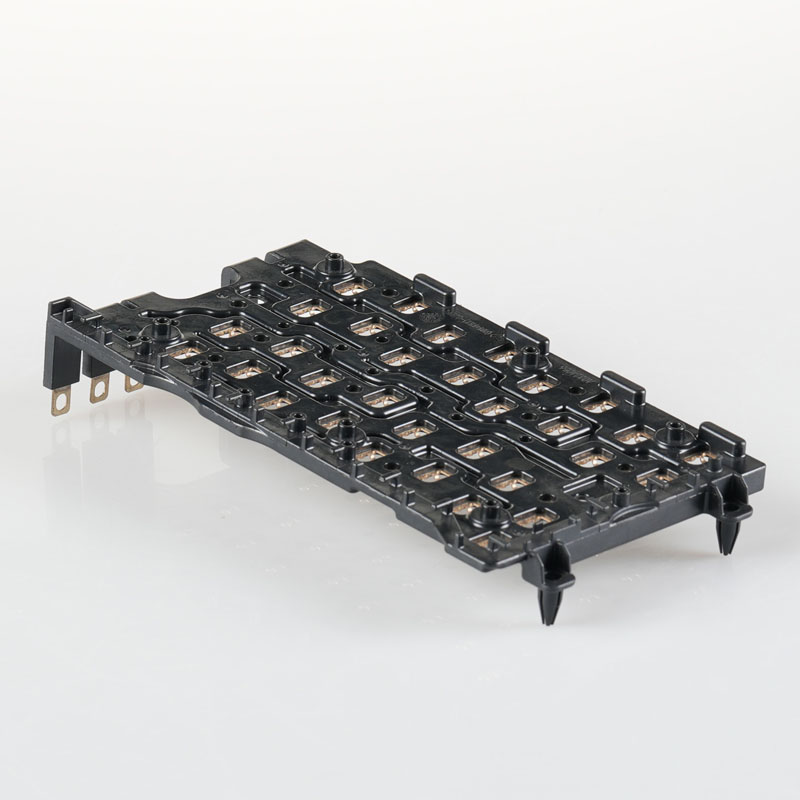
Terminal windows and the mounting feet on the edge.
What 30% Glass Does to a Flat Panel
Glass fiber makes the panel stiff and dimensionally stable under heat — exactly what a fuse carrier needs when the engine bay pushes it toward softening. The same fibers make the part want to warp, because they orient along the flow and shrink differently across and along it. On a large flat face this shows as dish or bow. The counters are mold-side: gate placement that splits the flow pattern, wall sections kept uniform, and cooling laid out so neither face of the panel sets before the other. Flatness is measured on a surface plate, not by eye.
The glass also toughens the resin against the one abuse a fuse panel gets: repeated seating and pulling of fuses, which loads the windows around every position.
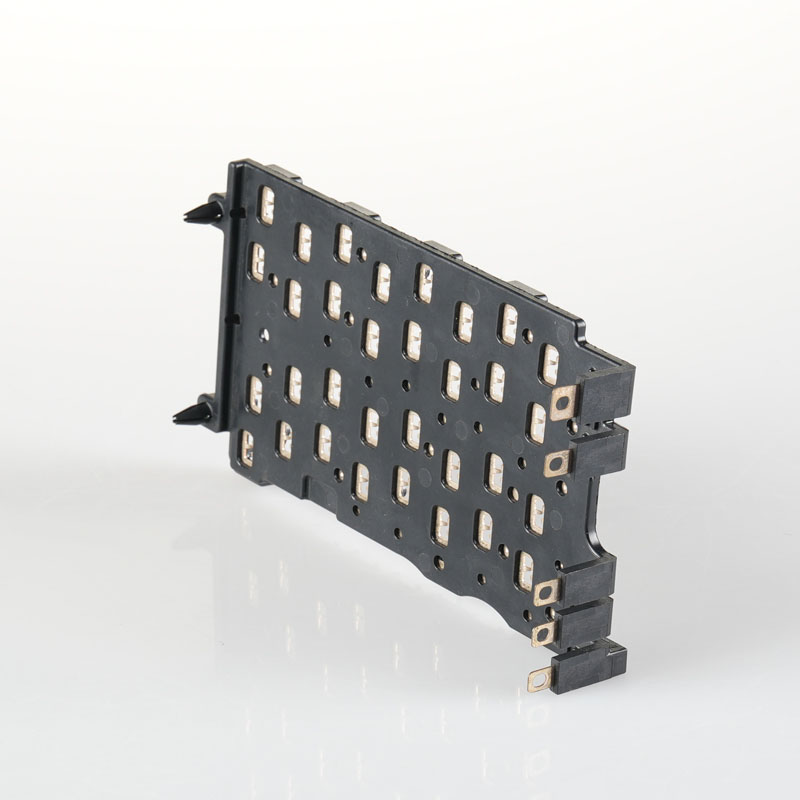
The back face: ribs and the anchors holding each terminal.
V0 and the Insulation Job
A fuse panel lives next to current, and the resin carries a UL94 V0 rating — it stops burning within ten seconds and does not drip flaming material. That rating is a property of this specific compound, not of “PA66 with glass” generally, so the resin lot and rating are checked against the material certificate on every receipt. The molding itself does the insulating work: creepage paths between adjacent contacts are drawn into the part as ribs and slots, so the distance current would have to travel across the surface meets the voltage requirement even in a dirty environment.
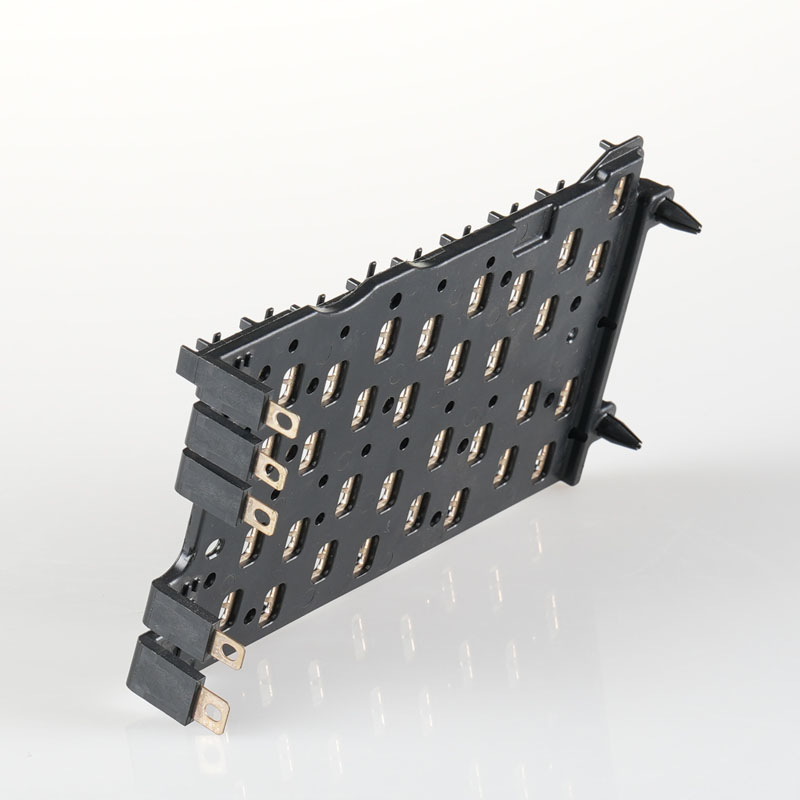
The spade tabs at the edges are left exposed by design, with the plastic around them forming the isolation walls between circuits.
Edge spades, isolated by walls molded between them.
Information to Confirm Before Starting an Overmolded Module Project
Terminal drawings and the contact pitch the tool must hold.
Voltage and creepage requirements between adjacent circuits.
Current load and the thermal environment the V0 compound must survive.
Mounting method — feet, clips or screw bosses — and its tolerance to the mating box.
Annual volume, which decides insert molding against post-assembly pressing.
Kunshan Maifeng Precision Industry Co., Ltd. runs insert overmolding like this panel in house, from terminal loading fixtures to sectioning checks, on machines from 90 to 700 tons with tooling built on site. Send us the terminal drawing and the circuit layout, and we will come back with a mold and process proposal.
Company Profile
About Us
Kunshan Maifeng Precision Industry Co., Ltd. (MIF) has an investment of RMB 35 million and an independent factory of more than 5,000 m². The company operates 36 single- and dual-color injection molding machines from 90 to 700 tons, together with more than 50 sets of mold manufacturing and processing equipment. Our service, management and production team includes over 100 people.
Our parent company was established in 2008. We provide product design, mold design and manufacturing, injection molding and product assembly services for custom plastic parts, supporting both domestic and international customers.
1. Product Design Product structure design and optimization based on customer drawings and samples.
2. Mold Design Mold design developed around product geometry, material and production requirements.
3. Mold Manufacturing Machining, polishing, fitting and assembly for custom injection molds.
4. Injection Molding Single- and dual-color injection molding for project and order requirements.
5. Product Assembly Supporting assembly services for molded plastic components.
Custom glossy black PC protective cover for lawn mowers: an open-ring shell with snap clips molded in one shot and a class-A face that survives stones, sun and cleaning.
Custom PC light-diffusion tail light grille for lawn mowers: an even light band, a ribbed outer face, a sealed fixing flange and an optical surface finished to the agreed polish.
Custom clear PC tail light strip for mowers and outdoor equipment: compound curve, uniform wall, polished optical face and colour matched to your chip.
PC+ABS automotive wireless charging housing with an open coil window, four mounting ears and a stiffening rib, molded, inspected and packed for console assembly.
PC lawn mower tail light grille produced through custom mold development, precision injection molding and strict quality control for demanding outdoor applications.
PP handles and plastic parts for a 3rd generation magnetic wall mounted toilet brush, produced at Maifeng Precision through custom mold design, injection molding and careful inspection.
ABS nasal irrigator outer housing produced with custom multi-cavity molds, precision injection molding, careful trimming and dust-free packaging for personal care brands.
ABS nasal irrigator base produced with custom mold design, precision injection molding, strict inspection and dust-free packaging for personal care and medical device assemblies.
No matter what your automotive needs may be, we’re here to help. Contact us today to learn more about our
services and how we can assist you with all of your needs.
ISO 13485-certified medical injection molding in Class 10,000/100,000 cleanrooms: 36 single and dual-color machines, proven medical cases and trusted partners.
One-stop cup and bottle molding: dual-color lids, tea-separation cups and handles, QS food-contact licensed production with proven cases for global brands.
Contact Us
To grow into a top global mold & injection molding supplier
To grow into a top global mold & injection molding supplier, specializing in differentiated custom parts. We focus on structural development, streamlined production and consistent quality supply.












 English
 Chinese



