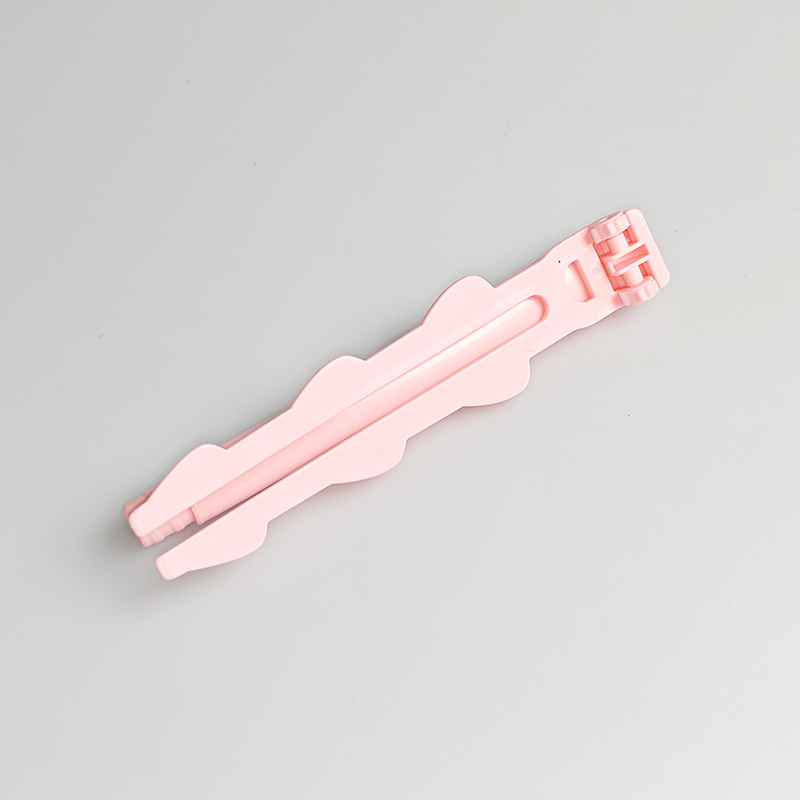
This household duster pole is precision injection molded in one piece, with a sculpted reinforcing spine that keeps a long slender part straight without adding wall thickness. The clip head at the tip is moulded in the same shot and takes replaceable duster heads, disposable or reusable, with engagement geometry that stays consistent across the production run. The modular layout lets short hand dusters and longer floor dusters share the same head connection. Pole length, colour and clip geometry can be adapted to a customer head design.
wavy spine profile raises stiffness along the length without a heavier wall
clip head moulded in the same shot, so replacement heads fit poles made months apart
modular length layout lets one head connection serve several pole sizes
A duster pole has an easy job to describe and a harder one to mould. It has to stay straight over its full length while a hand pushes it back and forth along a ceiling, it has to survive being knocked against door frames, and the head at the end has to click off and back on hundreds of times without the connection wearing loose. The pole shown here is that connection end: a long moulded spine with a wavy outline and a clip head in coloured resin.
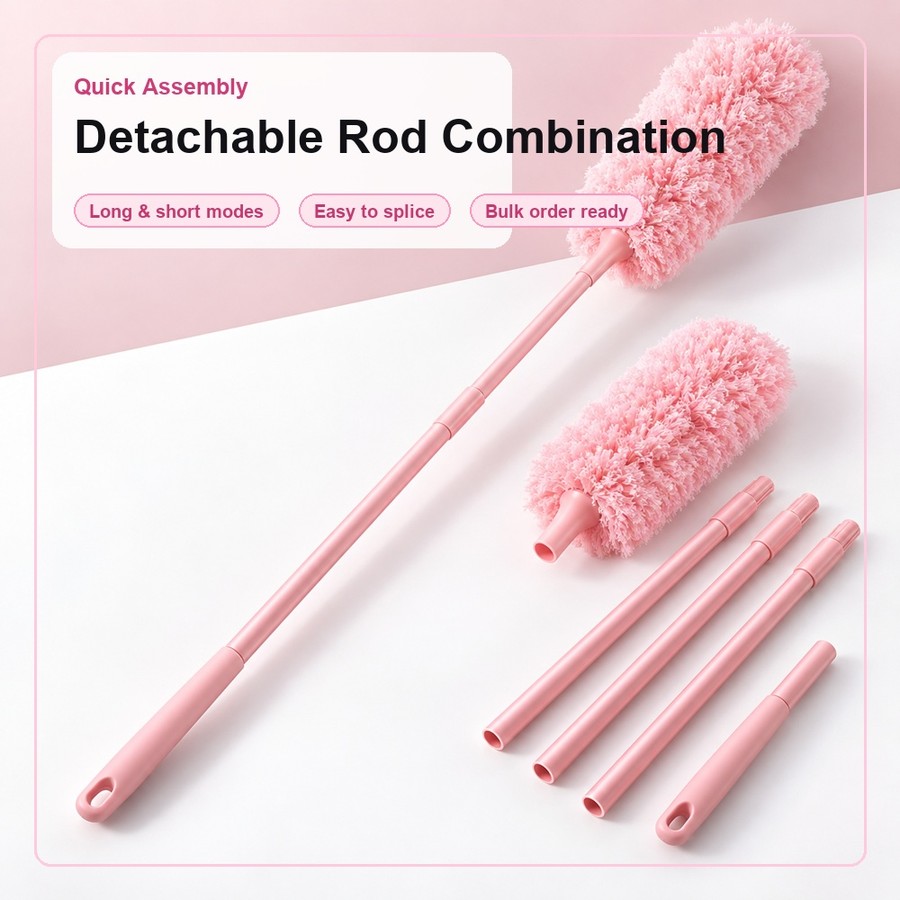
The part is moulded as one piece from a light resin, with the clip features formed at the tip in the same shot. Length adjustment comes from the modular layout, so a shorter hand duster and a longer floor duster can share the same head and the same connection geometry. In the set below that layout is three extension sections: the head on the short handle for close work, or the head on the full stack for a metre of reach.
The set as it ships: one fluffy head, a short handle and three extension sections, assembled here to about 100 cm. Every plastic part on this page — head shell, joint, handle and all three sections — comes off our own tools.
The Wavy Profile Is Structure, Not Style
The moulded spine. The wavy profile along the length is structure, and the clip head at the tip takes the replaceable duster head.
A straight flat strip of this length would bow noticeably the first summer it spent in a hot car or a damp utility room. The sculpted outline does two jobs at once. The bulges raise the moment of inertia along the length without adding wall thickness everywhere, and the transitions break up the shrinkage so the pole stays straighter than a plain strip of the same weight would.
There is a trade. A contoured outline needs the melt to flow around corners and rejoin, and every rejoin is a potential weak line. The tool is gated so the flow front moves down the length steadily rather than splitting early, and the wall is kept even through the waves, because a thick pocket behind a thin one would sink and show on the visible face.
Moulding a Long, Thin Rod Straight
Four sections, one head. Because each section is a separate moulding, every one of them has to come out straight on its own — a single bowed section puts a kink in a pole that is otherwise perfect.
Length is the enemy here. The pole is many times longer than it is wide, so any imbalance in cooling between the two sides of the cavity comes out as a bow. Balanced cooling channels around the cavity, even packing, and enough cooling time before ejection are what keep the part true. Rushing the cycle saves seconds and gives back a pole that rocks on a flat table.
Ejection gets the same care. A long slender part grips the core over its whole length, and pushing it off with a few pins in the wrong places bends it before it ever leaves the tool. The ejector layout spreads the load along the spine, and the clip features at the tip are released in the right order so nothing drags.
The Head Connection
The clip head at the tip is the part that gets used. It clicks onto the duster head plate, holds under the drag of wiping, and releases cleanly when the head is swapped. That balance comes from the clip geometry: engagement depth, lead-in angle and the flexibility of the arms behind the clips all have to be read together, because a clip that is deep enough to hold firmly may also be deep enough to crack the arm when the user pulls at the wrong angle.
Because the clips are moulded into the pole, their dimensions repeat from shot to shot. On a head that is sold as replaceable, that repeatability is what lets the same replacement pack fit poles made months apart.
The knuckle above the head shell. Two moulded halves, one pin and a spring detent: the head folds down to lie flat on a shelf and turns to face the gap behind a radiator.
Resin Choice for a Household Pole
PP is the usual pick for this kind of part: it flexes instead of snapping, it shrugs off the cleaning chemicals that land on it, and it moulds cheaply at household volumes. Its weakness is stiffness, which is exactly what the contoured spine compensates for. Where a programme needs a straighter, stiffer pole, a filled grade raises stiffness at the cost of a less forgiving clip and a heavier part.
Reaching a Ceiling Without Standing on a Chair
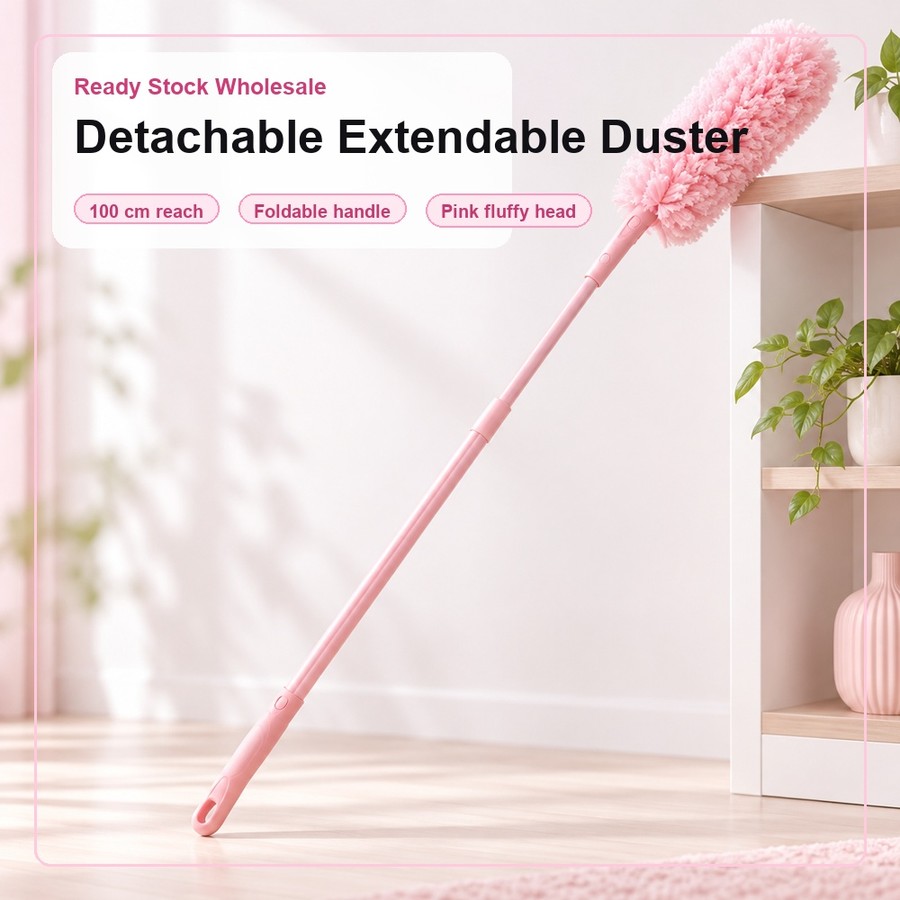
Everything above is about one part. What the customer actually judges is the assembled set, at full extension, with the head loaded and the arm above the shoulder. Three extension sections give roughly a metre of reach, which is the difference between dusting a ceiling corner and moving furniture to get to it — and the reason this design sells as a set rather than as a pole.
Reach costs rigidity. Every added section adds a joint, and a joint is a place where a pole can flex, rotate or work loose under a twisting wipe. The sections here join end to end with a defined engagement depth, and the assembled stack is checked for play at each joint rather than only at the head. Short mode is the same head on the moulded handle: no joint at all, which is why it stays the stiffest configuration in the set and the one people reach for on shelves and skirting boards.
Full stack: shelf tops, ceiling line and the corner where the wall meets the cornice.Short mode and long mode from the same head — the split that makes one SKU cover both jobs.
In the showroom: the head folded into a corner, the same head screwed onto the extension sections, and the finished sets counted against stock.
What Gets Checked on a Duster Pole
Straightness over the full length, checked on a flat surface. Clip engagement and pull-off force, tested against the actual head plate rather than a gauge. Flex under a realistic wiping load, so the pole returns true rather than taking a set. Colour match between the spine and the coloured clip end, since the two surfaces sit side by side in the hand.
On the assembled set the checks move up a level: build it to full length, load the head and press it against a wall, then let go — the stack should come back straight and the joints should still be tight. A set that passes every part-level check can still fail here, which is why we assemble and test the set, not just the components.
Information to Confirm Before Starting a Duster Pole Project
The duster head drawing or a sample, since the clip geometry has to be built around the real mating plate.
Target length range and whether the modular sections join mid-pole or only at the head.
Resin and colour specification, including the contrast colour for the clip end if it differs.
Expected use pattern, disposable or reusable heads, and how often the connection is exercised.
Annual volume, which decides the cavity count and how much tooling investment is justified.
The retail set: washable head, three sections and a drawstring bag. For wholesale programmes the bag, the header card and the carton split are quoted together with the parts.
Kunshan Maifeng Precision Industry Co., Ltd. reviews household product designs before quoting, builds the injection molds in house, and molds single-color and dual-color parts on 36 machines from 40 to 700 tons. Send us the head drawing and the length range you need, and we will come back with a feasibility comment and a tooling proposal.
Contact Us
Lucy Liu — Kunshan Maifeng Precision Industry Co., Ltd.
Custom Mold • Precision Injection Molding • Consistent Production. Send us the head drawing and the length range, and we will come back with a tooling proposal.
Company Profile
About Us
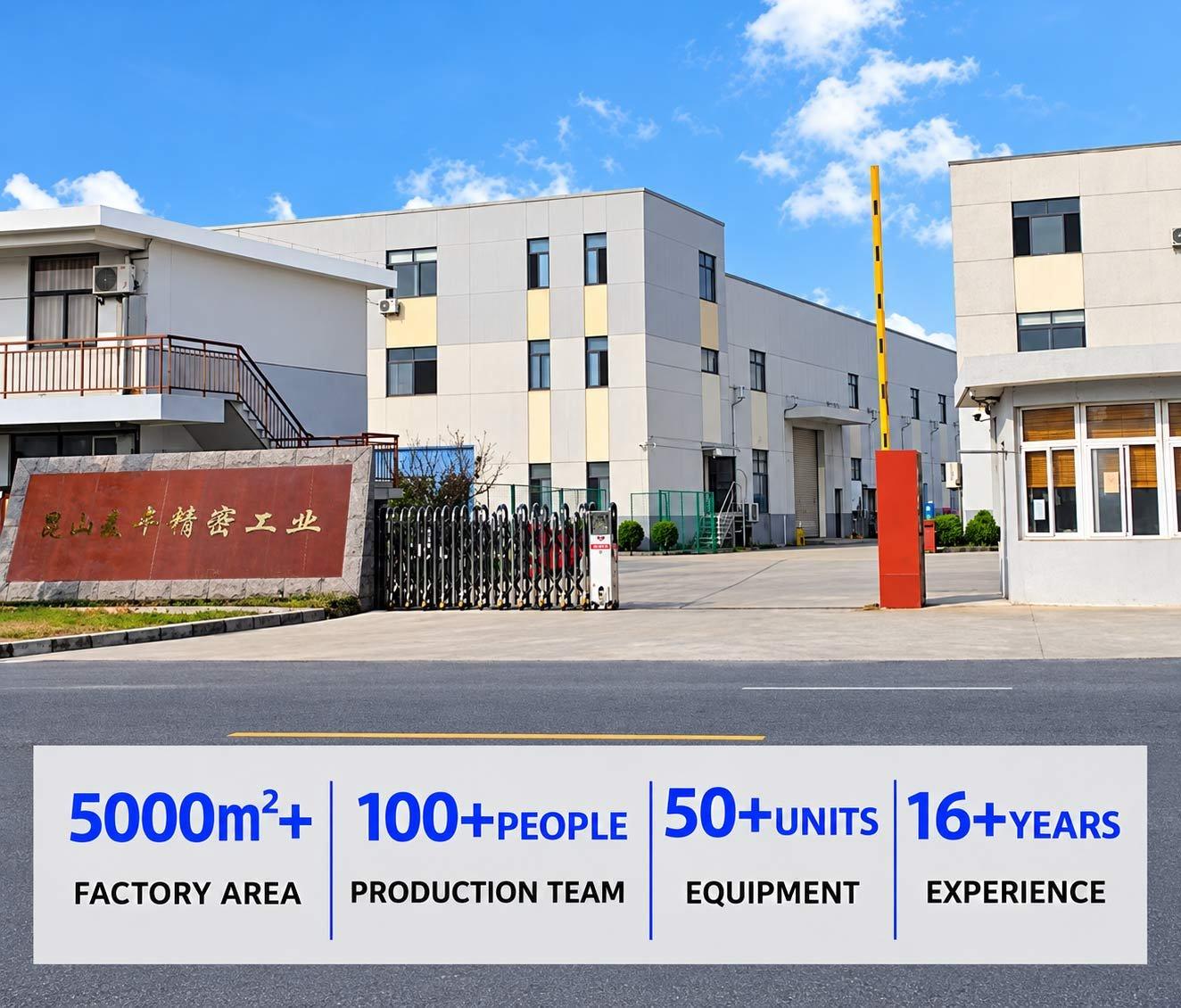
Kunshan Maifeng Precision Industry Co., Ltd. (MIF) has an investment of RMB 35 million and an independent factory of more than 5,000 m². The company operates 36 single- and dual-color injection molding machines from 40 to 700 tons, together with more than 50 sets of mold manufacturing and processing equipment. Our service, management and production team includes over 100 people.
Our parent company was established in 2008. We provide product design, mold design and manufacturing, injection molding and product assembly services for custom plastic parts, supporting both domestic and international customers.
1. Product Design Product structure design and optimization based on customer drawings and samples.
2. Mold Design Mold design developed around product geometry, material and production requirements.
3. Mold Manufacturing Machining, polishing, fitting and assembly for custom injection molds.
4. Injection Molding Single- and dual-color injection molding for project and order requirements.
5. Product Assembly Supporting assembly services for molded plastic components.
Custom glossy black PC protective cover for lawn mowers: an open-ring shell with snap clips molded in one shot and a class-A face that survives stones, sun and cleaning.
Custom PC light-diffusion tail light grille for lawn mowers: an even light band, a ribbed outer face, a sealed fixing flange and an optical surface finished to the agreed polish.
Custom clear PC tail light strip for mowers and outdoor equipment: compound curve, uniform wall, polished optical face and colour matched to your chip.
PC+ABS automotive wireless charging housing with an open coil window, four mounting ears and a stiffening rib, molded, inspected and packed for console assembly.
PC lawn mower tail light grille produced through custom mold development, precision injection molding and strict quality control for demanding outdoor applications.
PP handles and plastic parts for a 3rd generation magnetic wall mounted toilet brush, produced at Maifeng Precision through custom mold design, injection molding and careful inspection.
ABS nasal irrigator outer housing produced with custom multi-cavity molds, precision injection molding, careful trimming and dust-free packaging for personal care brands.
ABS nasal irrigator base produced with custom mold design, precision injection molding, strict inspection and dust-free packaging for personal care and medical device assemblies.
No matter what your automotive needs may be, we’re here to help. Contact us today to learn more about our
services and how we can assist you with all of your needs.
ISO 13485-certified medical injection molding in Class 10,000/100,000 cleanrooms: 36 single and dual-color machines, proven medical cases and trusted partners.
One-stop cup and bottle molding: dual-color lids, tea-separation cups and handles, QS food-contact licensed production with proven cases for global brands.
Contact Us
To grow into a top global mold & injection molding supplier
To grow into a top global mold & injection molding supplier, specializing in differentiated custom parts. We focus on structural development, streamlined production and consistent quality supply.















 English
 Chinese



