Router Plastic Housing, Network Communication Device Shell
This router housing is injection molded in black PC/ABS as a top cover and base that close on a parting line at the waist and fasten with self-tapping screws into cored corner bosses. The top carries a field of several hundred drafted vent holes sized to the customer's thermal budget, and the port openings for RJ45, USB and DC jack are held against the PCB connector positions, checked on first articles with the board drawing. The status window is a shallow recess that keeps the light pipe zone clear. Flame-retardant grades are available; the mold is cut to the specified resin because FR compounds shrink differently.
vent field of drafted moulded holes sized to the thermal budget and kept clear of the parting line
port openings positioned against the PCB connector layout and checked on first articles
cored corner bosses keep the base flat so the finished unit does not rock on the desk
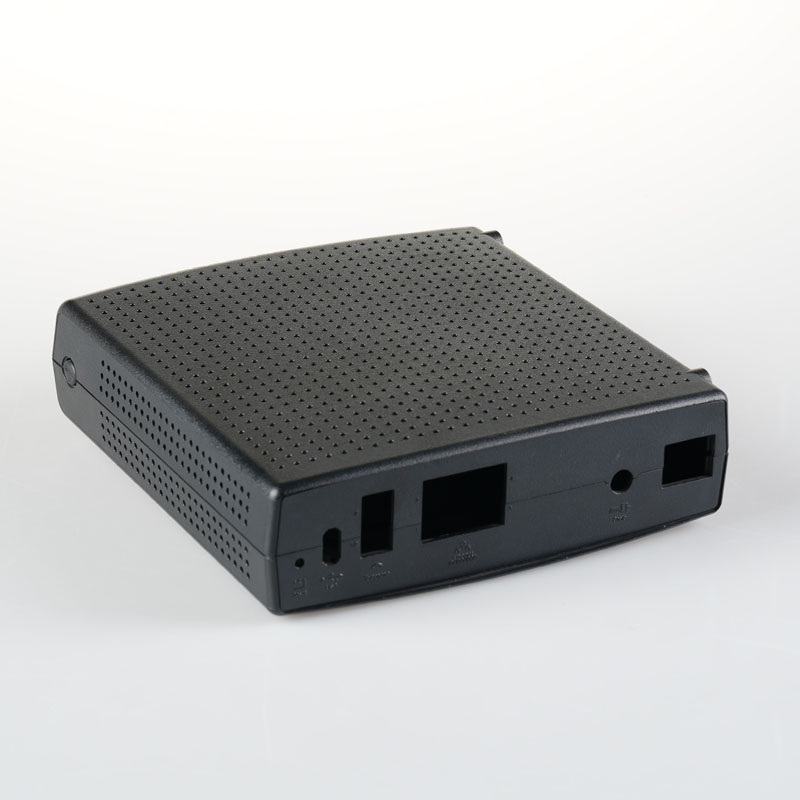
This black shell is the housing of a desktop router or small network switch. The circuit board, the power jack, the RJ45 ports and the status lights all live inside it, and the perforated field on the top cover is what lets the chipset breathe. It is a two-part injection molding: a top cover and a base that close on a parting line around the middle and hold with self-tapping screws into moulded bosses.
The housing is molded in black PC/ABS as two shells. The top carries the vent field and the port openings; the base carries the bosses, the label recess and the feet. Dimensions follow the PCB and the connector stack, so the housing is really a mechanical adapter between the electronics and the desk. This page covers the split, the vent field, the port openings and the resin choice.
Black router housing seen from the front left, with the vent field and front ports visible.
One Shell, Two Halves
The parting line runs around the waist of the housing, low on the side wall, so the seam sits where the eye least expects it. The top cover is the show surface; the base is the working surface. Four screw bosses rise from the base corners, and the screws pass into the cover’s ribs from below, which keeps the top face free of fastener marks.
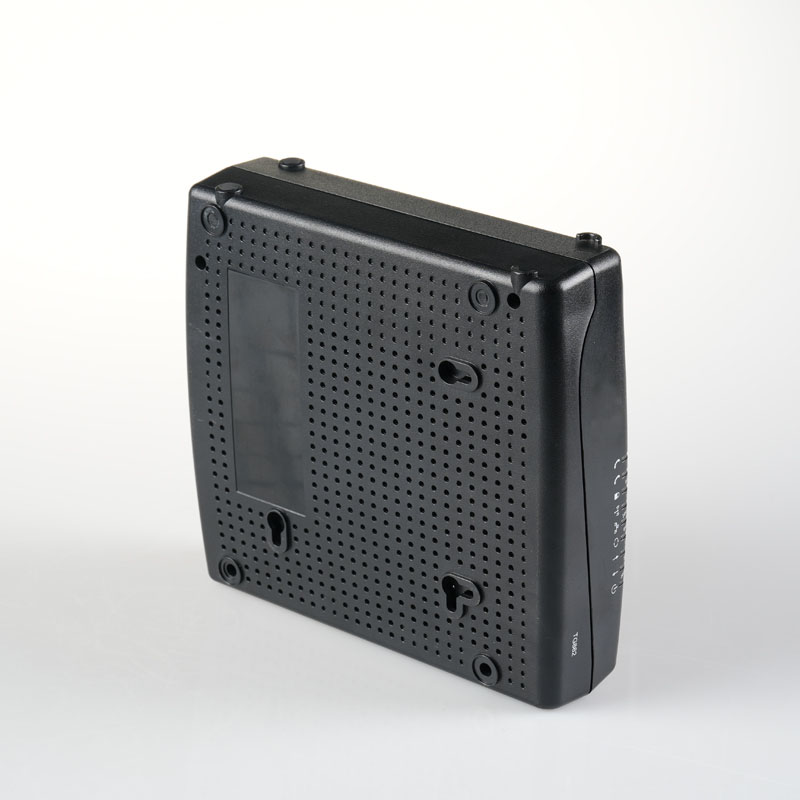
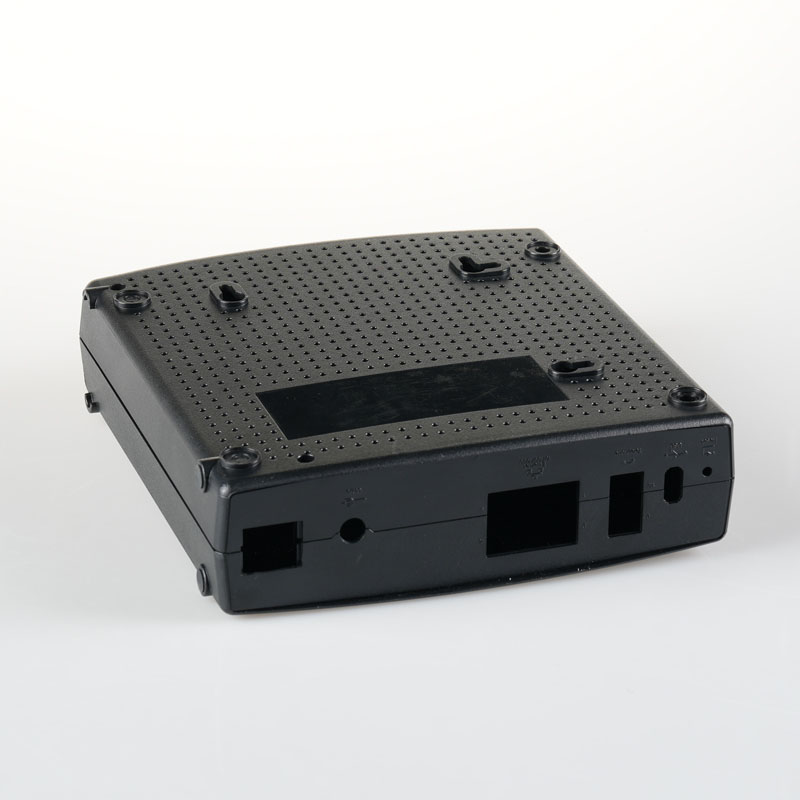
The bosses are cored rather than solid. A solid boss at the corner of a flat base would sink, and the sink would telegraph through to the desk as a wobble. Cored bosses keep the section near the wall and the base flat, which matters more than it sounds: a router that rocks on the desk reads as cheap no matter how well the rest of it is molded.
Underside of the base showing the screw bosses, the vent field and the label recess.
The Perforated Vent Field
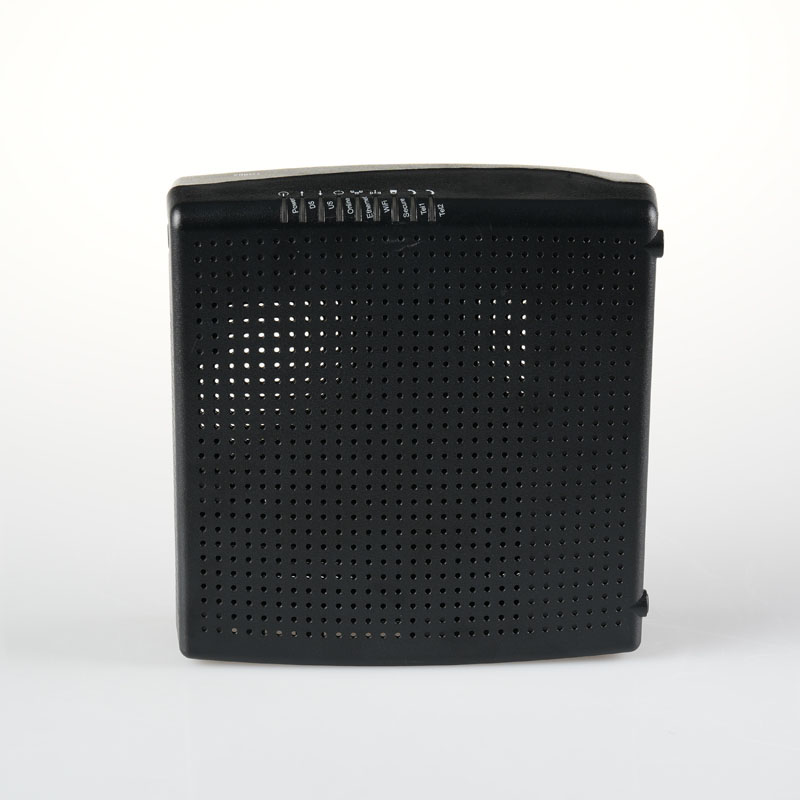
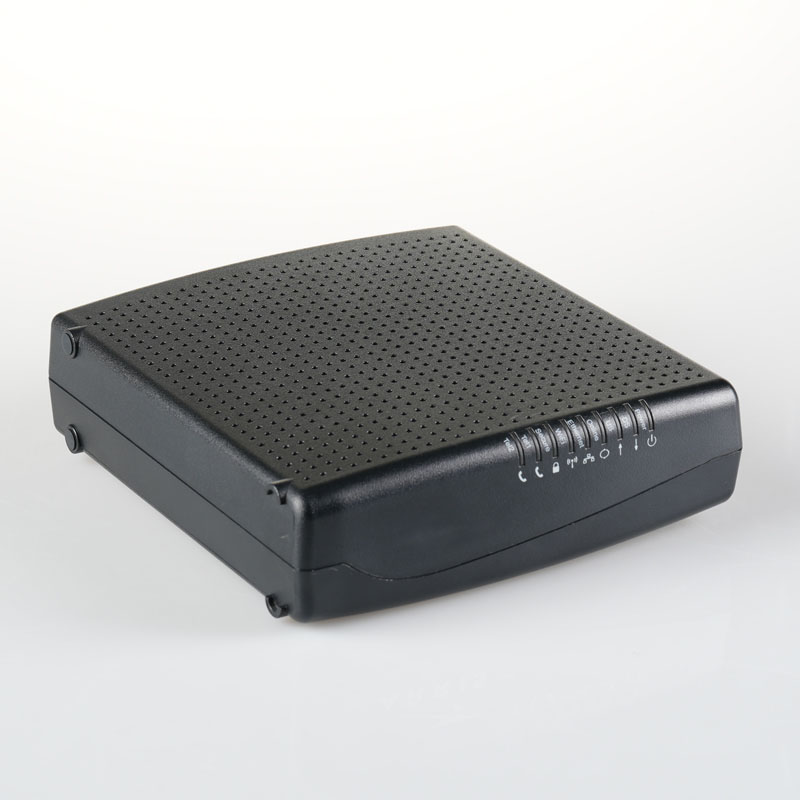
The dotted field across the top is several hundred small moulded holes. Each one is a tiny core in the tool, and the whole field is a manufacturing decision: hundreds of cores cost tool maintenance, vent cleaning and inspection effort, in exchange for passive cooling that needs no fan. The holes are drafted so the cores release cleanly, and the field is kept away from the parting line, where a burr on one hole edge would catch a fingernail and read as a defect.
There is a trade-off worth naming. Denser holes mean more cooling and more tool risk; sparser holes mold faster and stay cleaner longer. The customer’s thermal budget decides the density, and the tool is built to the drawing rather than to taste.
Front view showing the dense perforated grille across the top surface.
Port Openings and the Front Face
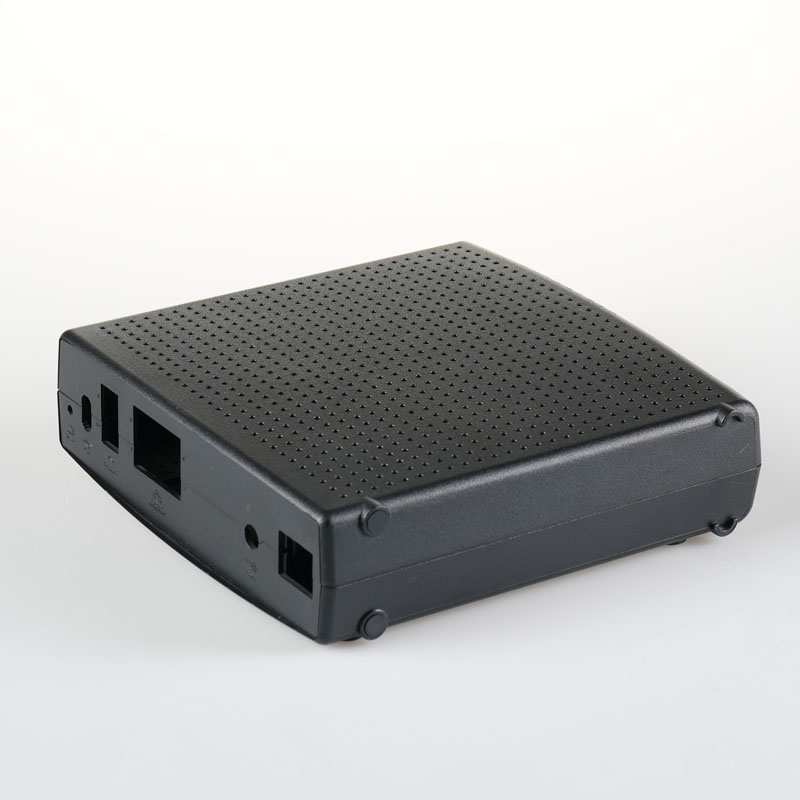
The openings for the RJ45 jacks, the USB port and the DC jack are cut where the connectors land on the PCB, and their positions are held against the board layout, not against the housing drawing alone. A port that sits half a millimetre off shows as a plug that will not seat, and the customer finds it at final assembly, which is the expensive place to find it. We mold first articles with the customer’s board drawing and check every opening against the connector positions.
The front face carries the slot for the status window. It is a shallow recess rather than a through hole, so the light pipe sits behind the wall and the shell stays closed. Light pipes need a clear, unfilled zone behind them; a thick wall or a rib in that zone scatters the light and the indicator reads dim.
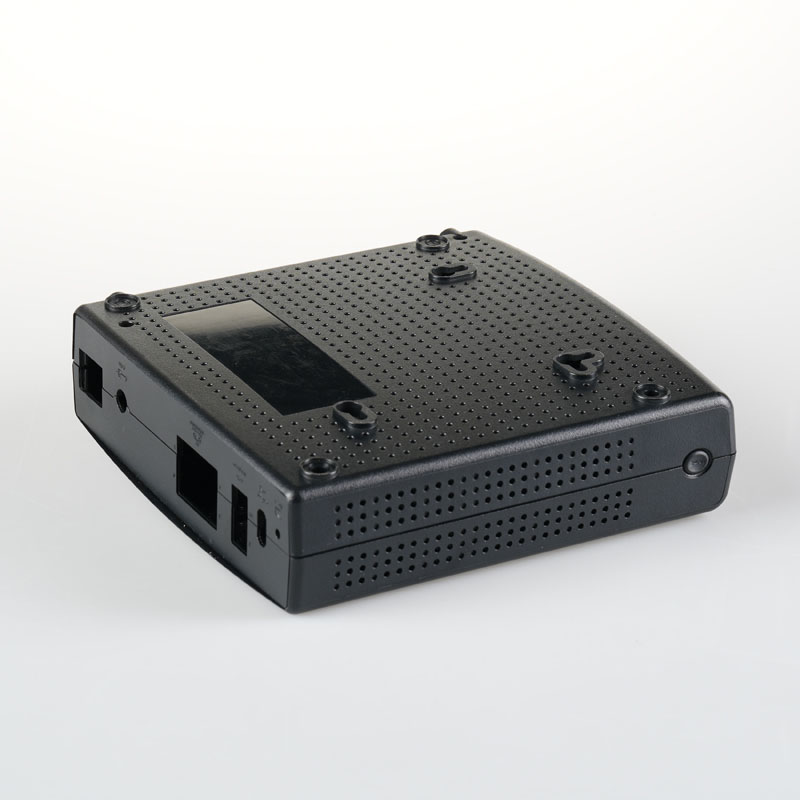
Rear angled view showing the port openings and the vent field across the top.
Resin, Color and Flame Rating
PC/ABS is the default for this class of shell: PC brings stiffness and heat resistance for a device that runs warm, ABS brings flow and finish, and the blend molds black to a uniform matte without streaks. Where the customer’s specification calls for a flame-retardant grade, the compound changes and so does the shrink — the mold is cut to the grade, not to a generic value, because FR resins move differently in the tool.
Black hides a lot, but not everything. Flow marks and gloss variation still show on a wide flat surface under office lighting, and the vent field makes the surface busier, not cleaner. Gate position and packing are tuned on the show face first; cycle time is optimized after the appearance is right, not before.
Bottom front view showing the rear ports and the ventilation openings.
Information to Confirm Before Starting a Network Device Housing Project
The PCB assembly drawing, since every port opening follows the connector positions on the board.
The thermal budget, which sets the vent field density and whether a fan cutout is needed.
Resin specification, including any flame-retardant grade and the exact color reference.
The mounting method: desk feet, wall-mount slots or both.
Annual volume and expected tool life, which decide cavity count and mold steel.
Kunshan Maifeng Precision Industry Co., Ltd. reviews network device housing designs before quoting, builds the injection molds in house, and molds single-color and dual-color parts on 36 machines from 90 to 700 tons. Send us the PCB drawing and the housing 3D model, and we will come back with a feasibility comment and a tooling proposal.
Company Profile
About Us
Kunshan Maifeng Precision Industry Co., Ltd. (MIF) has an investment of RMB 35 million and an independent factory of more than 5,000 m². The company operates 36 single- and dual-color injection molding machines from 90 to 700 tons, together with more than 50 sets of mold manufacturing and processing equipment. Our service, management and production team includes over 100 people.
Our parent company was established in 2008. We provide product design, mold design and manufacturing, injection molding and product assembly services for custom plastic parts, supporting both domestic and international customers.
1. Product Design Product structure design and optimization based on customer drawings and samples.
2. Mold Design Mold design developed around product geometry, material and production requirements.
3. Mold Manufacturing Machining, polishing, fitting and assembly for custom injection molds.
4. Injection Molding Single- and dual-color injection molding for project and order requirements.
5. Product Assembly Supporting assembly services for molded plastic components.
Custom glossy black PC protective cover for lawn mowers: an open-ring shell with snap clips molded in one shot and a class-A face that survives stones, sun and cleaning.
Custom PC light-diffusion tail light grille for lawn mowers: an even light band, a ribbed outer face, a sealed fixing flange and an optical surface finished to the agreed polish.
Custom clear PC tail light strip for mowers and outdoor equipment: compound curve, uniform wall, polished optical face and colour matched to your chip.
PC+ABS automotive wireless charging housing with an open coil window, four mounting ears and a stiffening rib, molded, inspected and packed for console assembly.
PC lawn mower tail light grille produced through custom mold development, precision injection molding and strict quality control for demanding outdoor applications.
PP handles and plastic parts for a 3rd generation magnetic wall mounted toilet brush, produced at Maifeng Precision through custom mold design, injection molding and careful inspection.
ABS nasal irrigator outer housing produced with custom multi-cavity molds, precision injection molding, careful trimming and dust-free packaging for personal care brands.
ABS nasal irrigator base produced with custom mold design, precision injection molding, strict inspection and dust-free packaging for personal care and medical device assemblies.
No matter what your automotive needs may be, we’re here to help. Contact us today to learn more about our
services and how we can assist you with all of your needs.
ISO 13485-certified medical injection molding in Class 10,000/100,000 cleanrooms: 36 single and dual-color machines, proven medical cases and trusted partners.
One-stop cup and bottle molding: dual-color lids, tea-separation cups and handles, QS food-contact licensed production with proven cases for global brands.
Contact Us
To grow into a top global mold & injection molding supplier
To grow into a top global mold & injection molding supplier, specializing in differentiated custom parts. We focus on structural development, streamlined production and consistent quality supply.












 English
 Chinese



