This transparent protective lid for wafer storage boxes is injection molded in high-clarity PC as a shallow tray with a flat top panel, a perimeter skirt and four built-in positioning buckles moulded into the inner wall. The cantilever buckles deflect as the lid drops over the box rim and snap behind it, absorbing wall thickness variation measured on real parts. PC is chosen over PMMA for stiffness and IPA wipe-down resistance, and the recessed panel fields keep the section uniform so thin areas stay sink-free. First articles are checked seated on the box, not on a fixture. Customizable to the customer's box outline.
four cantilever buckles snap behind the box rim and absorb wall thickness variation
recessed panel fields stiffen the thin clear top and leave nowhere for a sink mark
first articles checked seated on the box, because the two-part interaction is what ships
The lid closes the top of the wafer storage box. It drops over the box rim, internal buckles grip the wall, and the closed assembly keeps dust off the wafers between process steps. That is the whole job, and every design decision on this part serves it.
The lid is injection molded in high-clarity PC as a shallow tray: a flat top panel, a perimeter skirt and a set of built-in positioning buckles moulded into the inner wall. It is an accessory to the box, so its dimensions follow the box, not the other way round.
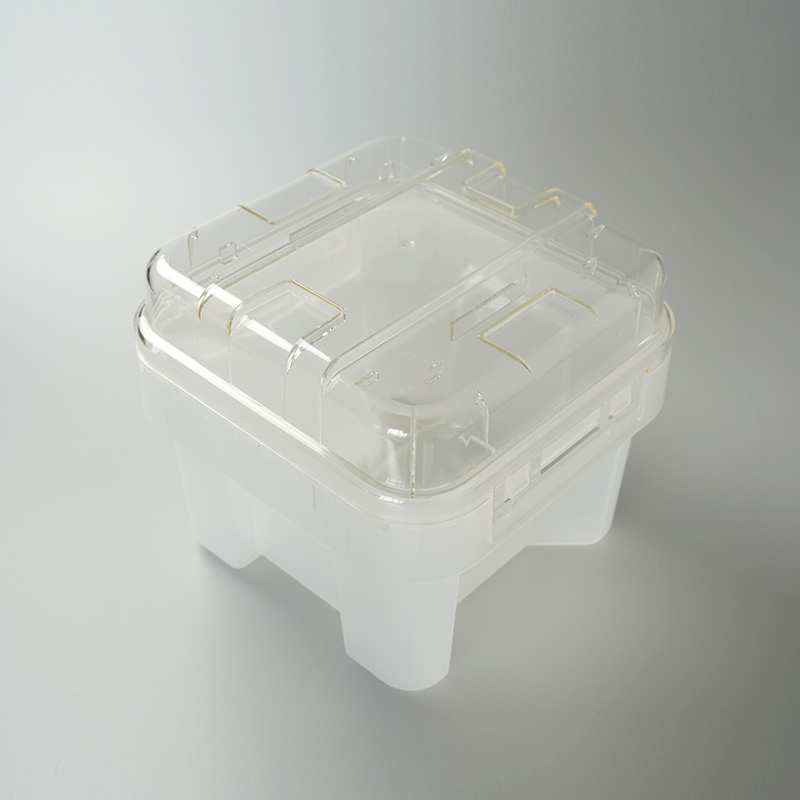
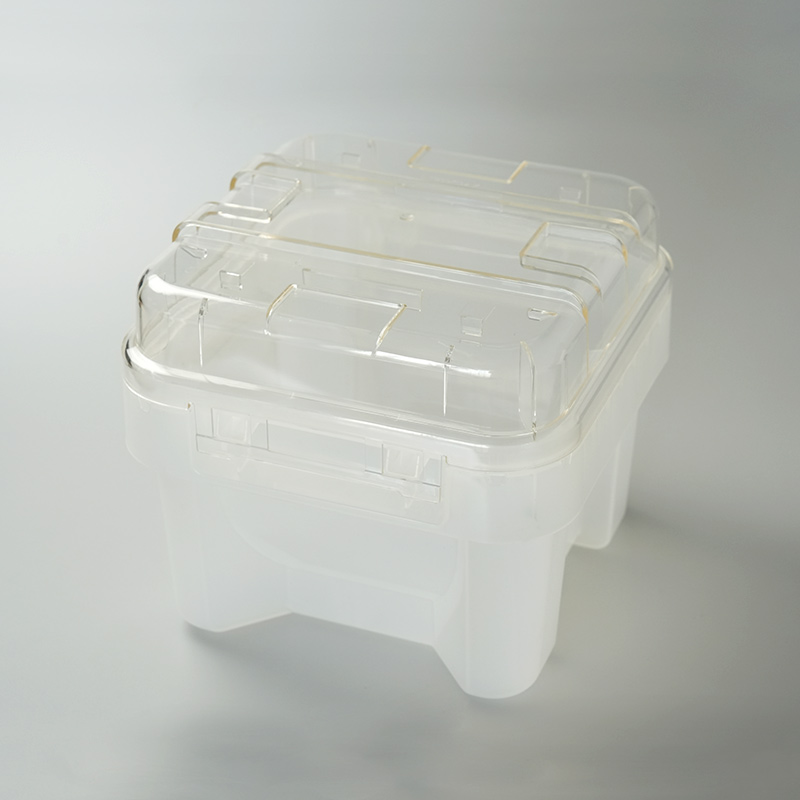
Clear PC lid seated on the wafer storage box, seen from the corner.
How the Lid Locks onto the Box
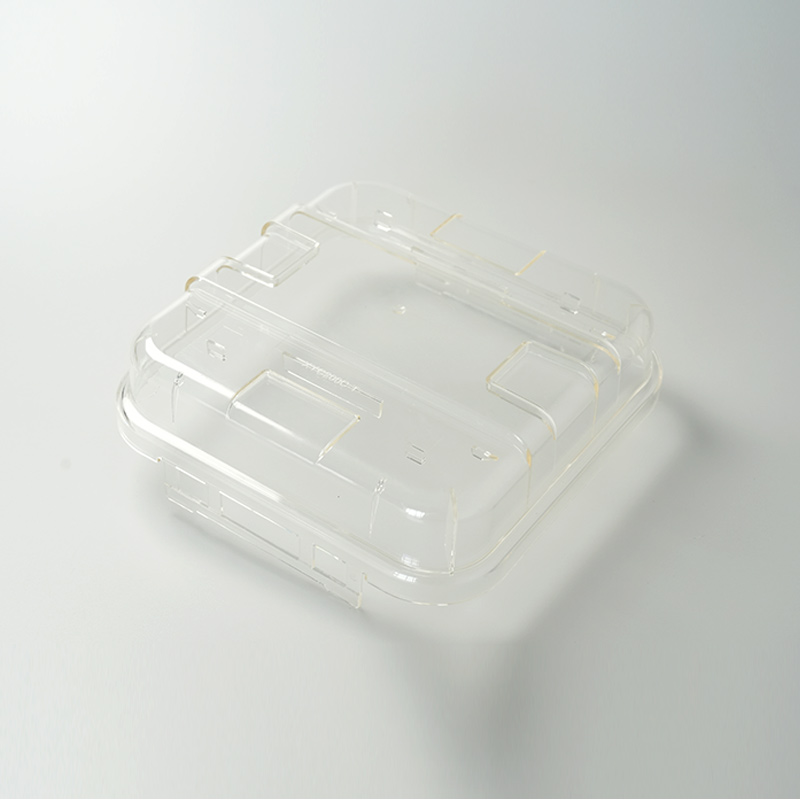
The positioning buckles are the reason a lid this open-looking actually holds. Each buckle is a short cantilever moulded into the inner skirt; it deflects as the lid drops over the box rim and snaps behind it. Four of them, one per corner region, hold the lid square. A friction fit would have done the same job on day one and failed by month three, because PC creeps under constant stress and a pure friction joint slowly relaxes.
The buckles also size the fit. Their engagement depth follows the box wall thickness measured on real parts, not on the drawing. When a box runs slightly heavy at the wall, the buckle takes up the difference; that tolerance absorption is deliberate.
Underside of the lid showing the moulded positioning buckles and recessed panels.
Why PC, Not PP or PMMA
The box below is semi-transparent PP. The lid is polycarbonate, and that split is not an accident. PC is stiff, so the flat top panel does not drum or oil-can when pressed; it stays clear after repeated wipe-downs with IPA, where PMMA would haze and craze; and it does not shatter into shards when a stacked box is knocked over. PC costs more and demands careful drying before molding — wet PC fills with splay streaks — but for a lid that gets handled, wiped and restacked every shift, it earns its price.
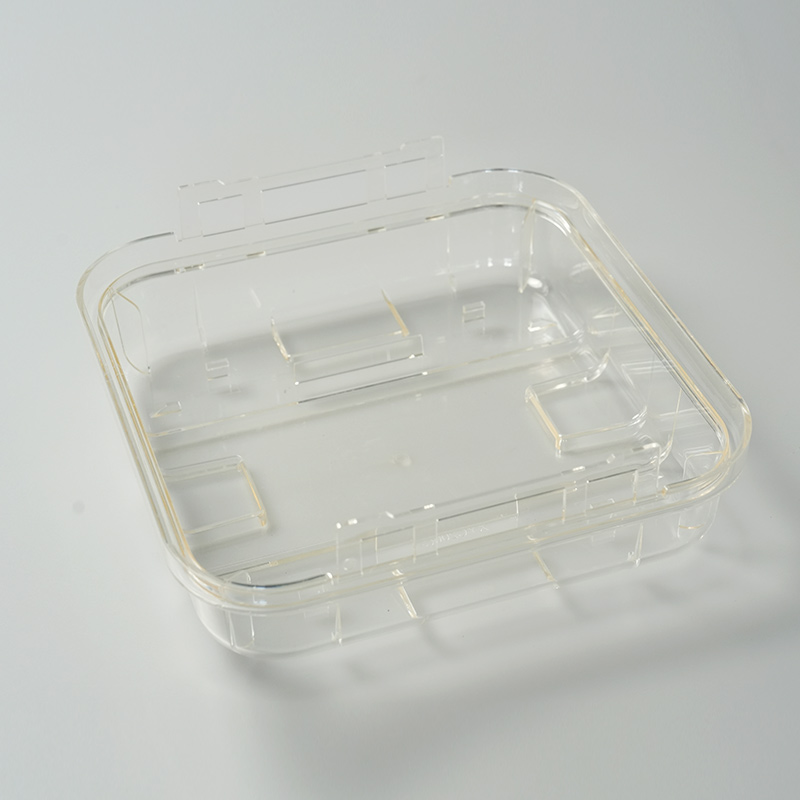
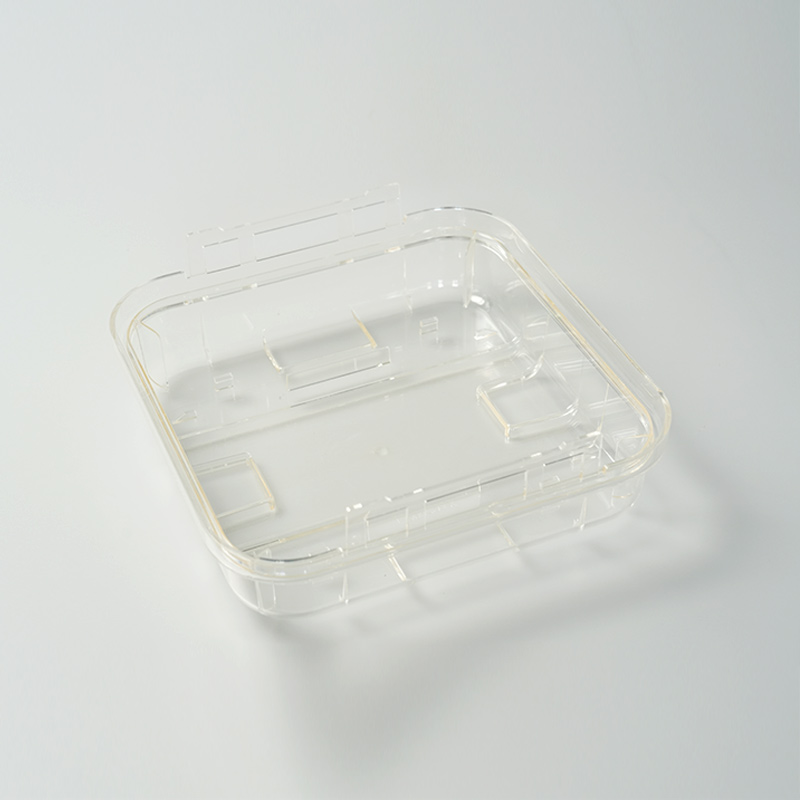
Angled view of the transparent lid showing the perimeter skirt and rim.
Flatness and the Visible Parting Line
A lid does not need to seal airtight here, but it must seat without rocking, and it must not gap at one corner. That comes back to flatness of the skirt edge. Thin clear parts warp when cooling is uneven, so the mold cools the skirt uniformly and the part is packed just long enough to set the rim before gate freeze. We check the first articles seated on the box, not on a fixture, because the interaction of the two parts is what the customer actually sees.
Flash on a clear lid is worse than flash anywhere else: light catches it, and the user reads the whole part as dirty. The parting line runs along the outer skirt edge where the two tool halves meet on polished steel, and that shut-off is maintained on a schedule.
Second underside view showing the buckle positions relative to the skirt.
Molding Thin Clear Panels
The panel field of the lid is thin, and thin clear panels sink where they thicken. The recessed rectangular fields you can see through the top are not cosmetic: they break up the flat panel, stiffen it against flex and keep the section uniform so there is nowhere for a sink mark to form. Gating is arranged so the flow front crosses the panel evenly and reaches the skirt together.
One trade-off is honest. PC’s viscosity is high, and a thin panel wants pressure the skirt would rather not take. The packing profile is tuned per mold, and the scrap from tuning is real. It is cheaper to spend the tuning shifts than to ship lids that warp in the carton.
Lid seated on the box seen from the opposite corner.
Information to Confirm Before Starting a Transparent Lid Project
The box interface: rim outline, wall thickness and the corners the buckles must engage.
Whether the lid needs to stack against the box above it or only close the top box.
Resin preference and any antistatic requirement for the working area.
The cleaning agents the lid will see, since solvents decide the PC grade.
Annual volume and expected tool life, which set the mold steel and cavity count.
Kunshan Maifeng Precision Industry Co., Ltd. reviews transparent lid designs before quoting, builds the injection molds in house, and molds single-color and dual-color parts on 36 machines from 90 to 700 tons. Send us the box drawing and the closing requirement, and we will come back with a feasibility comment and a tooling proposal.
Company Profile
About Us
Kunshan Maifeng Precision Industry Co., Ltd. (MIF) has an investment of RMB 35 million and an independent factory of more than 5,000 m². The company operates 36 single- and dual-color injection molding machines from 90 to 700 tons, together with more than 50 sets of mold manufacturing and processing equipment. Our service, management and production team includes over 100 people.
Our parent company was established in 2008. We provide product design, mold design and manufacturing, injection molding and product assembly services for custom plastic parts, supporting both domestic and international customers.
1. Product Design
Product structure design and optimization based on customer drawings and samples.
2. Mold Design
Mold design developed around product geometry, material and production requirements.
3. Mold Manufacturing
Machining, polishing, fitting and assembly for custom injection molds.
4. Injection Molding
Single- and dual-color injection molding for project and order requirements.
5. Product Assembly
Supporting assembly services for molded plastic components.
Custom glossy black PC protective cover for lawn mowers: an open-ring shell with snap clips molded in one shot and a class-A face that survives stones, sun and cleaning.
Custom PC light-diffusion tail light grille for lawn mowers: an even light band, a ribbed outer face, a sealed fixing flange and an optical surface finished to the agreed polish.
Custom clear PC tail light strip for mowers and outdoor equipment: compound curve, uniform wall, polished optical face and colour matched to your chip.
PC+ABS automotive wireless charging housing with an open coil window, four mounting ears and a stiffening rib, molded, inspected and packed for console assembly.
PC lawn mower tail light grille produced through custom mold development, precision injection molding and strict quality control for demanding outdoor applications.
PP handles and plastic parts for a 3rd generation magnetic wall mounted toilet brush, produced at Maifeng Precision through custom mold design, injection molding and careful inspection.
ABS nasal irrigator outer housing produced with custom multi-cavity molds, precision injection molding, careful trimming and dust-free packaging for personal care brands.
ABS nasal irrigator base produced with custom mold design, precision injection molding, strict inspection and dust-free packaging for personal care and medical device assemblies.
No matter what your automotive needs may be, we’re here to help. Contact us today to learn more about our
services and how we can assist you with all of your needs.
ISO 13485-certified medical injection molding in Class 10,000/100,000 cleanrooms: 36 single and dual-color machines, proven medical cases and trusted partners.
One-stop cup and bottle molding: dual-color lids, tea-separation cups and handles, QS food-contact licensed production with proven cases for global brands.
Contact Us
To grow into a top global mold & injection molding supplier
To grow into a top global mold & injection molding supplier, specializing in differentiated custom parts. We focus on structural development, streamlined production and consistent quality supply.












 English
 Chinese



