Two-Color Injection Molded Comfort-Grip Cup Handle
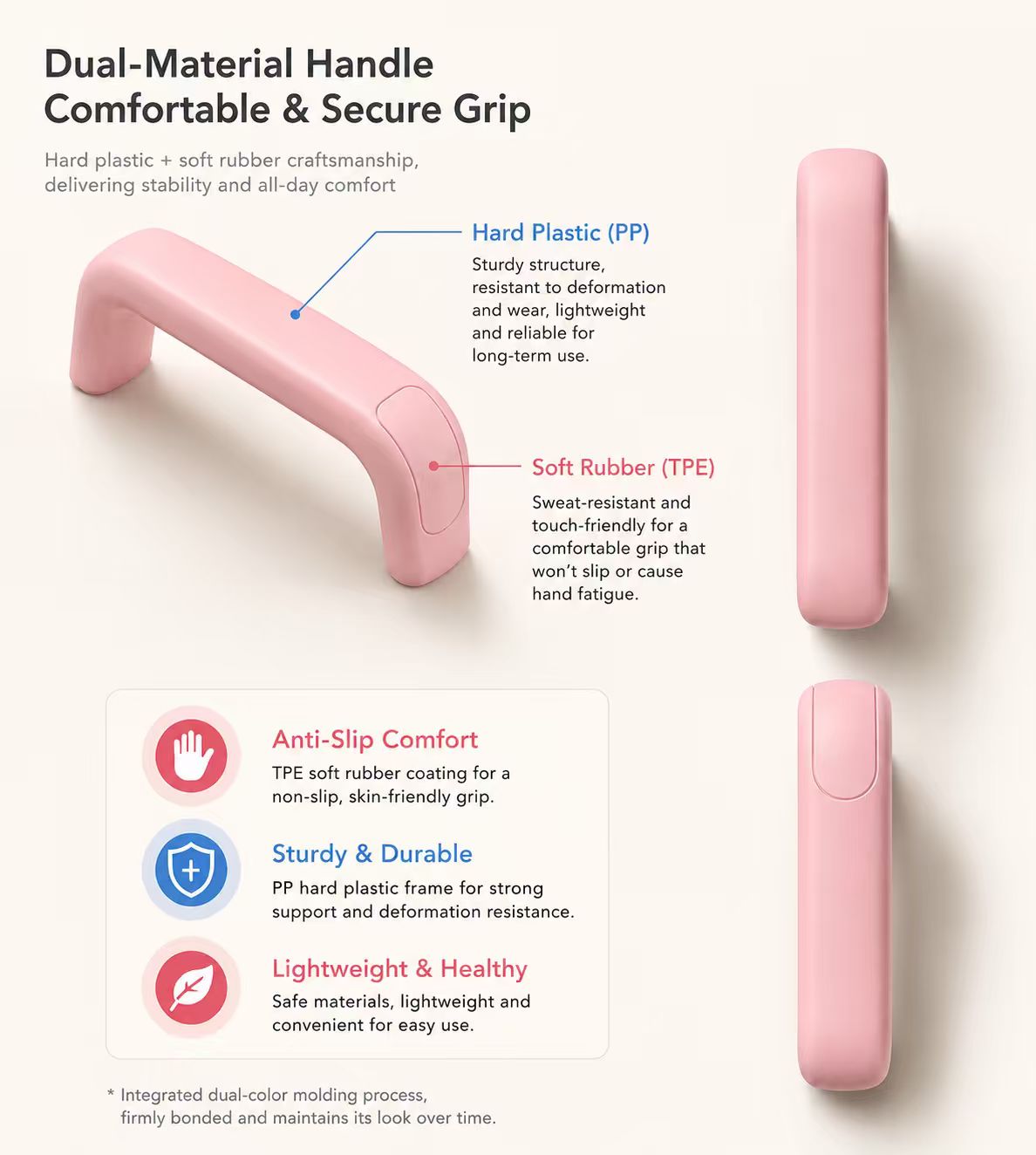
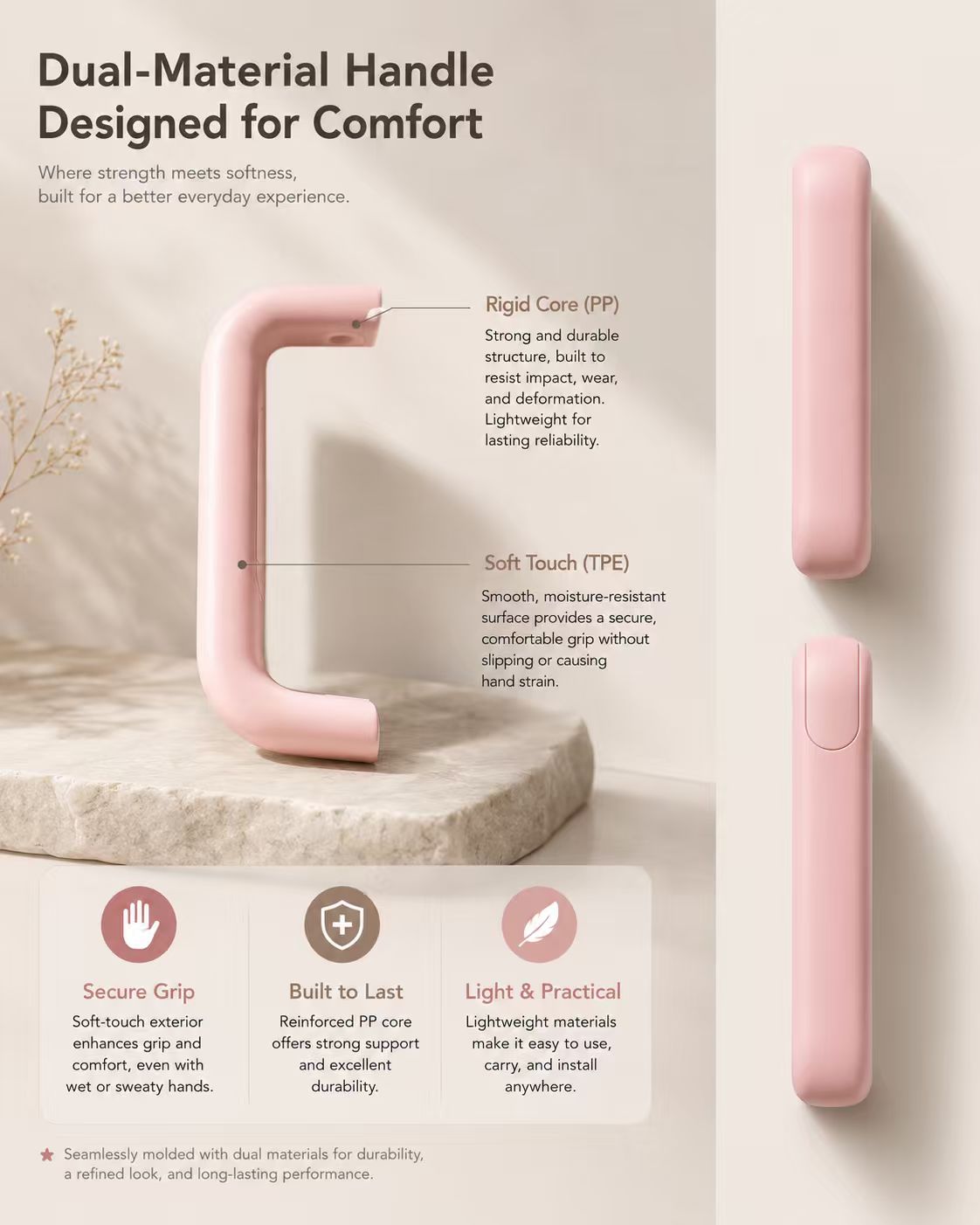
This dual-material cup handle combines a rigid PP load-bearing structure with a localized TPE soft-touch area. The two-material molding process integrates structural support and grip comfort without a separate adhesive assembly step. Maifeng Precision provides product structure review, custom mold development, double-shot injection molding and supporting production for drinkware and daily-use plastic components.
scientific dual-material collocation realizes stable structure and long service life.
TPE soft rubber overmolding optimizes anti-slip performance and ergonomic experience.
integrated two-color molding improves product quality and assembly stability.
A cup handle looks simple until two materials, assembly fit and daily handling all have to work together. The rigid portion must carry the load and hold its shape. The contact area should feel comfortable in the hand. Both materials also need to meet cleanly, without an obvious step, loose insert or secondary bonding operation.
This pink handle uses a rigid PP structure with a soft-touch TPE area. It is produced through a two-material molding process for drinkware and everyday-use products. The design shows why the part structure, material pairing and tooling sequence need to be planned together before mold construction begins.
The handle combines a rigid PP load-bearing structure with a localized TPE soft-touch section.
Why Use PP and TPE in One Handle?
PP gives the handle its basic shape and structural support while keeping the part relatively light. TPE is placed where the user touches or grips the handle, adding a softer surface and more friction than the rigid substrate alone. The two materials do different jobs, so the design should not treat the TPE as decoration applied after the main part is complete.
The interface between PP and TPE needs enough area and suitable geometry for stable retention. Material compatibility, surface texture, local thickness and the flow path of the second material all affect the finished bond. Where necessary, mechanical locking features can be added to support the material interface rather than relying only on adhesion.
The soft-touch area is integrated into the handle design while the rigid core carries the structural load.
Tooling Has to Account for Two Molding Stages
In a two-color or overmolding process, the first shot creates the rigid substrate and the second shot adds the soft material. The tool and transfer method must keep the first component located accurately before the second cavity fills. If the substrate shifts, the soft-touch boundary can become uneven or the second material can flash into areas that should remain clean.
Gate position, venting and shutoff design matter at both stages. The PP shot needs to fill the full handle without creating avoidable deformation. The TPE shot needs to reach the end of its contact area while maintaining a controlled edge around the visible interface. Early DFM review should also check draft, radii, wall transitions and ejection so that the part can leave the mold without marking its gripping surfaces.
Product presentation of the molded PP and TPE handle and its two-material construction.
Shape and Assembly Still Come First
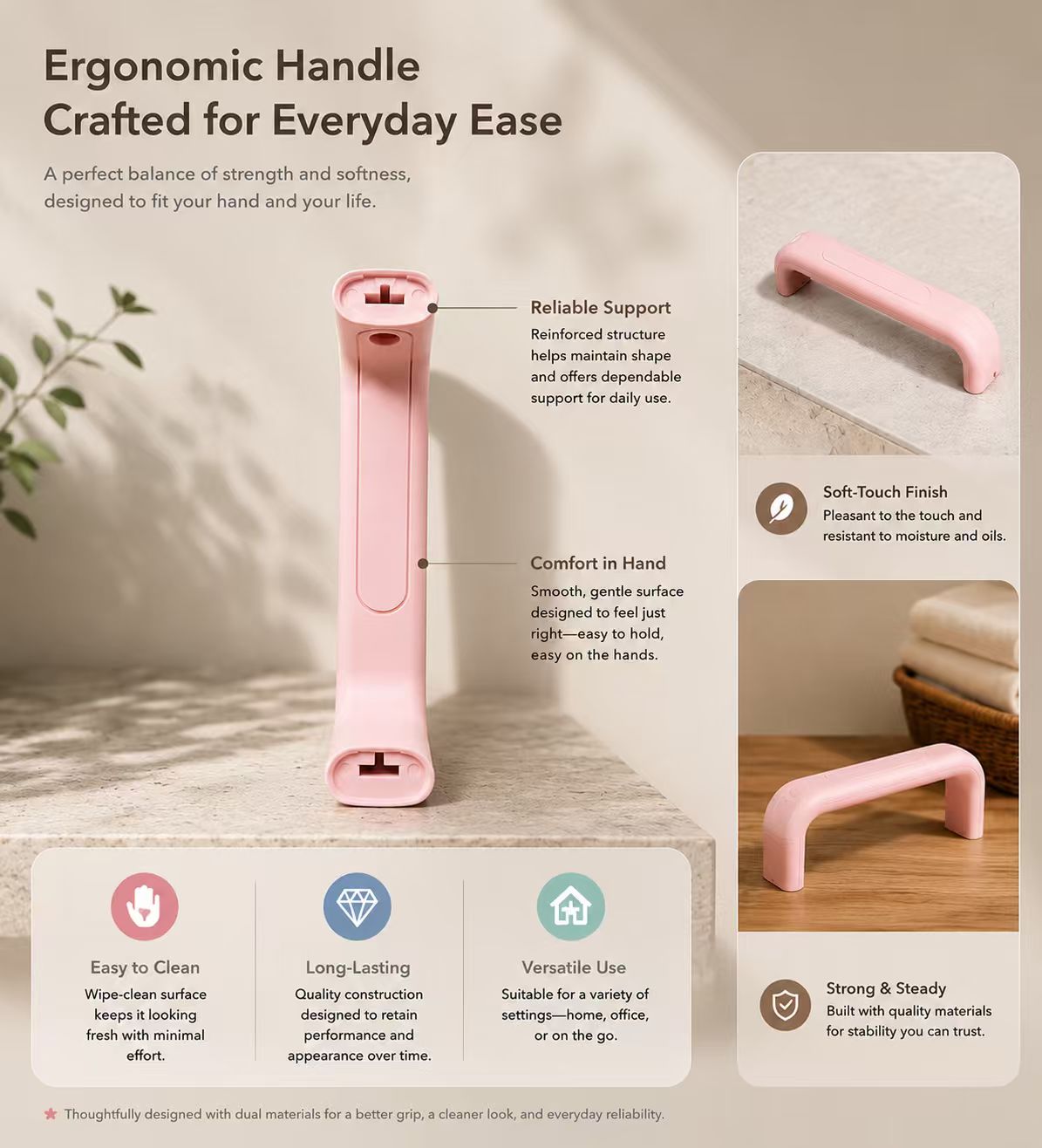
A soft surface cannot correct a weak handle geometry. The mounting ends, internal supports and transition into the curved grip need to carry the expected load before the TPE layer is considered. The part should also locate consistently against the mating cup or bracket so that assembly forces do not twist the handle or concentrate stress at one fastening point.
The images show a smooth outer profile, reinforced mounting ends and a defined soft-touch insert area. These features are reviewed together because a change to the exterior can affect wall thickness, tooling access or the available space for internal support.
The mounting ends, curved grip and soft-touch region must work as one assembly-ready structure.
Coordinating the Handle With the Tumbler Lid
Drinkware programs often include several molded components rather than a single isolated part. A handle, lid, closure, seal carrier and decorative components may use different materials and tooling, but they still share color, fit and appearance requirements. Managing these parts under one development workflow makes it easier to review interfaces and production samples together.
The second video shows an injection molded tumbler lid from the same broader product category. Its geometry, moving features and assembly interfaces are different from the handle, yet the manufacturing questions are familiar: material selection, dimensional control, visible-surface quality and repeatable fit with mating components.
An injection molded tumbler lid illustrating the wider set of components involved in a drinkware program.
What to Confirm Before Starting a Double-Shot Handle Mold
Which areas carry the structural load, and which areas require a soft-touch surface?
Are the selected PP and TPE grades suitable for the intended bonding method?
How will the first-shot substrate be located during the second molding stage?
Where should gates, vents and visible material boundaries be placed?
What assembly dimensions and appearance points need to be checked during trials?
Kunshan Maifeng Precision Industry Co., Ltd. supports product structure review, custom mold design and manufacturing, two-material injection molding and plastic part assembly. Drawings, material requirements, expected volume and mating-part information give the engineering team a practical basis for reviewing a new handle or drinkware component.
Company Profile
About Us
Kunshan Maifeng Precision Industry Co., Ltd. (MIF) has an investment of RMB 35 million and an independent factory of more than 5,000 m². The company operates 36 single- and dual-color injection molding machines from 90 to 700 tons, together with more than 50 sets of mold manufacturing and processing equipment. Our service, management and production team includes over 100 people.
Our parent company was established in 2008. We provide product design, mold design and manufacturing, injection molding and product assembly services for custom plastic parts, supporting both domestic and international customers.
1. Product Design Product structure design and optimization based on customer drawings and samples.
2. Mold Design Mold design developed around product geometry, material and production requirements.
3. Mold Manufacturing Machining, polishing, fitting and assembly for custom injection molds.
4. Injection Molding Single- and dual-color injection molding for project and order requirements.
5. Product Assembly Supporting assembly services for molded plastic components.
Custom glossy black PC protective cover for lawn mowers: an open-ring shell with snap clips molded in one shot and a class-A face that survives stones, sun and cleaning.
Custom PC light-diffusion tail light grille for lawn mowers: an even light band, a ribbed outer face, a sealed fixing flange and an optical surface finished to the agreed polish.
Custom clear PC tail light strip for mowers and outdoor equipment: compound curve, uniform wall, polished optical face and colour matched to your chip.
PC+ABS automotive wireless charging housing with an open coil window, four mounting ears and a stiffening rib, molded, inspected and packed for console assembly.
PC lawn mower tail light grille produced through custom mold development, precision injection molding and strict quality control for demanding outdoor applications.
PP handles and plastic parts for a 3rd generation magnetic wall mounted toilet brush, produced at Maifeng Precision through custom mold design, injection molding and careful inspection.
ABS nasal irrigator outer housing produced with custom multi-cavity molds, precision injection molding, careful trimming and dust-free packaging for personal care brands.
ABS nasal irrigator base produced with custom mold design, precision injection molding, strict inspection and dust-free packaging for personal care and medical device assemblies.
No matter what your automotive needs may be, we’re here to help. Contact us today to learn more about our
services and how we can assist you with all of your needs.
ISO 13485-certified medical injection molding in Class 10,000/100,000 cleanrooms: 36 single and dual-color machines, proven medical cases and trusted partners.
One-stop cup and bottle molding: dual-color lids, tea-separation cups and handles, QS food-contact licensed production with proven cases for global brands.
Contact Us
To grow into a top global mold & injection molding supplier
To grow into a top global mold & injection molding supplier, specializing in differentiated custom parts. We focus on structural development, streamlined production and consistent quality supply.













 English
 Chinese



