Vehicle Interior Transparent Bracket, Injection Fitting Part for Auto Interior
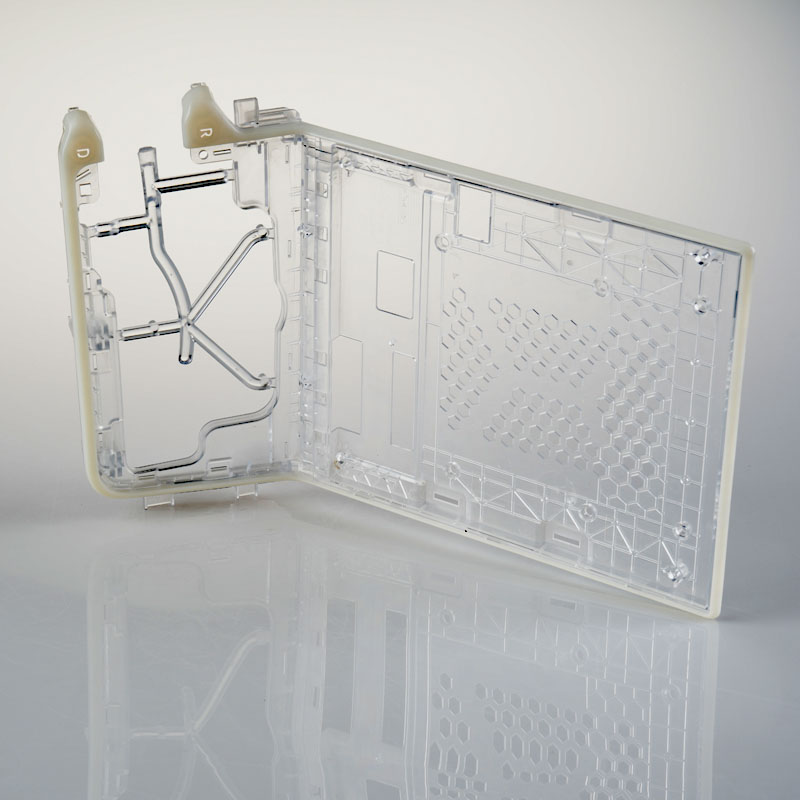
This automotive interior bracket is a folded transparent frame moulded in one shot, with a soft secondary material overmolded around the outer edge. The clear material lets light pass from whatever sits behind the panel, and crossing ribs inside the second panel give stiffness without the thickness that would cloud a clear resin. Positioning buckles are moulded into the same shot, so clip positions hold from lot to lot. We can adjust the fold angle, rib layout, edge material and buckle positions to a customer housing.
clear resin chosen for light transmission and toughness together, not clarity alone
soft overmolded edge hides the parting line and stops squeak against the mating housing
crossing ribs restore stiffness without the wall thickness that would cloud the part
Most brackets inside a car are black and nobody looks at them. This one is clear, and the transparency is doing work rather than decorating the part. Something in the cabin has to be seen or has to be lit through it, and the bracket has to hold that position for the life of the vehicle without rattling, whitening or cracking at the clips.
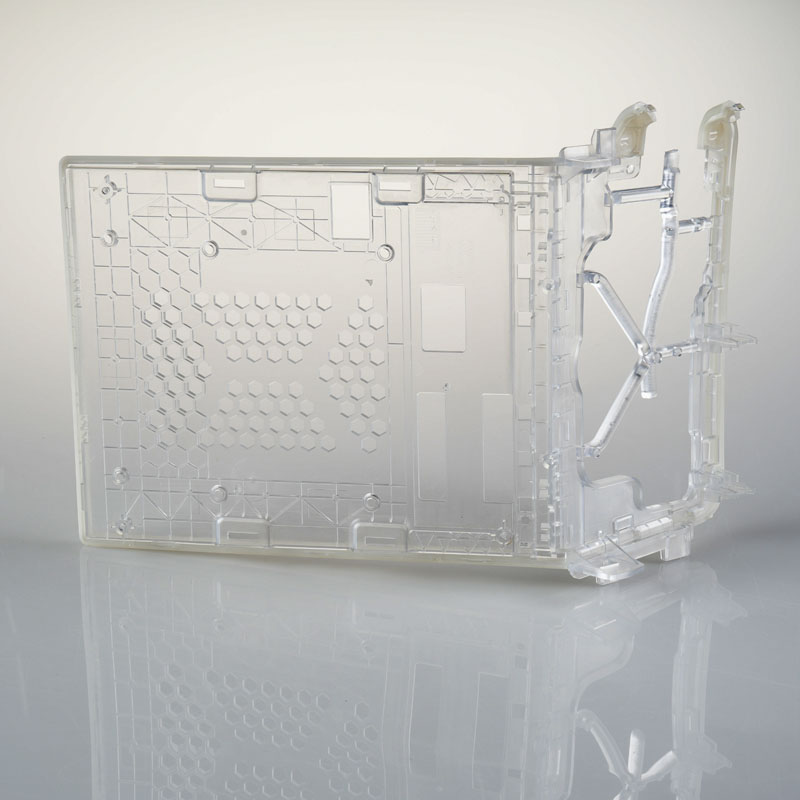
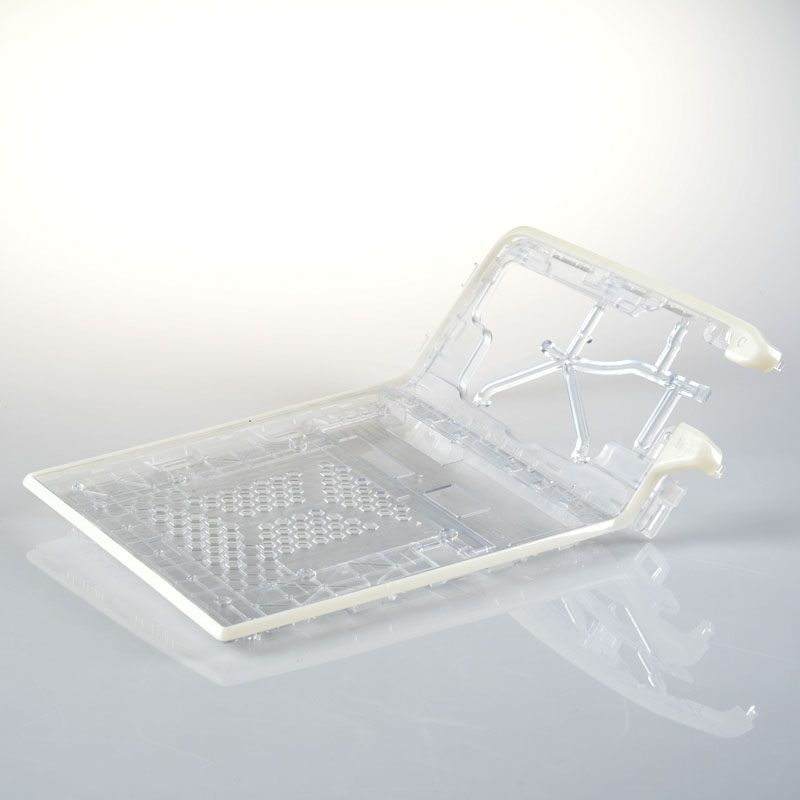
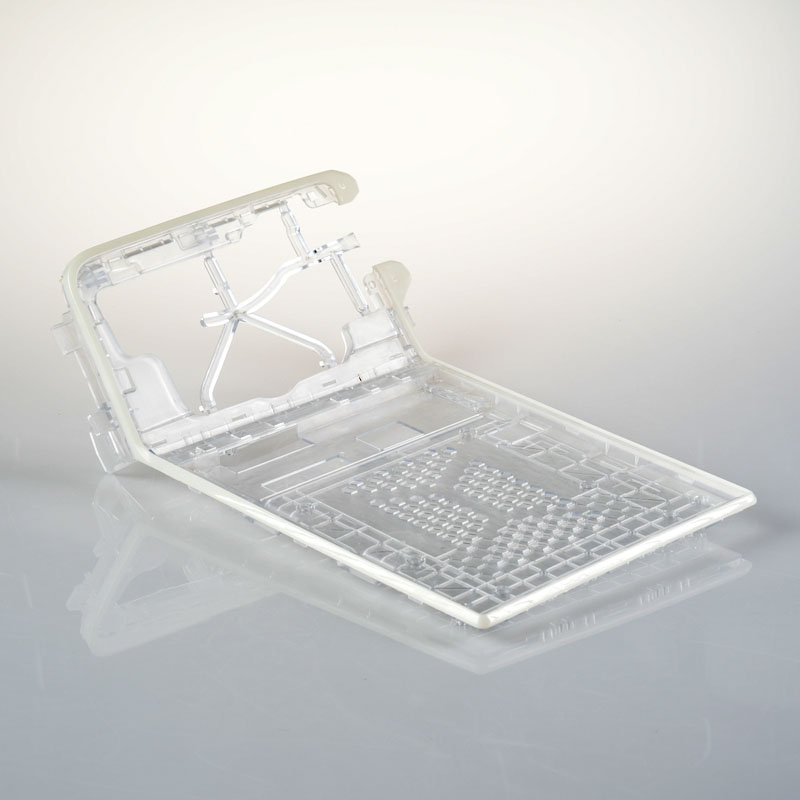
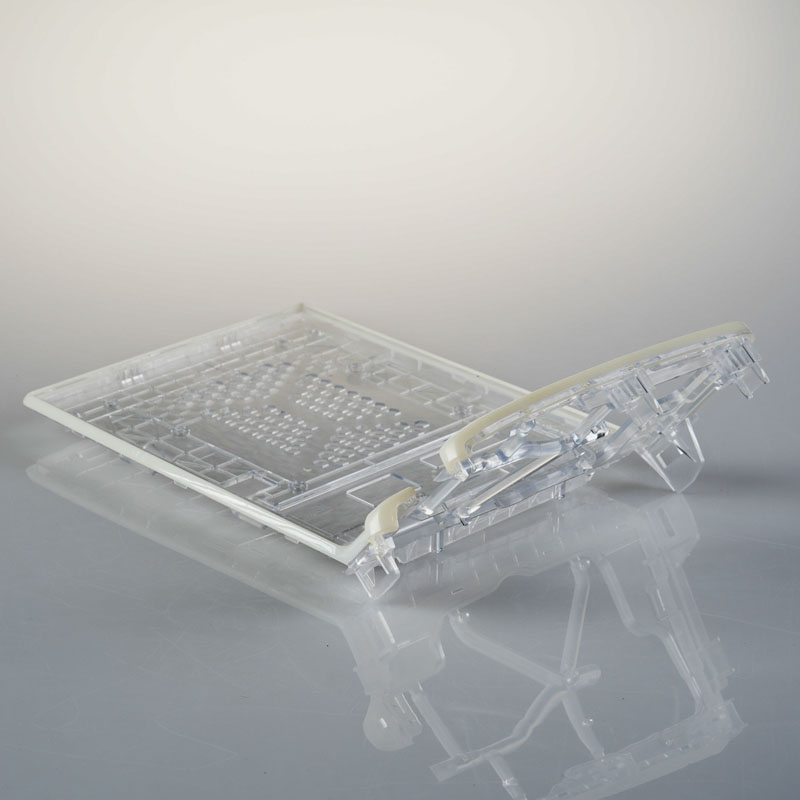
The part is a folded frame: a wide flat panel with a field of small moulded dimples, a second panel set at roughly ninety degrees with crossing ribs inside, and a soft edge running around the outside rim. Everything is moulded in one tool. The photographs show the finished part from five angles, and the white edge in the last two is the overmolded material, not a separate trim piece.
Rear three-quarter view. The dimple field covers the flat panel and the crossing ribs are visible inside the second panel.
Why the Bracket Is Transparent
Clarity buys nothing on a part that only carries load. Here the material has to pass light from whatever sits behind the panel, so haze and streaks become functional defects rather than cosmetic ones. A flow line that would disappear completely in a black ABS part shows up as a visible band the moment a lamp behind the bracket is switched on.
Toughness is the other half of the requirement. Interior parts get knocked during assembly, during service and by the customer, and a brittle clear material cracks at the first clip. The resin has to stay clear and stay tough at the same time, which narrows the choice considerably and also rules out most cheap regrind blends.
The two panels and the angle between them. The fold has to come out of the tool correctly or the bracket will not sit square in the housing.
The Soft Overmolded Edge
The white rim is a second material moulded over the edge of the clear frame. It serves three practical purposes. It hides the parting line, which on a clear part is otherwise visible from every angle. It stops the hard plastic edge from squeaking against the housing it clips into. And it takes the small scratches that an edge would otherwise pick up during assembly, which on a clear part are far more noticeable than on a black one.
Getting the two materials to stay together is the interesting part of the tooling. The soft material needs enough overlap area and the right geometry to lock on mechanically, otherwise it lifts or peels back after a few thermal cycles in a hot car. Where the geometry does not give enough bite, small locking features are added so the joint does not depend on adhesion alone.
Front view, standing. The white rim follows the whole outer edge in one continuous run.
Ribs and Buckles Carry the Load
The crossing ribs inside the second panel are there because a thin clear panel cannot be made thick enough to be rigid on its own. Thickening it would slow the cycle, add weight and, worse, make the panel read cloudy because clear resins lose clarity as thickness rises. Ribs give the stiffness back without the thickness penalty, and they sit on the side that is not seen.
The positioning buckles moulded into the panel are what the assembly actually hangs on. Their positions come out of the same tool as the optical surfaces, so they hold from shot to shot. On an assembly line that matters more than it sounds: a bracket whose clips drift by a fraction of a millimetre between lots turns into an intermittent fit problem that is expensive to trace.
Rear view. The crossing ribs and the buckle features are all on the non-appearance side.
What Gets Checked on This Part
Clip and buckle positions come off the dimensional report first, because that is where an assembly fit problem starts. The folded angle is checked against the housing, not against the drawing alone. The overmolded edge is pulled and flexed to confirm the two materials have bonded rather than just sat next to each other. Haze and transmission are measured on a sample from the lot, and a light-transmission check against a reference part catches streaks and flow lines that a measurement alone will miss.
Information to Confirm Before Starting a Transparent Bracket Project
The housing or mating part drawing, so the fold angle, clip positions and edge run can be checked against real geometry.
Clear resin preference and any automotive material approval the program carries, including low-haze requirements.
Soft edge material and hardness, plus whether the edge runs continuously or stops at defined points.
Which surfaces are appearance surfaces and what the allowable parting line and gate positions are.
Annual volume and expected program life, which drive the cavity count and the tooling budget.
Kunshan Maifeng Precision Industry Co., Ltd. reviews bracket and interior part designs before quoting, builds the injection molds in house, and moulds single-color and dual-color parts on 36 machines from 90 to 700 tons. Send us the housing drawing and the material specification, and we will come back with a feasibility comment and a tooling proposal.
Company Profile
About Us
Kunshan Maifeng Precision Industry Co., Ltd. (MIF) has an investment of RMB 35 million and an independent factory of more than 5,000 m². The company operates 36 single- and dual-color injection molding machines from 90 to 700 tons, together with more than 50 sets of mold manufacturing and processing equipment. Our service, management and production team includes over 100 people.
Our parent company was established in 2008. We provide product design, mold design and manufacturing, injection molding and product assembly services for custom plastic parts, supporting both domestic and international customers.
1. Product Design Product structure design and optimization based on customer drawings and samples.
2. Mold Design Mold design developed around product geometry, material and production requirements.
3. Mold Manufacturing Machining, polishing, fitting and assembly for custom injection molds.
4. Injection Molding Single- and dual-color injection molding for project and order requirements.
5. Product Assembly Supporting assembly services for molded plastic components.
Custom glossy black PC protective cover for lawn mowers: an open-ring shell with snap clips molded in one shot and a class-A face that survives stones, sun and cleaning.
Custom PC light-diffusion tail light grille for lawn mowers: an even light band, a ribbed outer face, a sealed fixing flange and an optical surface finished to the agreed polish.
Custom clear PC tail light strip for mowers and outdoor equipment: compound curve, uniform wall, polished optical face and colour matched to your chip.
PC+ABS automotive wireless charging housing with an open coil window, four mounting ears and a stiffening rib, molded, inspected and packed for console assembly.
PC lawn mower tail light grille produced through custom mold development, precision injection molding and strict quality control for demanding outdoor applications.
PP handles and plastic parts for a 3rd generation magnetic wall mounted toilet brush, produced at Maifeng Precision through custom mold design, injection molding and careful inspection.
ABS nasal irrigator outer housing produced with custom multi-cavity molds, precision injection molding, careful trimming and dust-free packaging for personal care brands.
ABS nasal irrigator base produced with custom mold design, precision injection molding, strict inspection and dust-free packaging for personal care and medical device assemblies.
No matter what your automotive needs may be, we’re here to help. Contact us today to learn more about our
services and how we can assist you with all of your needs.
ISO 13485-certified medical injection molding in Class 10,000/100,000 cleanrooms: 36 single and dual-color machines, proven medical cases and trusted partners.
One-stop cup and bottle molding: dual-color lids, tea-separation cups and handles, QS food-contact licensed production with proven cases for global brands.
Contact Us
To grow into a top global mold & injection molding supplier
To grow into a top global mold & injection molding supplier, specializing in differentiated custom parts. We focus on structural development, streamlined production and consistent quality supply.












 English
 Chinese



