Water Bottle Replacement Insert Strainer with Inner & Outer Threads
This replacement strainer insert for sports bottles carries internal and external threads on the same moulded skirt, so the fitting below and the lid above both screw to it. The perforated screen across the base is moulded in place rather than welded, with holes laid out in groups so the melt feeds evenly and flow through the screen stays uniform. Two moulded spring buttons on the rim snap into recesses in the bottle neck and stop the insert spinning when the lid is tightened. The smoky tint hides stains between washes, and the resin is specified for hot liquid and dishwasher use. Thread forms, hole pattern and button geometry are built to the customer bottle neck.
internal and external threads formed on one skirt, both moulded rather than cut
moulded screen cannot delaminate like a welded mesh, with even flow hole group layout
spring buttons lock the insert against spin when the lid above is tightened
A strainer insert looks like the simplest part on a bottle and is quietly one of the pickiest. It screws into the neck from inside, another lid screws onto its external thread from above, and both threads are on the same moulded wall. The perforated screen has to hold leaves and tea back while letting liquid through fast, and the whole thing has to come out of the tool with the threads intact, because threads do not forgive flash.
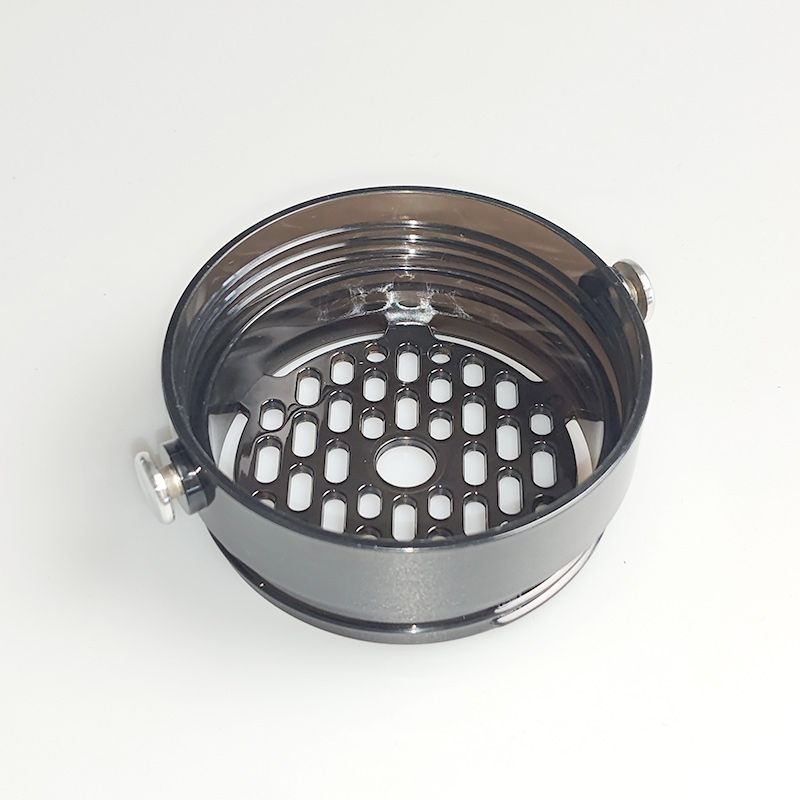
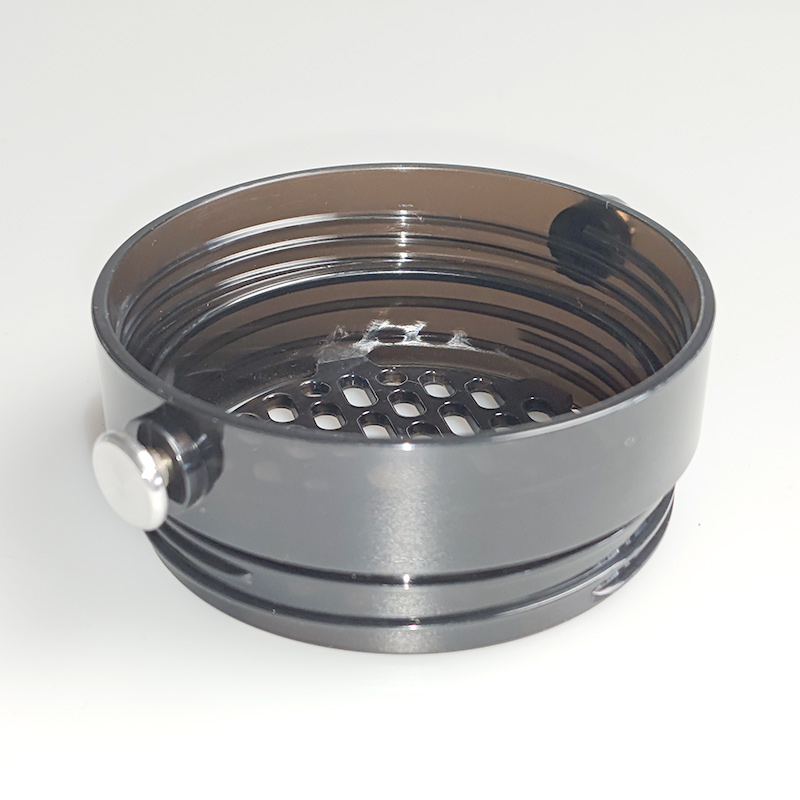
The part shown here is a replacement strainer insert in smoky-translucent plastic, with internal and external threads on the same skirt, a perforated screen moulded across the base, and two sliding buttons on the rim that locate it in the bottle.
The insert seen from above. The screen covers the base, and the two buttons on the rim lock it into the bottle neck.
Two Threads on One Wall
Carrying internal and external threads on the same skirt is the defining constraint of this part. The internal thread accepts the fitting below; the external thread takes the lid above. Both need full form to seal and to carry the tightening torque, and both are formed by the tool rather than cut afterwards.
Threads need a way out of the mould. The external thread releases with a simple split. The internal one is the problem: a rigid core cannot simply be pulled through a threaded bore. The usual answers are an unscrewing mechanism, a collapsible core, or a thread form shallow enough to jump off. Which one is used changes the tool cost and the cycle time, and it is decided before steel is cut, not after the first trial.
The external thread runs the full skirt height. The side buttons are moulded spring features that snap into the bottle neck.
Moulding the Perforated Screen
The screen is a dense field of moulded holes rather than a separate mesh welded in. That choice shows up everywhere. A moulded screen cannot delaminate or come loose the way a welded mesh can, its holes are consistent from part to part, and it survives dishwashers. The cost is in the tool: hundreds of small pins, each one a potential hang-up on ejection or a burr that blocks a hole.
Hole layout is set by flow as much as by filtration. Holes packed too densely starve the melt between them and leave the last-formed region short; laid out in a pattern with feeding channels between groups, the screen fills cleanly and the flow rate through it stays even. On a tea strainer the difference is visible the first time it is used: an even screen drains, an uneven one pools.
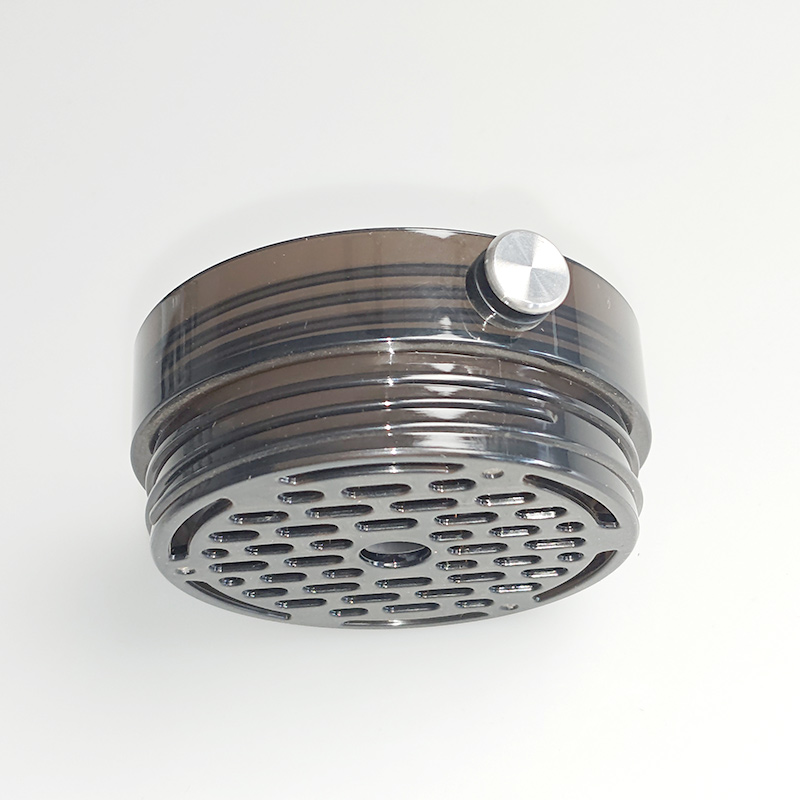
Base view of the moulded screen. The holes are laid out in groups so the melt feeds evenly between them.
The Side Buttons
The two moulded buttons on the rim are locating features, not decoration. They press outward against the inside of the bottle neck and snap into corresponding recesses, which keeps the insert from spinning when the lid above is tightened. Without them, tightening the lid would simply spin the strainer, and the internal fitting below would unwind with it.
They are moulded as spring features: shaped so they deflect inward on assembly and recover once past the recess. The force balance matters. Too stiff and the insert is hard to seat; too soft and it spins under torque anyway. The geometry comes from the bottle neck drawing, which is why we ask for it rather than sizing the buttons from the insert alone.
Smoky-Translucent Resin
The tint hides tea stains and scale between washes, which is why these inserts rarely mould in water-clear material. The resin still has to be food-contact rated for the destination market and able to take repeated hot liquid and dishwasher exposure without cracking around the thin screen holes, which is where a part like this usually fails first if the material is wrong.
What Gets Checked Before Shipping
Thread form, gauged with the actual mating fitting and lid rather than a ring gauge alone. Screen hole quality under magnification, looking for burrs and blocked holes. Button snap force and resistance to spin under tightening torque. Flow rate through the screen on a sample, since a strainer that drains slowly gets blamed on the tea.
Information to Confirm Before Starting a Strainer Insert Project
The bottle neck drawing, including the recesses the side buttons locate into.
Thread specifications above and below, with the mating fittings if they are not our own parts.
Hole diameter and open-area target for the screen, matched to what the user strains through it.
Resin and tint specification, plus food-contact and dishwasher requirements for the destination market.
Annual volumes, which decide whether the internal thread justifies an unscrewing tool or a jump-off form.
Kunshan Maifeng Precision Industry Co., Ltd. reviews drinkware part designs before quoting, builds the injection molds in house, and molds single-color and dual-color parts on 36 machines from 90 to 700 tons. Send us the bottle neck drawing and the thread specification, and we will come back with a feasibility comment and a tooling proposal.
Company Profile
About Us
Kunshan Maifeng Precision Industry Co., Ltd. (MIF) has an investment of RMB 35 million and an independent factory of more than 5,000 m². The company operates 36 single- and dual-color injection molding machines from 90 to 700 tons, together with more than 50 sets of mold manufacturing and processing equipment. Our service, management and production team includes over 100 people.
Our parent company was established in 2008. We provide product design, mold design and manufacturing, injection molding and product assembly services for custom plastic parts, supporting both domestic and international customers.
1. Product Design Product structure design and optimization based on customer drawings and samples.
2. Mold Design Mold design developed around product geometry, material and production requirements.
3. Mold Manufacturing Machining, polishing, fitting and assembly for custom injection molds.
4. Injection Molding Single- and dual-color injection molding for project and order requirements.
5. Product Assembly Supporting assembly services for molded plastic components.
Custom glossy black PC protective cover for lawn mowers: an open-ring shell with snap clips molded in one shot and a class-A face that survives stones, sun and cleaning.
Custom PC light-diffusion tail light grille for lawn mowers: an even light band, a ribbed outer face, a sealed fixing flange and an optical surface finished to the agreed polish.
Custom clear PC tail light strip for mowers and outdoor equipment: compound curve, uniform wall, polished optical face and colour matched to your chip.
PC+ABS automotive wireless charging housing with an open coil window, four mounting ears and a stiffening rib, molded, inspected and packed for console assembly.
PC lawn mower tail light grille produced through custom mold development, precision injection molding and strict quality control for demanding outdoor applications.
PP handles and plastic parts for a 3rd generation magnetic wall mounted toilet brush, produced at Maifeng Precision through custom mold design, injection molding and careful inspection.
ABS nasal irrigator outer housing produced with custom multi-cavity molds, precision injection molding, careful trimming and dust-free packaging for personal care brands.
ABS nasal irrigator base produced with custom mold design, precision injection molding, strict inspection and dust-free packaging for personal care and medical device assemblies.
No matter what your automotive needs may be, we’re here to help. Contact us today to learn more about our
services and how we can assist you with all of your needs.
ISO 13485-certified medical injection molding in Class 10,000/100,000 cleanrooms: 36 single and dual-color machines, proven medical cases and trusted partners.
One-stop cup and bottle molding: dual-color lids, tea-separation cups and handles, QS food-contact licensed production with proven cases for global brands.
Contact Us
To grow into a top global mold & injection molding supplier
To grow into a top global mold & injection molding supplier, specializing in differentiated custom parts. We focus on structural development, streamlined production and consistent quality supply.












 English
 Chinese



