
Nullam dignissim, ante scelerisque the is euismod fermentum odio sem semper the is erat, a feugiat leo urna eget eros. Duis Aenean a imperdiet risus.
Nullam dignissim, ante scelerisque the is euismod fermentum odio sem semper the is erat, a feugiat leo urna eget eros. Duis Aenean a imperdiet risus.
 Maifeng Precision Team
For an ultrasonic surgical instrument handle, the plastic enclosure is more than an outer cover. It has to hold internal components in position, provide a comfortable gripping surface and bring two molded halves together without obvious mismatch. Those requirements make the housing a useful example of how product design, mold design and injection molding have to be considered as one connected process.
The handle shell shown here was developed and molded by Kunshan Maifeng Precision Industry Co., Ltd. The supplied material specification is PC with 10% fiber reinforcement. The component has a curved grip, a broad upper enclosure and a detailed internal structure with ribs, bosses, slots and locating features.
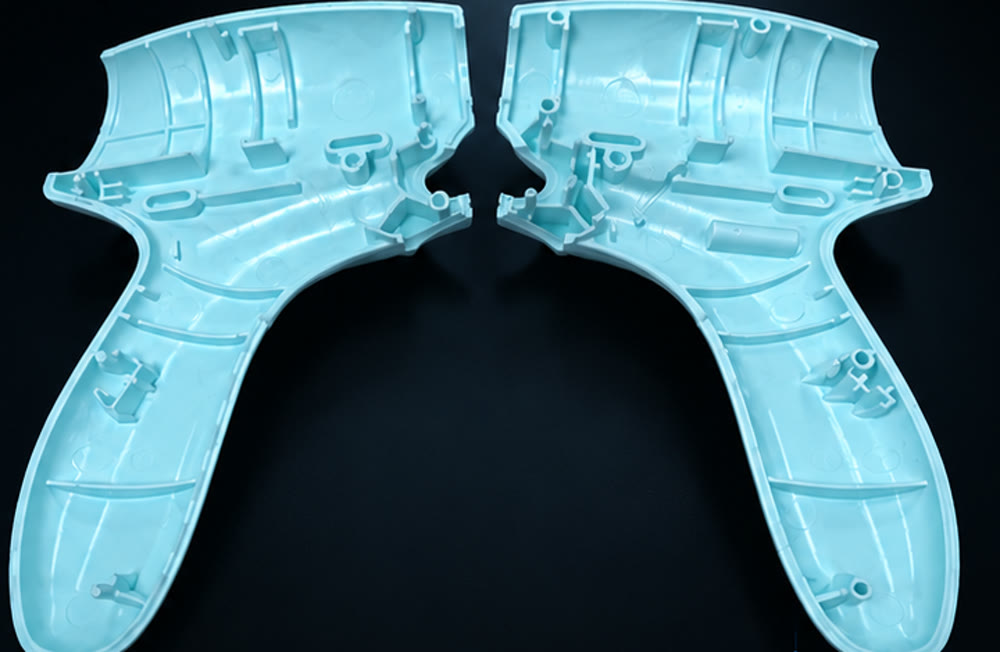
The exterior gives the handle its grip and visual profile, but most molding decisions are driven by what is inside. The two halves need enough space for the functional assembly while keeping the wall structure practical for molding. Bosses and ribs must support fastening and positioning without creating unnecessary material concentration on the visible surface.
For this type of enclosure, design review should look closely at wall transitions, rib thickness, boss support, screw locations, assembly clearance and the parting line. These details affect filling, cooling, ejection and the way the two halves meet after molding. A feature that looks minor in a CAD model can become a recurring assembly or appearance issue if it is not resolved before tooling.
Fiber-reinforced PC is selected when the design needs more rigidity and dimensional stability than an unreinforced grade may provide. The reinforcement also changes how the melt flows and how the part responds during cooling. Gate location, flow direction, venting and local wall thickness therefore need to be reviewed together.
The material does not remove the need for balanced geometry. Sharp thickness changes can still contribute to sink, stress concentration or uneven cooling. Long flow paths around a curved handle can also produce different fiber orientation from one region to another. Mold trials are used to assess filling behavior, surface appearance, deformation and assembly fit before the process is finalized.
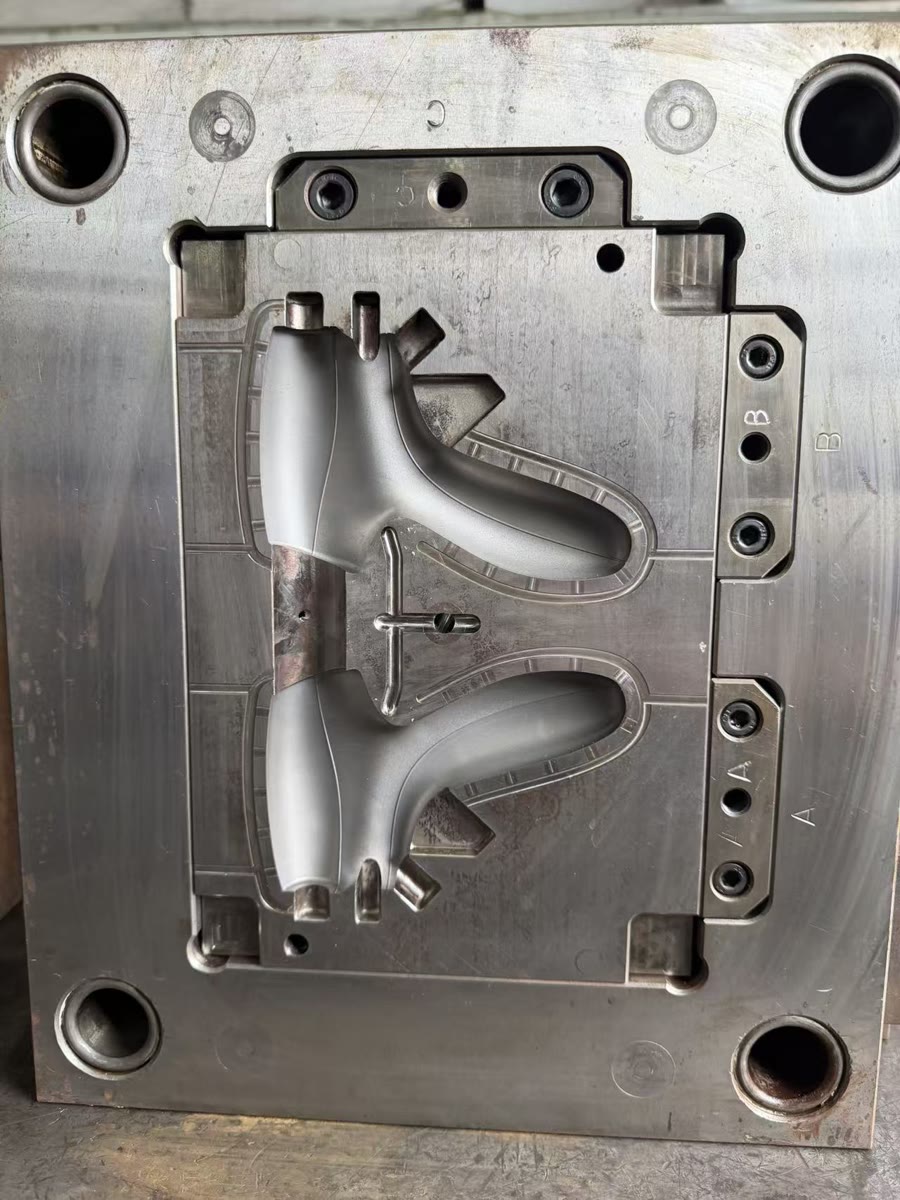
The cavity side forms the visible outer surfaces of the enclosure. Its finish and transitions influence the appearance of the molded handle, so polishing, parting-line control and consistent cavity condition matter. The photograph below also shows how both shell halves are arranged within one mold set.
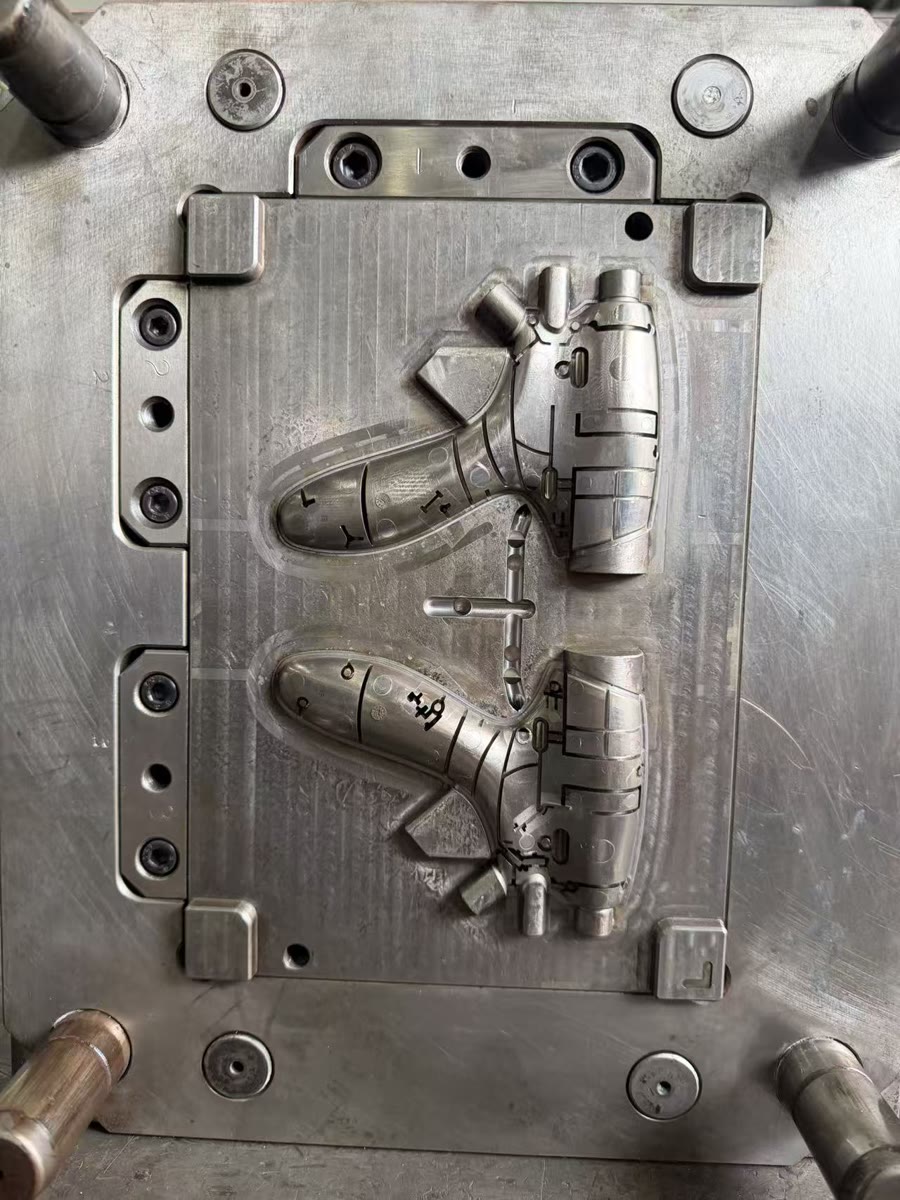
The core side carries much of the internal geometry. Ribs, bosses and recesses create more complex steel conditions than the outside surface suggests. Tool access, steel strength, cooling paths and ejection positions all need to be considered so that the part can release without damaging its functional features.
A first molded sample is not the end of the job. The two shell halves are checked together because their fit depends on the combined effect of cavity dimensions, shrinkage, warpage and process conditions. Visual surfaces, parting lines, internal features and fastening locations are reviewed alongside actual assembly behavior.
During process development, the molding team establishes a stable window for filling, packing, cooling and ejection. Any adjustment should be evaluated against the whole part rather than a single dimension. For a reinforced material and a curved enclosure, this disciplined approach helps keep appearance and assembly behavior consistent from trial parts into production.
Answering these questions early reduces late tool changes and gives the molding team a clearer route to a stable process. Maifeng Precision supports product review, mold design and manufacturing, injection molding and assembly for custom plastic components. For a new handle enclosure project, drawings, material requirements, annual volume and assembly information are useful starting points for a technical review.
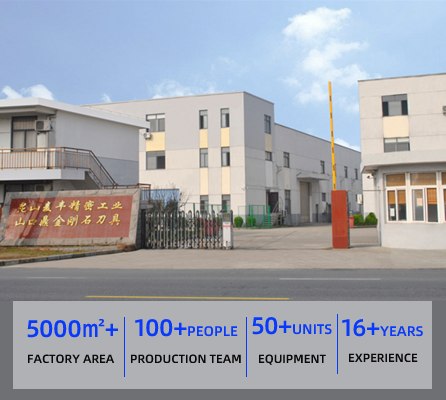
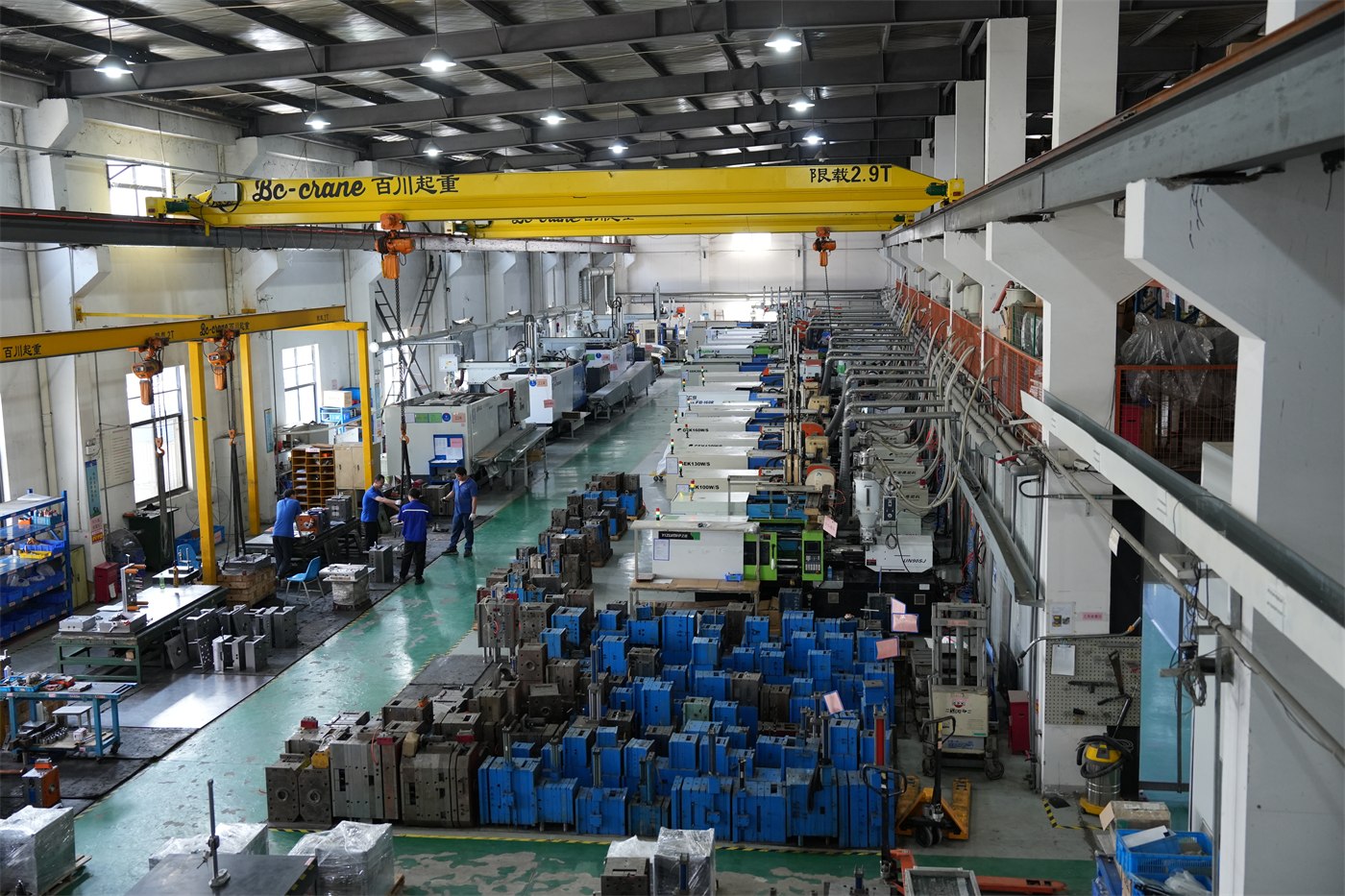
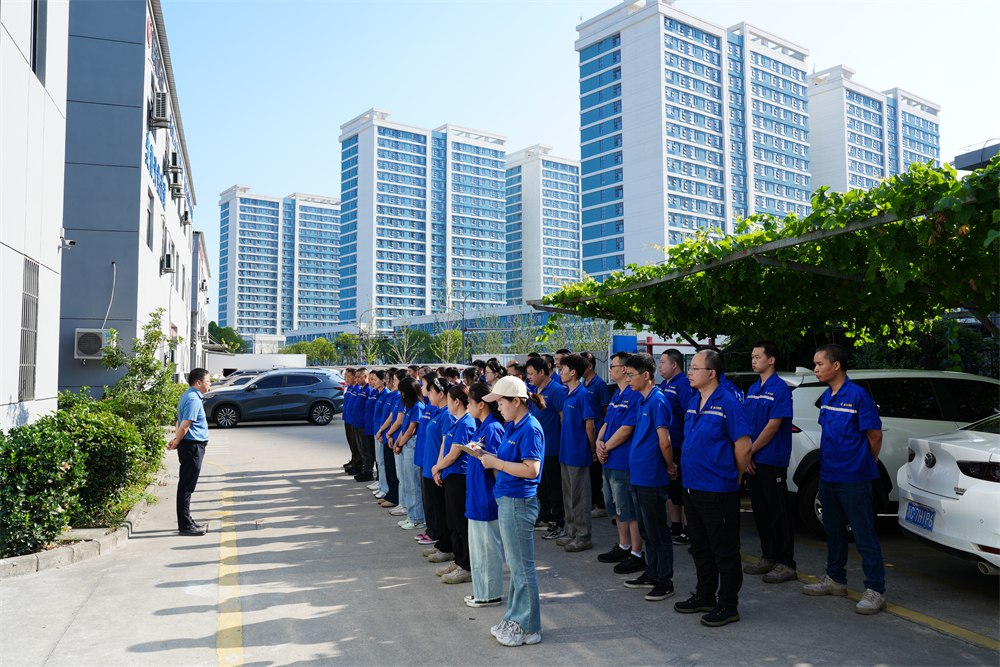
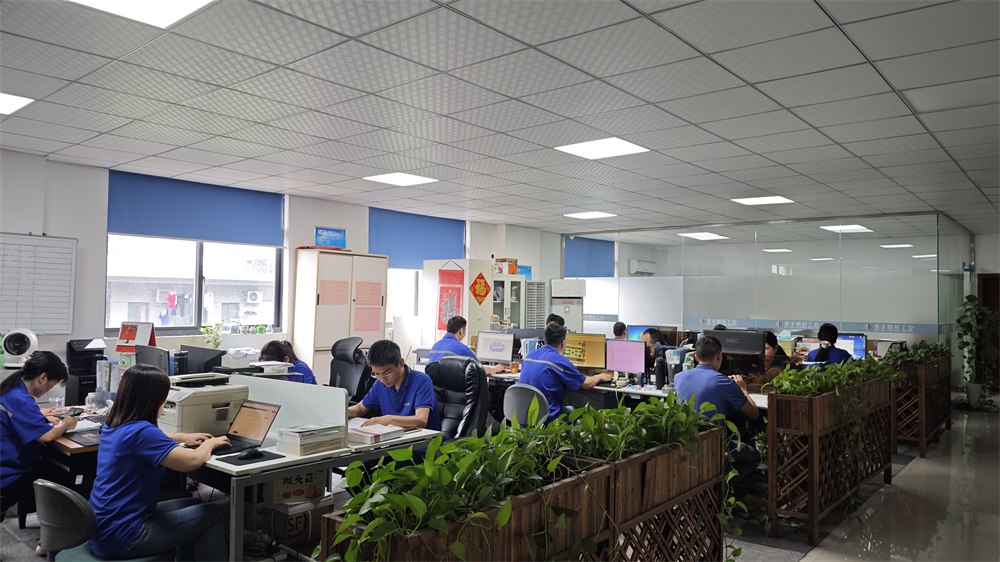
Kunshan Maifeng Precision Industry Co., Ltd. (MIF) has an investment of RMB 35 million and an independent factory of more than 5,000 m². The company operates 36 single- and dual-color injection molding machines from 90 to 700 tons, together with more than 50 sets of mold manufacturing and processing equipment. Our service, management and production team includes over 100 people.
Our parent company was established in 2008. We provide product design, mold design and manufacturing, injection molding and product assembly services for custom plastic parts, supporting both domestic and international customers.
1. Product Design
Product structure design and optimization based on customer drawings and samples.
2. Mold Design
Mold design developed around product geometry, material and production requirements.
3. Mold Manufacturing
Machining, polishing, fitting and assembly for custom injection molds.
4. Injection Molding
Single- and dual-color injection molding for project and order requirements.
5. Product Assembly
Supporting assembly services for molded plastic components.





 Chinese
  English