Spherical Small Home Appliance Plastic Housing, White Precision Injection Molded Enclosure
This spherical housing for a smart learning machine is moulded as a single piece in a white gloss resin. The speaker grille is a field of small moulded holes rather than a printed pattern, the display cutout and sensor aperture are formed in the same shot, and the connector openings at the rear clear the plugs used on the finished device. Positioning posts and buckles sit on the inside where they cannot be seen. We can adjust the cutout layout, grille pattern, surface texture and colour to a customer design.
spherical body moulded in one piece with the parting line controlled on a curved gloss surface
speaker grille and cutouts moulded rather than printed, so hole edges stay clean in use
internal posts and buckles formed in the same shot, keeping assembly positions repeatable
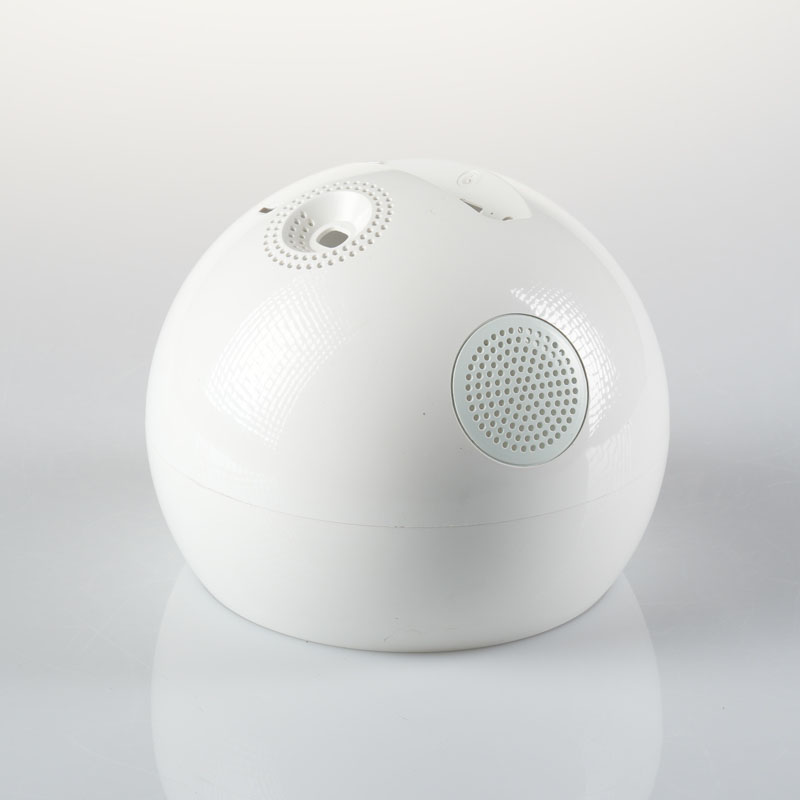
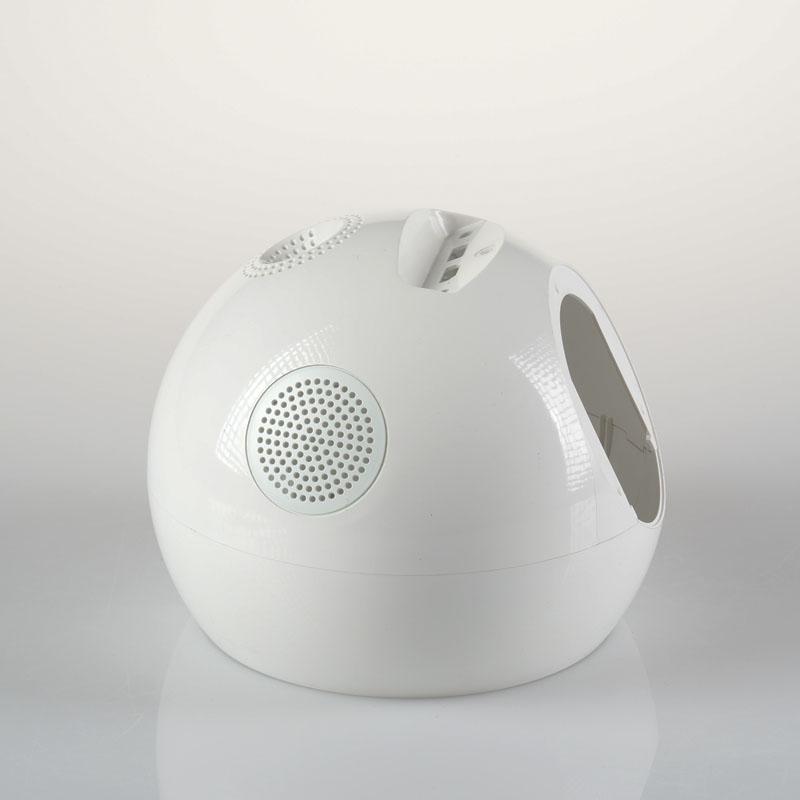
A spherical housing looks friendly on a shelf and is awkward on a moulding bench. There is no natural flat face to eject from, no obvious place for a gate, and every visible surface is an appearance surface because the eye travels all the way round. The white enclosure shown here is a housing for a children’s learning device, and the photographs cover it from six directions including the open front and the connector panel at the back.
The part is moulded as a single piece. The speaker grille, the display cutout, the sensor aperture and the connector openings are all formed in the same shot, and the posts and buckles that hold the internals are moulded on the inside where they cannot be seen. Nothing is glued or screwed on from the outside.
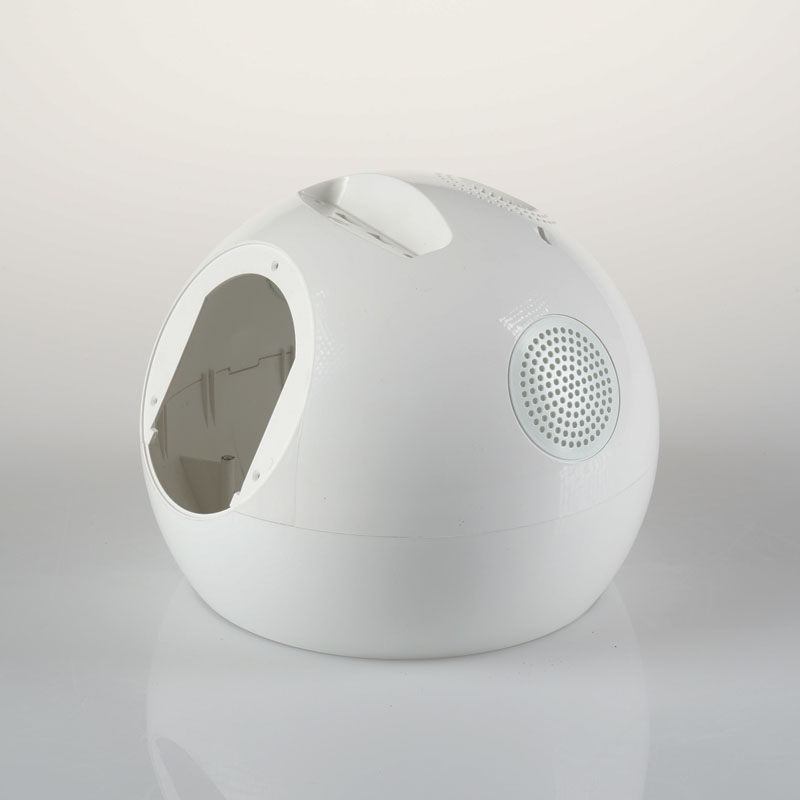
Three-quarter view of the housing, with the speaker grille on the flank and the display cutout facing forward.
Moulding a Sphere
A round body has to split into two halves at the parting line, and on this part the split runs around the middle where the eye naturally falls. That makes the parting line quality worth more attention than it would get on a box-shaped enclosure. Any flash or mismatch shows up as a visible seam on a curved, glossy surface, where the same defect on a flat side wall would hardly register.
Draft is the other constraint. A sphere has no vertical walls to speak of, so the tool has to be built so the part releases cleanly without scuffing the gloss. Ejection is placed where the marks cannot be seen, and the cooling has to be even enough that the two halves shrink the same amount, otherwise the assembled housing comes out oval rather than round.
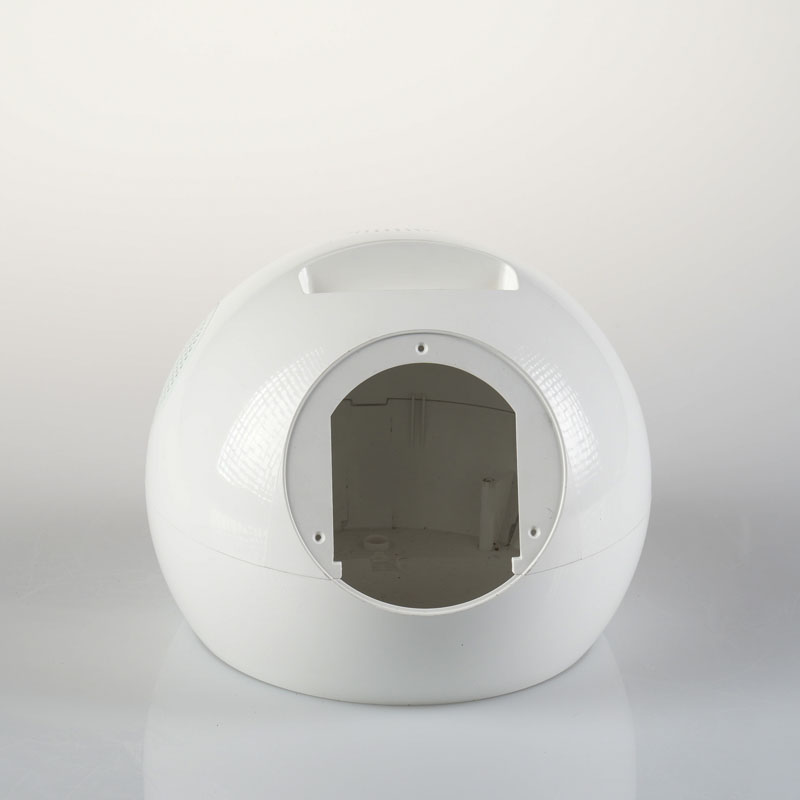
The front cutout. Internal posts and buckles are visible inside, moulded in the same shot as the outer shell.
Speaker Grille and Functional Cutouts
The circular grille is a dense field of small holes rather than a printed pattern. Moulding hundreds of tiny holes in a curved wall puts a lot of small pins into the tool, and every one of those pins is a place where the part can hang up on ejection or pick up a burr. The hole edges need to come out clean, because a child’s finger runs over that surface constantly.
The cutouts follow the same logic with different tolerances. The display opening has to accept a screen module with a defined gap all round. The sensor aperture has to line up with the component behind it. The connector openings at the back have to clear the plugs that get pushed into them, which on a used device happens thousands of times.
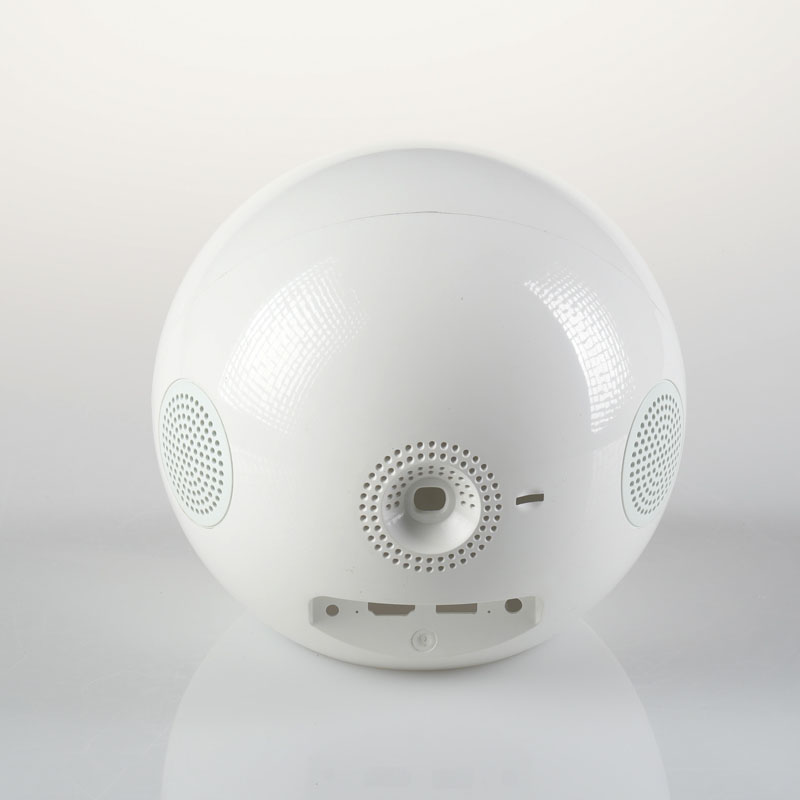
The connector panel at the back, with the sensor aperture above it and the grille on both flanks.
Gloss, Texture and Wall Thickness
The surface is gloss with a very fine texture visible in the reflections. A polished cavity gives the gloss; the texture is what stops the housing looking like a plain plastic ball and helps hide the handling marks that a children’s product collects. Both come from the steel, so the cavity finish has to be right before the first shot, and it has to be maintained, because a polished surface degrades over a production run.
Wall thickness on a curved body is a compromise. Thin walls mould faster and resist sink, but the housing has to survive being dropped on a floor. Ribs and bosses inside do the stiffening where they can, and the thickness is kept uniform as far as the shape allows, because a thick region behind a thin one will sink and leave a visible dimple on a gloss surface.
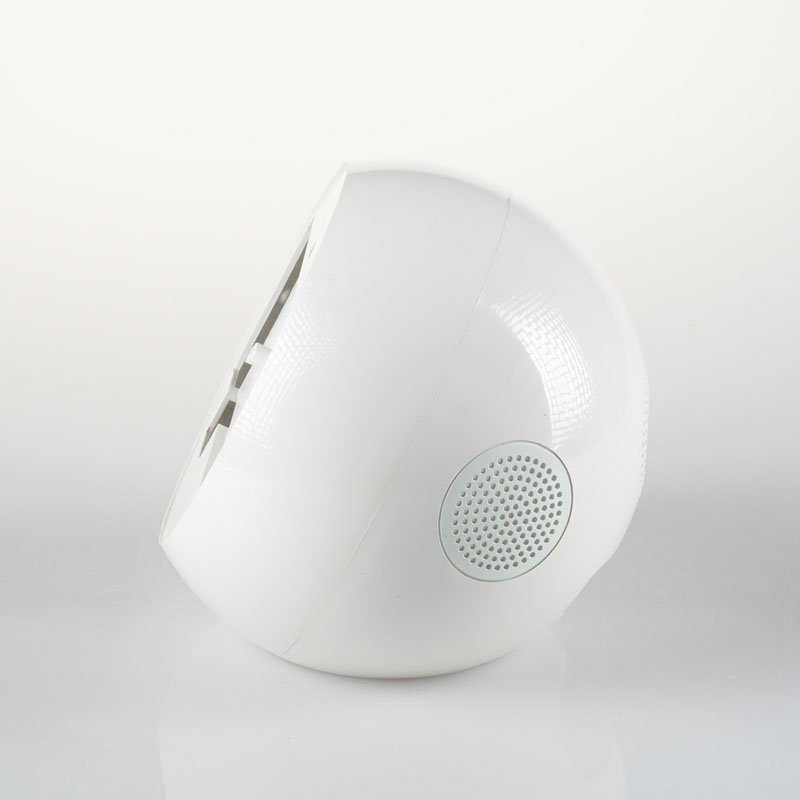
The gloss surface with its fine moulded texture. The grille holes are moulded, not drilled, and the edges come out clean.
What Gets Checked Before the Parts Ship
Roundness and the parting line seam, checked against a reference sample. Grille hole quality, looked at under magnification for burrs. Fit of the screen module and the rear panel, using the actual mating parts rather than a gauge alone. Drop and flex testing on the housing where the customer specification calls for it, and a colour check against the approved master to keep re-orders matching.
Information to Confirm Before Starting a Spherical Housing Project
Internal layout of the screen, speaker, sensor and battery, since that decides the cutouts and the post positions.
Resin choice and any child-product material or safety requirement that applies in the destination market.
Gloss and texture specification, ideally with an approved master sample to match against.
Colour and colour-matching tolerance, and whether the housing runs in more than one colour.
Expected annual volume, which drives the cavity count and how much tooling investment makes sense.
Kunshan Maifeng Precision Industry Co., Ltd. reviews enclosure designs before quoting, builds the injection molds in house, and moulds single-color and dual-color parts on 36 machines from 90 to 700 tons. Send us the internal layout and the surface specification, and we will come back with a feasibility comment and a tooling proposal.
Company Profile
About Us
Kunshan Maifeng Precision Industry Co., Ltd. (MIF) has an investment of RMB 35 million and an independent factory of more than 5,000 m². The company operates 36 single- and dual-color injection molding machines from 90 to 700 tons, together with more than 50 sets of mold manufacturing and processing equipment. Our service, management and production team includes over 100 people.
Our parent company was established in 2008. We provide product design, mold design and manufacturing, injection molding and product assembly services for custom plastic parts, supporting both domestic and international customers.
1. Product Design Product structure design and optimization based on customer drawings and samples.
2. Mold Design Mold design developed around product geometry, material and production requirements.
3. Mold Manufacturing Machining, polishing, fitting and assembly for custom injection molds.
4. Injection Molding Single- and dual-color injection molding for project and order requirements.
5. Product Assembly Supporting assembly services for molded plastic components.
Custom glossy black PC protective cover for lawn mowers: an open-ring shell with snap clips molded in one shot and a class-A face that survives stones, sun and cleaning.
Custom PC light-diffusion tail light grille for lawn mowers: an even light band, a ribbed outer face, a sealed fixing flange and an optical surface finished to the agreed polish.
Custom clear PC tail light strip for mowers and outdoor equipment: compound curve, uniform wall, polished optical face and colour matched to your chip.
PC+ABS automotive wireless charging housing with an open coil window, four mounting ears and a stiffening rib, molded, inspected and packed for console assembly.
PC lawn mower tail light grille produced through custom mold development, precision injection molding and strict quality control for demanding outdoor applications.
PP handles and plastic parts for a 3rd generation magnetic wall mounted toilet brush, produced at Maifeng Precision through custom mold design, injection molding and careful inspection.
ABS nasal irrigator outer housing produced with custom multi-cavity molds, precision injection molding, careful trimming and dust-free packaging for personal care brands.
ABS nasal irrigator base produced with custom mold design, precision injection molding, strict inspection and dust-free packaging for personal care and medical device assemblies.
No matter what your automotive needs may be, we’re here to help. Contact us today to learn more about our
services and how we can assist you with all of your needs.
ISO 13485-certified medical injection molding in Class 10,000/100,000 cleanrooms: 36 single and dual-color machines, proven medical cases and trusted partners.
One-stop cup and bottle molding: dual-color lids, tea-separation cups and handles, QS food-contact licensed production with proven cases for global brands.
Contact Us
To grow into a top global mold & injection molding supplier
To grow into a top global mold & injection molding supplier, specializing in differentiated custom parts. We focus on structural development, streamlined production and consistent quality supply.












 Chinese
 English



