Disposable Medical Filter Enclosure, Transparent Injection Molded Part
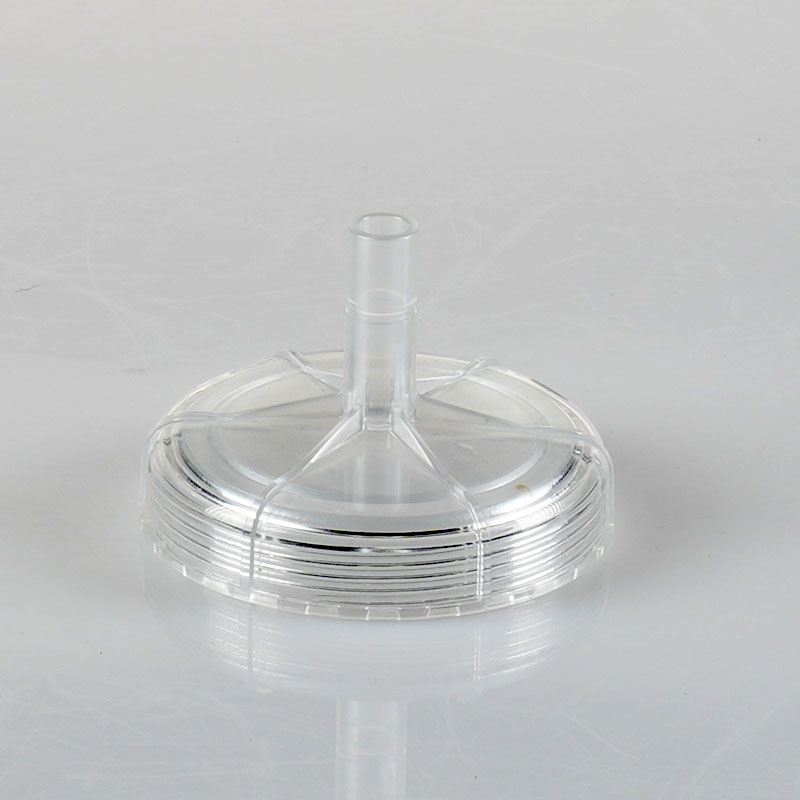
This disposable medical filter enclosure is injection molded in transparent medical-grade resin as one piece: ribbed skirt, domed body, internal star web and threaded neck. The star web supports the filter medium across the full diameter and channels flow evenly from edge to center, so no single sector clogs first. The thread is molded by unscrewing core, jump thread or split core, chosen against thread depth, resin and sealing requirement, and first articles are gauged with the customer's mating cap. Walls are held to the minimum the pressure spec allows because the part runs in multi-cavity tooling at volume. Resin candidates include PC, PMMA and cyclic olefins per the customer's specification.
star web supports the medium and evens the flow path so no sector clogs ahead of the rest
thread mechanism chosen at quoting stage: unscrewing core, jump thread or split core
first articles gauged with the customer's mating cap and leak-tested per cavity on a sampling plan
This transparent enclosure is the body of a single-use medical filter. The filter medium sits inside the star-shaped web, fluid or air crosses it, and the threaded joint at the base closes the housing against a seal. Because the wall is clear, a nurse or technician can see the medium and any trapped air or contamination without opening anything — and since the housing is disposable, it has to deliver that clarity mold after mold, in volume.
The part is injection molded in medical-grade transparent resin as one piece: a ribbed skirt, a domed body, an internal star web and a threaded neck. The ribs stiffen the skirt, the web supports the medium and spreads the flow, and the thread carries the assembly load. This page covers those three jobs and what they cost in tooling.
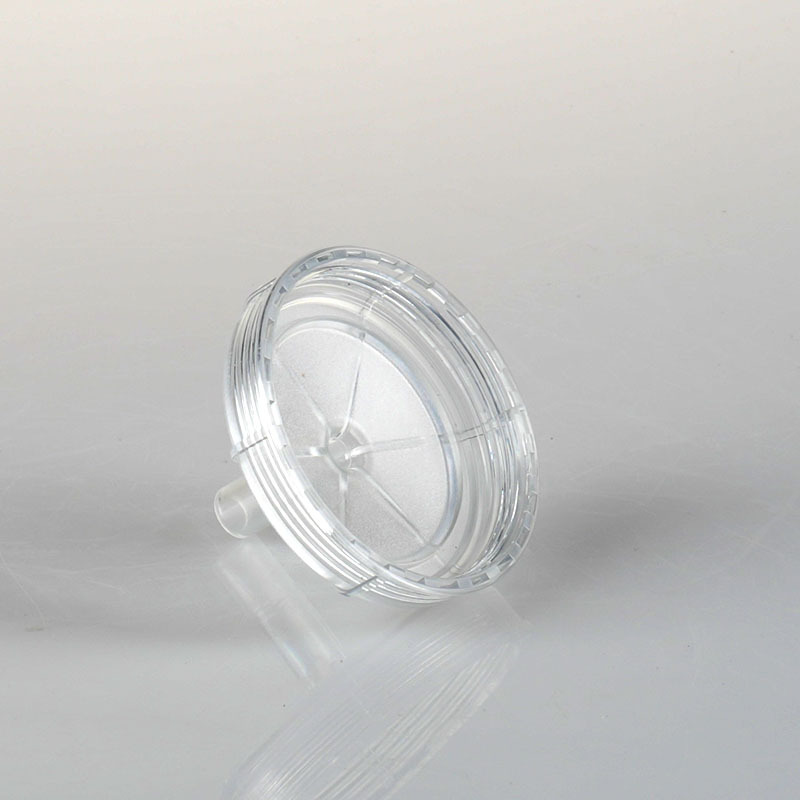
The ribbed enclosure seen from an angle, with the star web visible through the dome.
What a Disposable Filter Housing Has to Do
The housing is a pressure vessel in miniature. It holds the medium in place while flow passes through it, it seals against leakage at the threaded joint, and it survives handling on a busy ward without cracking. It also has to show its contents, because the user checks the medium through the wall before use. Those two demands pull in opposite directions: clarity wants thin, clean walls; pressure wants section and stiffness. The compromise is geometry — ribs instead of bulk, a drafted skirt instead of a thick cylinder.
Disposability sets the economics. The part runs in multi-cavity tooling at volumes where a fraction of a gram of resin per piece is real money, so wall thickness is held to the minimum the pressure spec allows, and the ribs do the rest of the work.
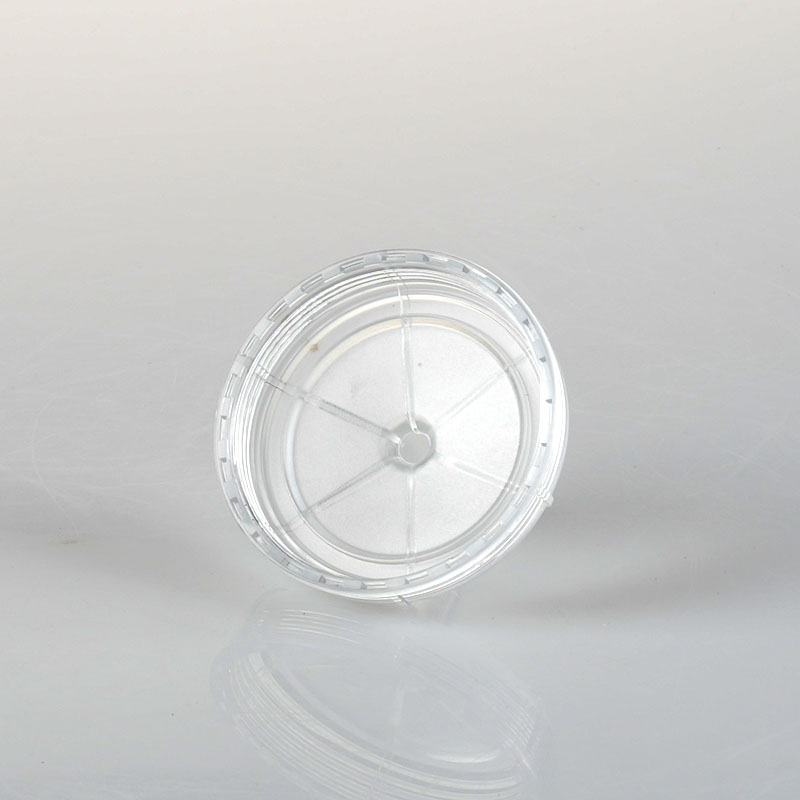
Top view showing the star-shaped support web inside the clear body.
The Star Web Inside
The star pattern moulded into the body is not decoration. Its arms support the filter medium across the full diameter, so the medium does not belly into the outlet under flow, and the channels between the arms give the flow an even path from edge to center. An even path matters: if the flow pools in one sector, that sector clogs first and the filter’s effective life drops even though the medium itself is fine.
Molding the web in the same shot as the body is the only sensible way to make it. The arms are thinner than the wall, so they fill from the main flow front without sinks on the outer face; the junctions where the arms meet the dome are radiused, because a sharp internal corner in a clear part is where stress and visible marks collect.
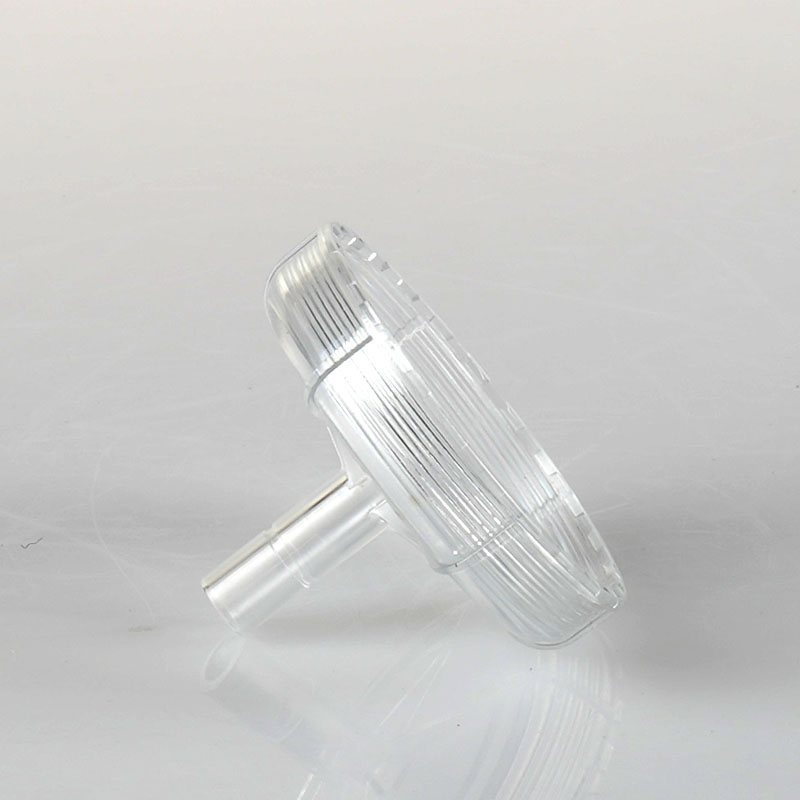
Side view showing the deep moulded ribs around the skirt.
Threads on a Molded Part
The threaded neck is the assembly joint, and molding a thread forces a tooling decision. An unscrewing core gives the truest thread form but adds mechanism, cost and another thing to maintain. A jump thread — where the segment lifts over an undercut on ejection — is cheaper and works well on shallow threads in flexible resins, but it needs draft and a forgiving thread form. Split cores are the third option and leave witness lines on the thread flanks. Which one is right depends on the thread depth, the resin and the sealing requirement, and it should be settled before the tool is quoted, not discovered after.
Whatever the mechanism, the thread has to gauge. A thread that assembles loosely lets the joint weep; one that binds wastes nursing time. First articles are checked with a mating cap from the customer’s drawing, not just with the mold’s own gauge.
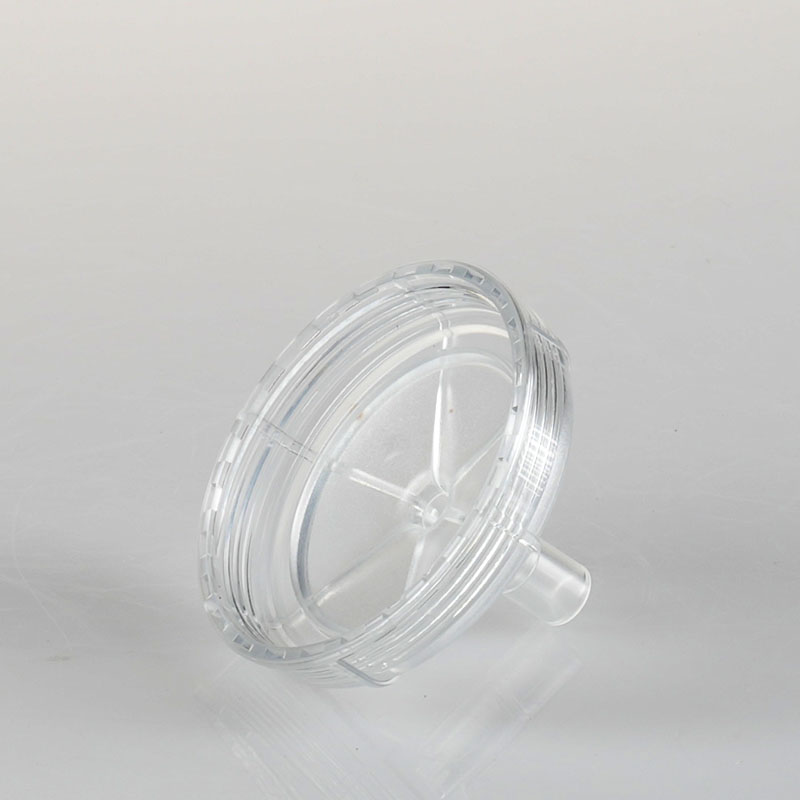
The domed housing with its central port stub and ribbed skirt.
Clarity, Welding Faces and Inspection
Transparent medical resins punish moisture. Splay streaks in a clear wall are scrap on sight, so the resin is dried to specification before molding and the hopper stays sealed between runs. Candidates for this class of part include PC, PMMA and the cyclic olefins; each brings a different balance of clarity, impact strength and chemical resistance to the media it will see, and the final grade belongs to the customer’s specification.
Where the two halves of a filter assembly meet, the welding face has to be clean, flat and flash-free. A whisker of flash on a sealing face is invisible until the joint fails a leak test. We inspect first articles against a light for streaks and sink, gauge the thread with a mating part, and leak-test sample parts from each cavity on a sampling plan agreed with the customer.
Information to Confirm Before Starting a Medical Filter Housing Project
The media the housing will see — liquid or air, and its chemistry — since the resin grade follows it.
The thread form and the mating cap drawing, including the seal type that sits inside the joint.
The filter medium and its support requirement, which the star web has to match.
Pressure or leak test limits, so the wall thickness and welding face are sized to them.
Annual volume and sterilization method, which decide cavity count, resin and packaging.
Kunshan Maifeng Precision Industry Co., Ltd. reviews disposable medical housing designs before quoting, builds the injection molds in house, and molds single-color and dual-color parts on 36 machines from 90 to 700 tons. Send us the housing drawing and the media specification, and we will come back with a feasibility comment and a tooling proposal.
Company Profile
About Us
Kunshan Maifeng Precision Industry Co., Ltd. (MIF) has an investment of RMB 35 million and an independent factory of more than 5,000 m². The company operates 36 single- and dual-color injection molding machines from 90 to 700 tons, together with more than 50 sets of mold manufacturing and processing equipment. Our service, management and production team includes over 100 people.
Our parent company was established in 2008. We provide product design, mold design and manufacturing, injection molding and product assembly services for custom plastic parts, supporting both domestic and international customers.
1. Product Design Product structure design and optimization based on customer drawings and samples.
2. Mold Design Mold design developed around product geometry, material and production requirements.
3. Mold Manufacturing Machining, polishing, fitting and assembly for custom injection molds.
4. Injection Molding Single- and dual-color injection molding for project and order requirements.
5. Product Assembly Supporting assembly services for molded plastic components.
Custom glossy black PC protective cover for lawn mowers: an open-ring shell with snap clips molded in one shot and a class-A face that survives stones, sun and cleaning.
Custom PC light-diffusion tail light grille for lawn mowers: an even light band, a ribbed outer face, a sealed fixing flange and an optical surface finished to the agreed polish.
Custom clear PC tail light strip for mowers and outdoor equipment: compound curve, uniform wall, polished optical face and colour matched to your chip.
PC+ABS automotive wireless charging housing with an open coil window, four mounting ears and a stiffening rib, molded, inspected and packed for console assembly.
PC lawn mower tail light grille produced through custom mold development, precision injection molding and strict quality control for demanding outdoor applications.
PP handles and plastic parts for a 3rd generation magnetic wall mounted toilet brush, produced at Maifeng Precision through custom mold design, injection molding and careful inspection.
ABS nasal irrigator outer housing produced with custom multi-cavity molds, precision injection molding, careful trimming and dust-free packaging for personal care brands.
ABS nasal irrigator base produced with custom mold design, precision injection molding, strict inspection and dust-free packaging for personal care and medical device assemblies.
No matter what your automotive needs may be, we’re here to help. Contact us today to learn more about our
services and how we can assist you with all of your needs.
ISO 13485-certified medical injection molding in Class 10,000/100,000 cleanrooms: 36 single and dual-color machines, proven medical cases and trusted partners.
One-stop cup and bottle molding: dual-color lids, tea-separation cups and handles, QS food-contact licensed production with proven cases for global brands.
Contact Us
To grow into a top global mold & injection molding supplier
To grow into a top global mold & injection molding supplier, specializing in differentiated custom parts. We focus on structural development, streamlined production and consistent quality supply.












 Chinese
 English



