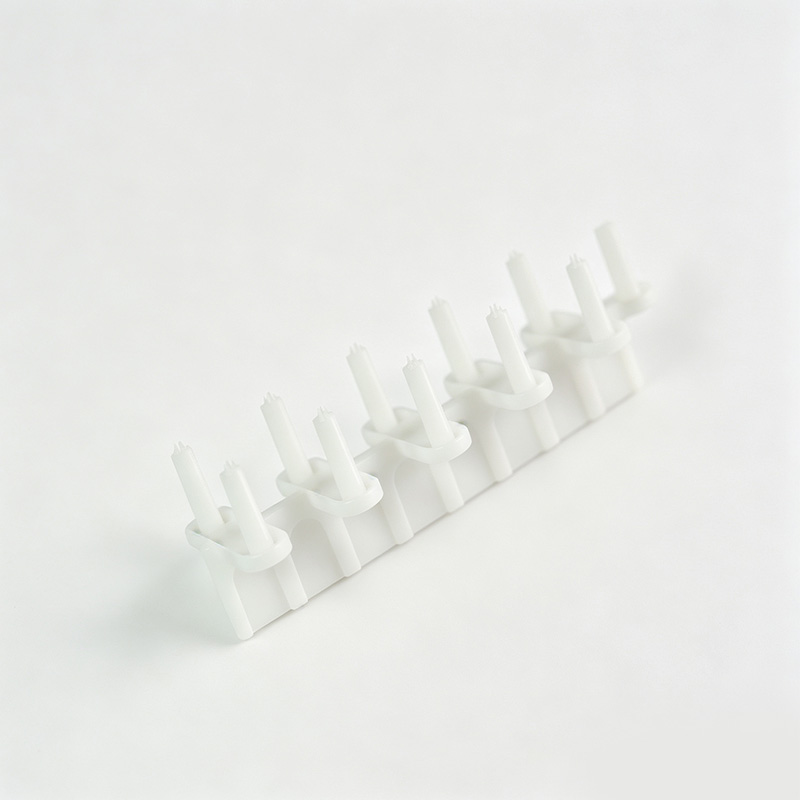
This disposable skin prick needle array is injection molded in medical-grade white polymer as a single piece: a row of lancet stems standing from a common spine, each stem ending in a moulded prong tip with a shoulder that limits prick depth. Arrays are supplied in a blue storage box with a transparent lid, seated in a white tray, so an operator lifts one array without touching the tips. Pitch along the spine is a controlled dimension checked on first articles, because uneven prick depths show up later as inconsistent wheal readings. Multi-cavity tooling keeps cavity-to-cavity tip geometry consistent, and tips are inspected under magnification on a sampling plan.
moulded prong tips with a shoulder below each one, so geometry limits prick depth without any steel
pitch along the common spine held as a controlled dimension and measured on first articles
multi-cavity consistency mapped by shot weight, with tip inspection under magnification
The skin prick needle is the part that touches the patient. In an allergen test, the array is pressed against the skin through a drop of extract, the tips make a set of uniform superficial pricks, and the reactions are read about twenty minutes later. This needle is a disposable white polymer array — no steel, no sharpening step, one patient and one test, then into the waste stream.
The array is injection molded as a single piece: a row of lancet stems standing from a common spine, each stem ending in a moulded prong tip. Arrays are supplied in a blue storage box with a transparent lid, seated in a white tray, so an operator can lift one array out without touching the tips. This page covers the tip geometry, the array consistency and how the part is molded in volume.
White multi-needle array with the lancet stems standing from a common spine.
A Needle Array With No Steel In It
Conventional prick needles are ground steel lancets. This product moulds the point instead. A moulded tip cannot be resharpened, so the geometry has to do the work: each stem ends in a small prong with a shoulder below it, and the shoulder is what limits how far the tip can travel into skin. The tip pricks; the shoulder stops. That is the safety concept in one sentence, and it only holds if every tip in the array ends at the same height.
The resin is a medical-grade white polymer chosen for stiffness at the tip section. A tip that flexes under finger pressure gives uneven prick depths across the array, and uneven depths show up later as inconsistent wheal readings — the exact error the test is trying to avoid.
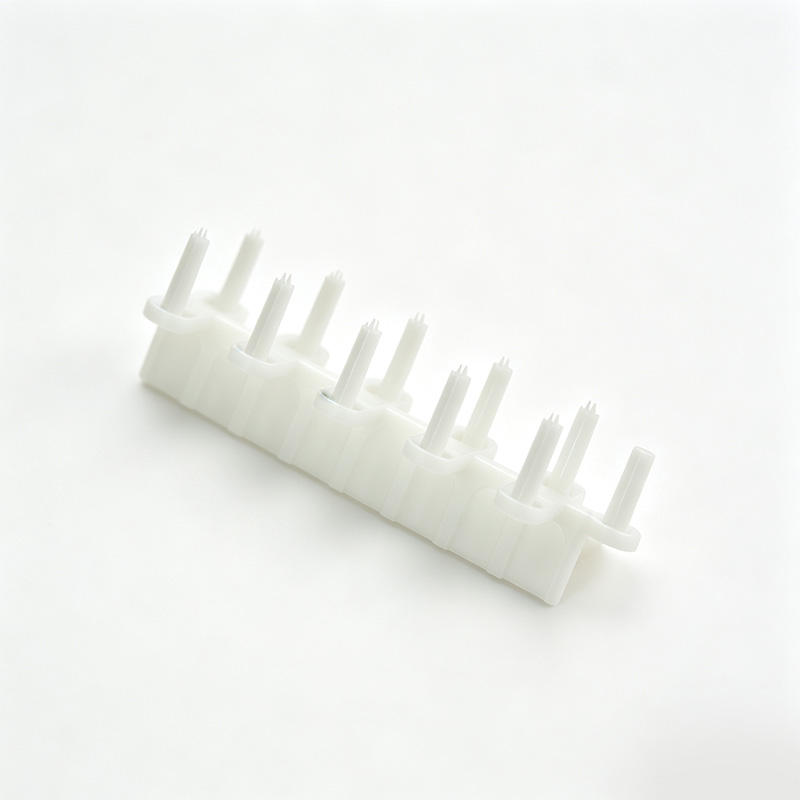
The array seen from the reverse, showing the spine and the stem roots.
Pitch and Tip Height Across the Array
The stems stand at a fixed pitch along the spine. The pitch is not cosmetic: a prick test compares reactions between sites on the forearm or back, and the sites are recorded against a template. If the array pitch drifts, the recorded site and the actual prick stop matching. Pitch is therefore a controlled dimension on the drawing, checked on first articles with a measuring microscope rather than assumed from the tool.
Tip height matters just as much. One stem sitting a tenth low pricks shallowly or not at all, and the operator has no way to see it. Height uniformity across the array is the single most reject-generating dimension on this part, which is why it gets its own inspection step.
Molding Tips That Come Out Right Every Time
A prong tip is a small, sharp feature on a part that otherwise wants generous radii. The tool cores each tip, keeps the parting line away from the tip zone, and gates the part so the flow reaches every stem evenly — a short shot or a disturbed tip on one stem is invisible until the array fails in use. Ejection pushes on the spine and tray-facing surfaces, never on the stems.
Because this is a single-use medical consumable, it runs in multi-cavity tooling, and cavity-to-cavity consistency is the whole game. Each cavity is mapped by shot weight and first-article measurement, and tip inspection runs under magnification on a sampling plan. A whisker of flash at a tip or on the spine edge gets caught there, not by the nurse.
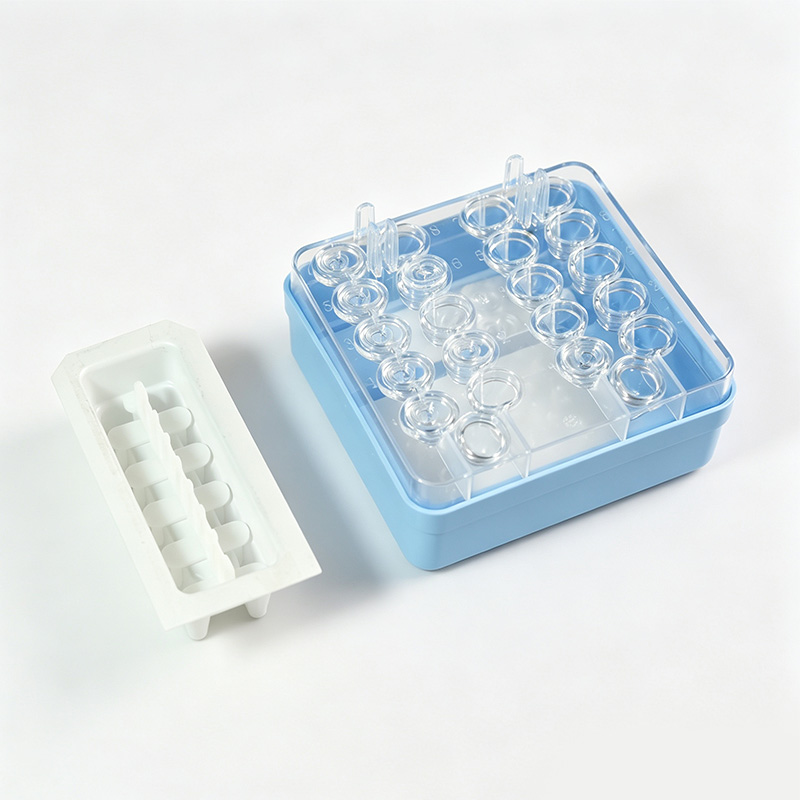
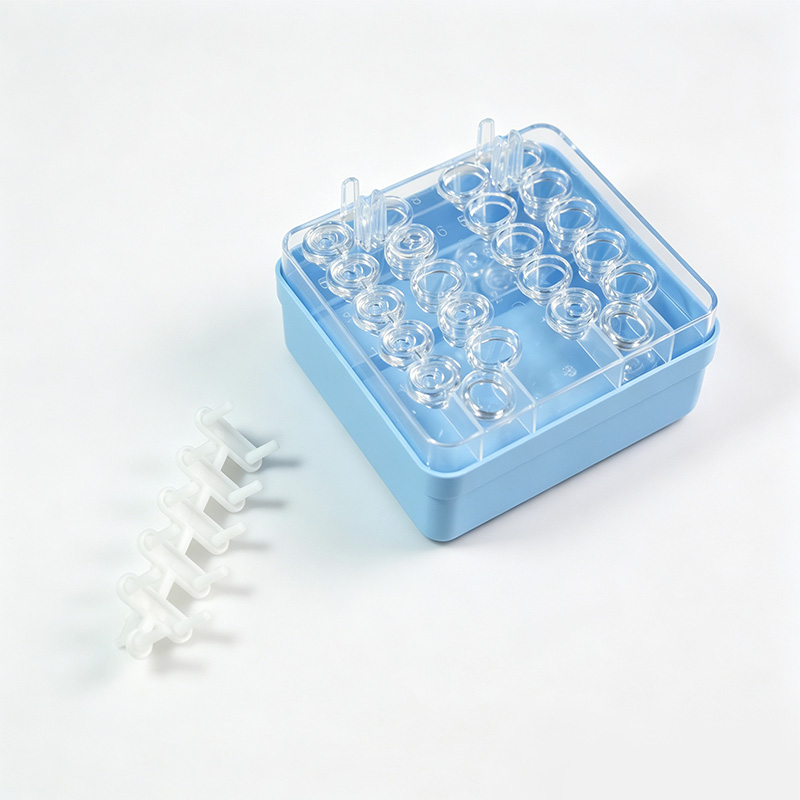
Blue storage box with transparent lid, arrays inside, white tray beside.
The Storage Box and Single-Use Handling
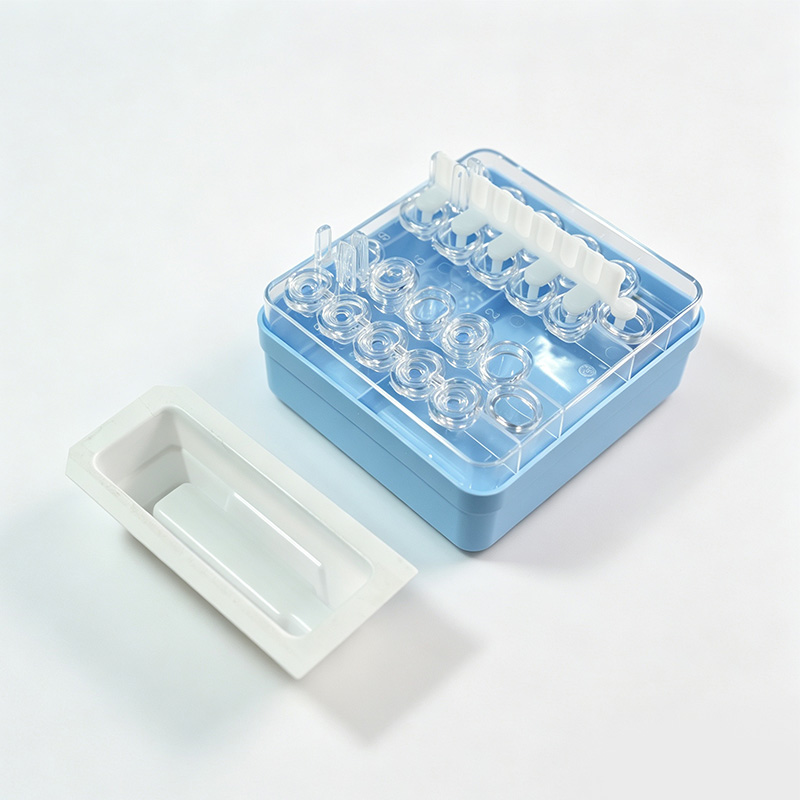
The blue box with the transparent lid is part of the product concept rather than an afterthought. Arrays sit in the white tray in rows; the lid lets a nurse count stock and pick one array without opening the box, which keeps fingers off the tips. The box is a handling and stock-control container. It is not a sterilization barrier, and we are careful not to imply otherwise — any sterilization or terminal packaging requirement belongs to the customer’s process and has to be specified before the packaging design is settled.
Storage box with a loose array lying beside it, tips clear of contact.
Information to Confirm Before Starting a Skin Prick Needle Project
The number of tips and the pitch, matched to the reading template the test uses.
Tip and shoulder geometry, since the shoulder sets the prick depth limit.
The resin grade and colorant specification, including any medical documentation requirement.
Terminal packaging: bulk arrays, boxed as shown, or prepared for the customer’s sterilization step.
Annual volume, which decides the cavity count and the inspection sampling plan.
Kunshan Maifeng Precision Industry Co., Ltd. reviews single-use medical array designs before quoting, builds the injection molds in house, and molds single-color and dual-color parts on 36 machines from 90 to 700 tons. Send us the array drawing and the tip specification, and we will come back with a feasibility comment and a tooling proposal.
Company Profile
About Us
Kunshan Maifeng Precision Industry Co., Ltd. (MIF) has an investment of RMB 35 million and an independent factory of more than 5,000 m². The company operates 36 single- and dual-color injection molding machines from 90 to 700 tons, together with more than 50 sets of mold manufacturing and processing equipment. Our service, management and production team includes over 100 people.
Our parent company was established in 2008. We provide product design, mold design and manufacturing, injection molding and product assembly services for custom plastic parts, supporting both domestic and international customers.
1. Product Design Product structure design and optimization based on customer drawings and samples.
2. Mold Design Mold design developed around product geometry, material and production requirements.
3. Mold Manufacturing Machining, polishing, fitting and assembly for custom injection molds.
4. Injection Molding Single- and dual-color injection molding for project and order requirements.
5. Product Assembly Supporting assembly services for molded plastic components.
Custom glossy black PC protective cover for lawn mowers: an open-ring shell with snap clips molded in one shot and a class-A face that survives stones, sun and cleaning.
Custom PC light-diffusion tail light grille for lawn mowers: an even light band, a ribbed outer face, a sealed fixing flange and an optical surface finished to the agreed polish.
Custom clear PC tail light strip for mowers and outdoor equipment: compound curve, uniform wall, polished optical face and colour matched to your chip.
PC+ABS automotive wireless charging housing with an open coil window, four mounting ears and a stiffening rib, molded, inspected and packed for console assembly.
PC lawn mower tail light grille produced through custom mold development, precision injection molding and strict quality control for demanding outdoor applications.
PP handles and plastic parts for a 3rd generation magnetic wall mounted toilet brush, produced at Maifeng Precision through custom mold design, injection molding and careful inspection.
ABS nasal irrigator outer housing produced with custom multi-cavity molds, precision injection molding, careful trimming and dust-free packaging for personal care brands.
ABS nasal irrigator base produced with custom mold design, precision injection molding, strict inspection and dust-free packaging for personal care and medical device assemblies.
No matter what your automotive needs may be, we’re here to help. Contact us today to learn more about our
services and how we can assist you with all of your needs.
ISO 13485-certified medical injection molding in Class 10,000/100,000 cleanrooms: 36 single and dual-color machines, proven medical cases and trusted partners.
One-stop cup and bottle molding: dual-color lids, tea-separation cups and handles, QS food-contact licensed production with proven cases for global brands.
Contact Us
To grow into a top global mold & injection molding supplier
To grow into a top global mold & injection molding supplier, specializing in differentiated custom parts. We focus on structural development, streamlined production and consistent quality supply.












 Chinese
 English



