This handle set for a spring-powered hand gripper pairs a curved hard-plastic base with a soft grip band overmoulded by vertical injection. The soft material flows through mechanical locks in the substrate, so it cannot peel under the twisting load of a hand at work, and its moulded texture adds friction and resists wear. Both the handle and the lever arm carry thickened cylindrical spring seats dimensioned from the actual spring, so the grip stays even through the full stroke. The curved parting line keeps the seam out of the grip zone. Grip hardness, texture and colour can be adapted to a customer design.
soft grip locked to the substrate mechanically, not by adhesion alone
spring seats thickened and dimensioned from the real spring for an even stroke feel
curved parting line planned so the mould seam never lands in the grip zone
A spring hand grip is used in bursts and stored in a gym bag, and its handle takes the worst of both: sweat, repeated full-force squeezing, and friction against whatever is around it. The handle set shown here is for a spring-powered gripper: a curved hard-plastic base with a soft grip overmoulded in a second shot, plus the matching lever arm that carries the spring end.
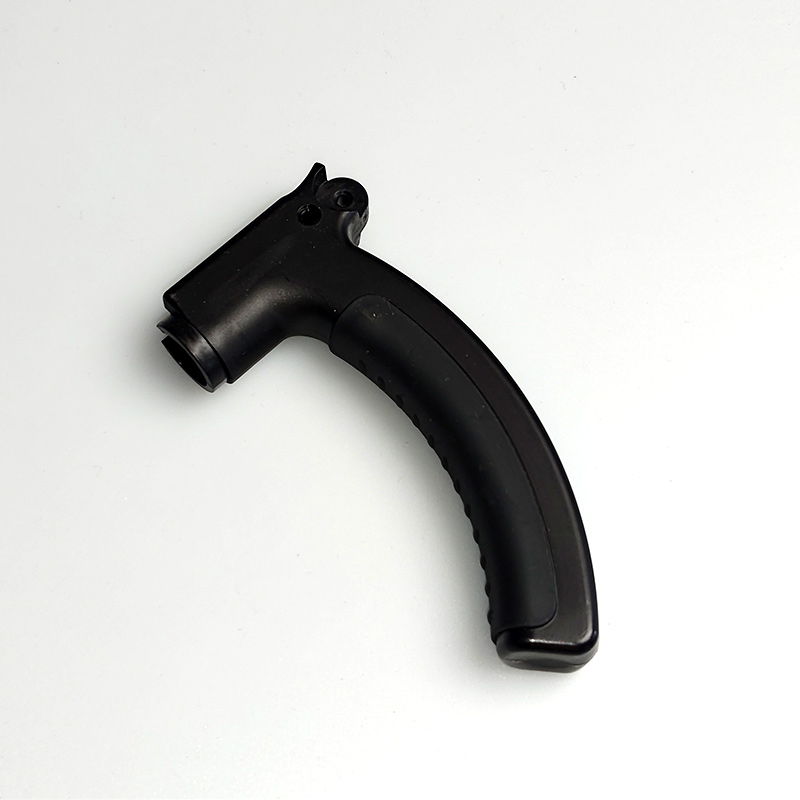
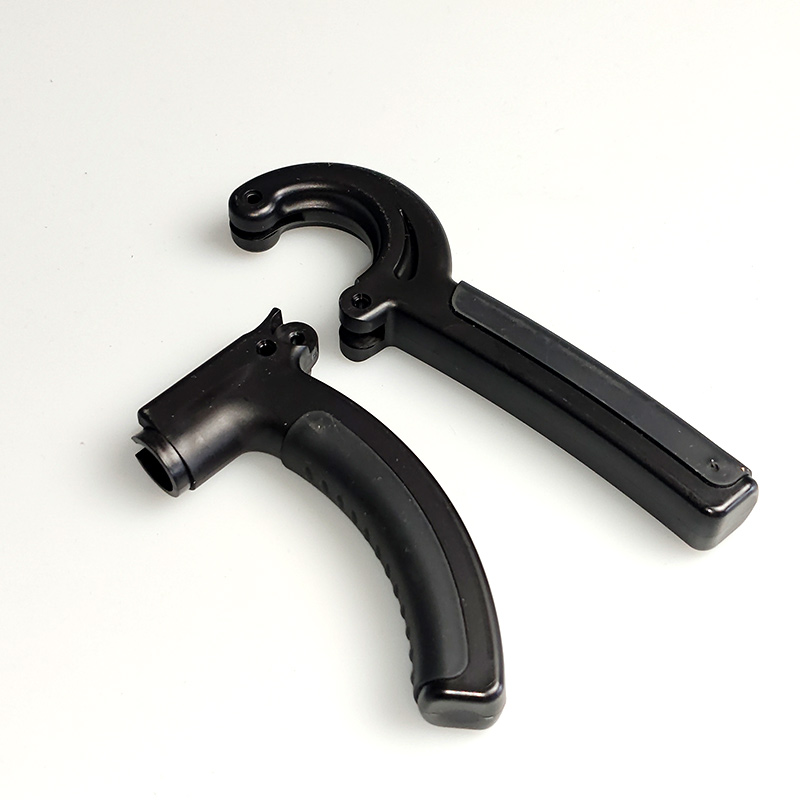
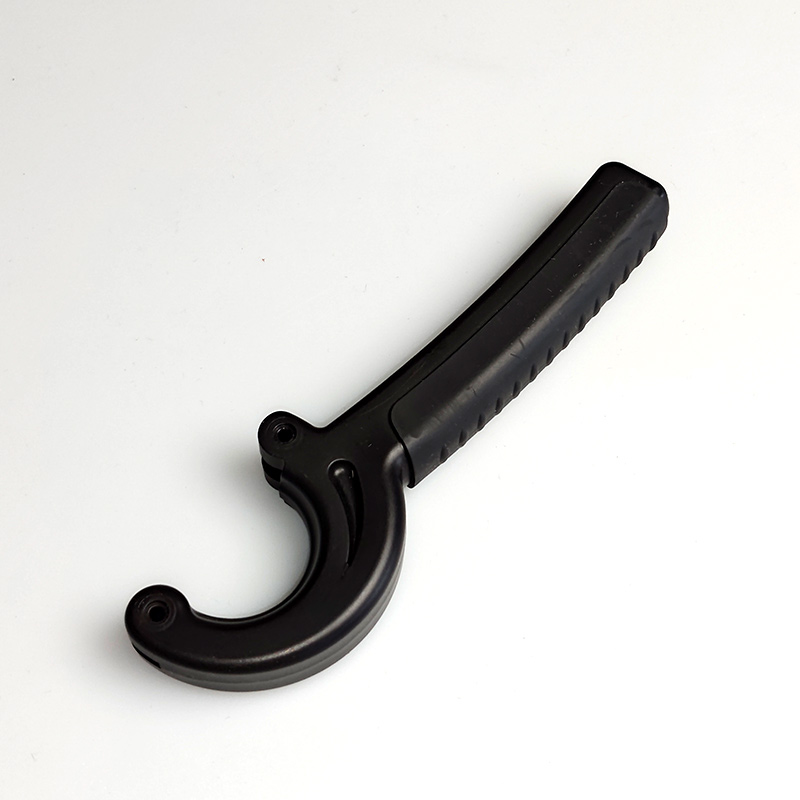
The photographs show the handle alone, the handle and lever together, and the assembled pair. The connection ends are moulded cylindrical seats, and the grip zone along the curve carries a textured soft surface where the hand actually lands.
The handle base. The cylindrical seat takes the spring pivot, and the textured band along the curve is the soft grip.
Why the Grip Is Overmoulded
A hard handle forces the fingers to do all the friction work, and they tire long before the spring does. The soft band over the curve does three jobs at once: it adds friction so the grip needs less clamping force, it spreads the pressure over the fingers, and it takes the wear that would otherwise polish and crack the hard substrate. It is moulded onto the handle in a vertical injection second shot, flowing through mechanical locks in the substrate rather than relying on adhesion.
Texturing the soft surface is part of the design, not decoration. The raised pattern increases friction and hides the sheen that a flat soft surface develops after weeks of use. The pattern is formed by the tool, so it repeats exactly across the production run.
The two components before assembly. The lever carries the opposite spring seat and closes against the handle.
The Spring Ends
Both the handle and the lever carry a cylindrical seat at their closing end, and those seats are the parts that see the load. The spring pushes with every squeeze and pulls back on release, thousands of cycles at whatever force the user chooses. The seat walls are thickened behind the spring coil, and the geometry is taken from the actual spring, not from a nominal diameter, because a seat that lets the coil wander makes the grip feel loose at the top of every stroke.
This is the reason we ask for the spring specification with the handle drawing. Seat depth, wall thickness and the relationship between the two seats in the closed position all come from the spring, and they decide whether the assembled gripper feels even through the stroke or pulls to one side.
The assembled pair. The handle curve follows the closed hand, with the soft grip where the fingers land.
Moulding a Curved Handle
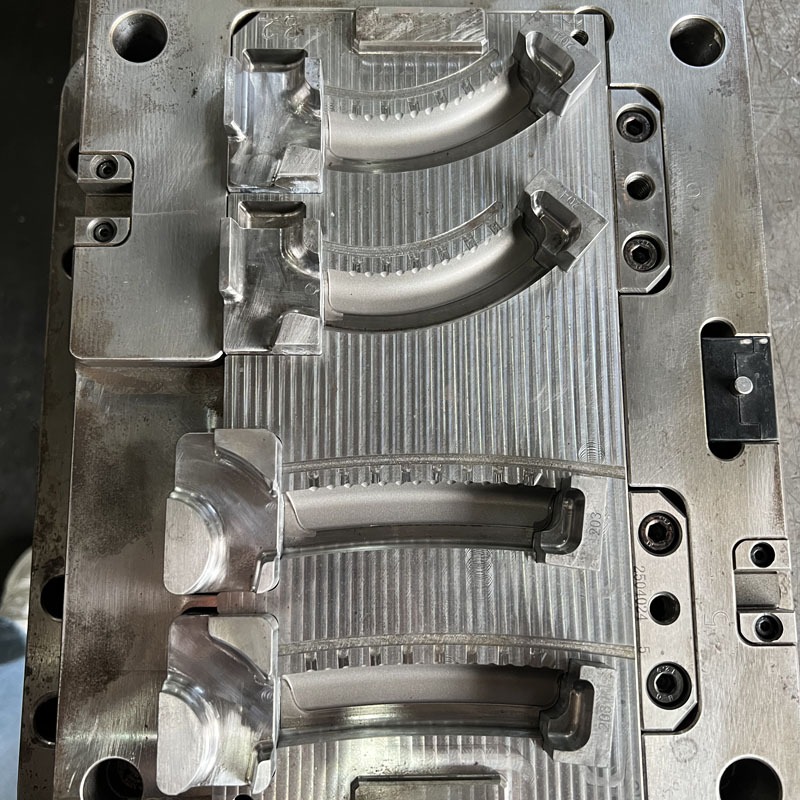
The curve itself is a tooling decision. A curved handle parts from its mould along a curved split line, which is more work in the tool than a straight pull, but it is what puts the grip surface where the closed hand wants it. Getting the parting line right keeps the seam out of the grip zone, because a seam line exactly where the fingers squeeze is felt immediately and reads as a defect.
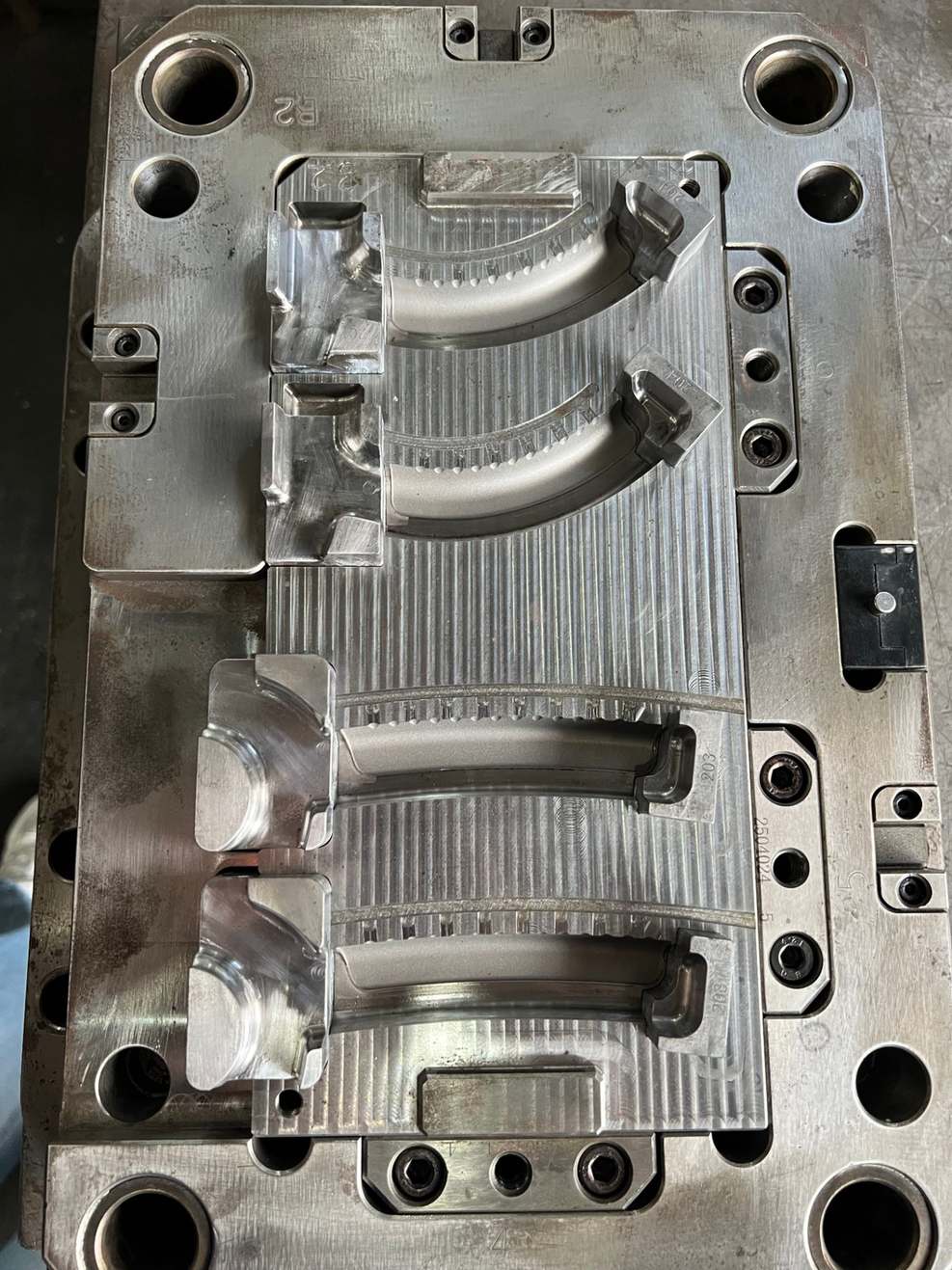
The cavity side of the overmould tool – curved split lines and grip zones for four handles.
The hard substrate is moulded first, in a layout that leaves the grip zone clean for the second shot. Where the soft material meets the hard one, the boundary is stepped and locked so the two materials cannot separate under the peeling load of a hand twisting on the grip.
The full multi-cavity tool – substrate and overmould cavities arranged around the curved split line.The grip handle mold running on the injection molding machine.
What Gets Checked Before Shipping
Bond strength between grip and substrate, checked by twisting and peeling a sample from each lot. Spring seat dimensions against the actual spring, and the assembled feel through the full stroke. Texture definition in the soft surface. Colour and surface finish of the substrate against the approved master.
Information to Confirm Before Starting a Gripper Handle Project
The spring specification, force, wire diameter and free length, since both seats are built around it.
Target grip force range and user group, which set the soft material hardness and the curve.
Whether resistance is fixed or adjustable, which changes the lever and seat geometry.
Colour and hardness specification for both materials, with masters to match.
Annual volume, which decides the tooling layout for the two-shot process.
Kunshan Maifeng Precision Industry Co., Ltd. reviews sporting goods and overmolded handle designs before quoting, builds the injection molds in house, and molds single-color and dual-color parts on 36 machines from 90 to 700 tons. Send us the spring specification and the handle layout, and we will come back with a feasibility comment and a tooling proposal.
Company Profile
About Us
Kunshan Maifeng Precision Industry Co., Ltd. (MIF) has an investment of RMB 35 million and an independent factory of more than 5,000 m². The company operates 36 single- and dual-color injection molding machines from 90 to 700 tons, together with more than 50 sets of mold manufacturing and processing equipment. Our service, management and production team includes over 100 people.
Our parent company was established in 2008. We provide product design, mold design and manufacturing, injection molding and product assembly services for custom plastic parts, supporting both domestic and international customers.
1. Product Design Product structure design and optimization based on customer drawings and samples.
2. Mold Design Mold design developed around product geometry, material and production requirements.
3. Mold Manufacturing Machining, polishing, fitting and assembly for custom injection molds.
4. Injection Molding Single- and dual-color injection molding for project and order requirements.
5. Product Assembly Supporting assembly services for molded plastic components.
Custom glossy black PC protective cover for lawn mowers: an open-ring shell with snap clips molded in one shot and a class-A face that survives stones, sun and cleaning.
Custom PC light-diffusion tail light grille for lawn mowers: an even light band, a ribbed outer face, a sealed fixing flange and an optical surface finished to the agreed polish.
Custom clear PC tail light strip for mowers and outdoor equipment: compound curve, uniform wall, polished optical face and colour matched to your chip.
PC+ABS automotive wireless charging housing with an open coil window, four mounting ears and a stiffening rib, molded, inspected and packed for console assembly.
PC lawn mower tail light grille produced through custom mold development, precision injection molding and strict quality control for demanding outdoor applications.
PP handles and plastic parts for a 3rd generation magnetic wall mounted toilet brush, produced at Maifeng Precision through custom mold design, injection molding and careful inspection.
ABS nasal irrigator outer housing produced with custom multi-cavity molds, precision injection molding, careful trimming and dust-free packaging for personal care brands.
ABS nasal irrigator base produced with custom mold design, precision injection molding, strict inspection and dust-free packaging for personal care and medical device assemblies.
No matter what your automotive needs may be, we’re here to help. Contact us today to learn more about our
services and how we can assist you with all of your needs.
ISO 13485-certified medical injection molding in Class 10,000/100,000 cleanrooms: 36 single and dual-color machines, proven medical cases and trusted partners.
One-stop cup and bottle molding: dual-color lids, tea-separation cups and handles, QS food-contact licensed production with proven cases for global brands.
Contact Us
To grow into a top global mold & injection molding supplier
To grow into a top global mold & injection molding supplier, specializing in differentiated custom parts. We focus on structural development, streamlined production and consistent quality supply.












 Chinese
 English



