
Nullam dignissim, ante scelerisque the is euismod fermentum odio sem semper the is erat, a feugiat leo urna eget eros. Duis Aenean a imperdiet risus.
Nullam dignissim, ante scelerisque the is euismod fermentum odio sem semper the is erat, a feugiat leo urna eget eros. Duis Aenean a imperdiet risus.
 Maifeng Precision Team
A dust-proof top cover looks like a simple black plastic cap, but in a car interior it has a real job to do: it seals an electronic module or connector area against dust and splash, survives years of heat and vibration, and still has to snap on and off with a clean, precise feel. That combination is exactly where glass-filled nylon earns its place — and where an average molded part shows its weaknesses through warpage, loose clips or dull, glass-marked surfaces.
In this project we manufactured a custom PA66+GF top cover for an automotive interior application, covering the full path from mold development and injection molding to quality inspection and carton packing. Below we walk through the material choice, the molding considerations specific to glass-filled nylon, and how the finished covers are inspected and packed for supply.
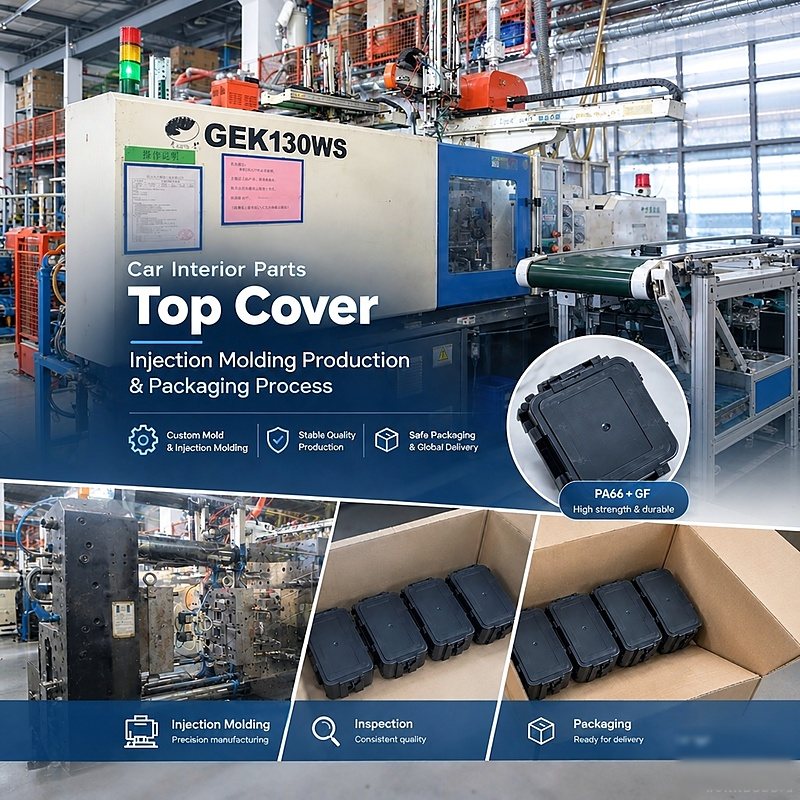
A cover mounted inside a vehicle sees temperature swings, sunlight through the windows and continuous vibration. Unreinforced plastics gradually lose stiffness under these conditions, and a cover that was snug at delivery can relax, rattle or let dust past its sealing face. PA66 reinforced with glass fiber (PA66+GF) keeps its rigidity at elevated temperature, resists automotive fluids and chemicals, and holds its dimensions far better over the life of the part.
The glass fiber is also what makes a thin-walled cover feel solid rather than flimsy: the wall section can stay slim for weight and cost, while the reinforcement carries the mechanical load. For this part, the cover and its mating features are molded from the same PA66+GF grade, so the snap-fit clips, the sealing face and the ribbed inner structure all shrink and behave consistently — which is what keeps the fit predictable from batch to batch.
Glass-filled nylon punishes careless mold design. Fiber orientation follows the flow path, so gate location directly affects how much the part distorts after molding; on a flat, closed cover like this, the gating and cooling were balanced to keep the sealing face flat instead of bowed. Vents are placed where the flow fronts meet, because glass-filled materials trap air easily and short shots or burn marks at the far corners are the classic symptoms of poor venting.
The filled material is also abrasive: corners, snap-fit hooks and rib roots see high shear, so those steel areas are hardened and polished to hold their dimension over tens of thousands of shots. During trials we check the clip engagement on the actual mating part, measure the flatness of the sealing face and adjust holding pressure and cycle time until the parts come out stable rather than sampling well once.
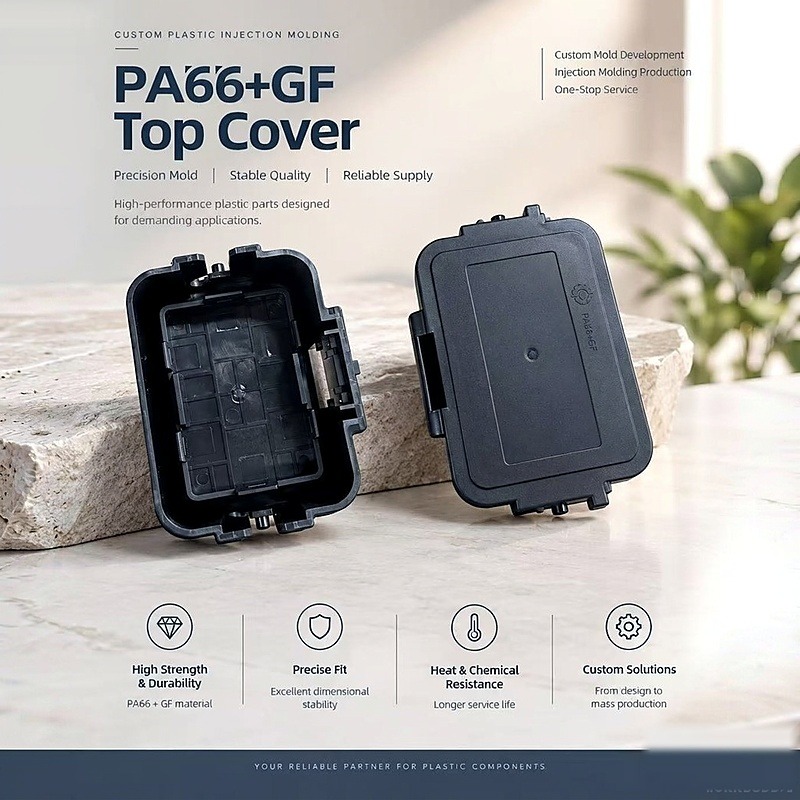
On a cover like this, dimensional accuracy is not cosmetic — it is the product. The side clips need to grip firmly without cracking during assembly, the sealing face needs to close evenly against the base, and the ribbed interior keeps the cover from flexing when pressed. Each of these depends on the molded corners and hooks staying within a few hundredths of a millimeter of nominal.
That is why the part is judged as an assembly, not just as a picture: covers are fitted to the mating base during inspection, and the clip feel, the closing gap and the release force are checked together. A cover that snaps on with a clean click and sits flush the first time is the practical result of that fit work.
After molding, the covers go through appearance and dimensional inspection before packing. Visible surfaces are checked for flow marks, glass fiber exposure, flash at the parting line and sink over the ribs; key dimensions are sampled against the drawing. Only covers that pass inspection are packed into cartons in the orientation shown below, so they arrive at the customer ready for assembly without re-sorting.
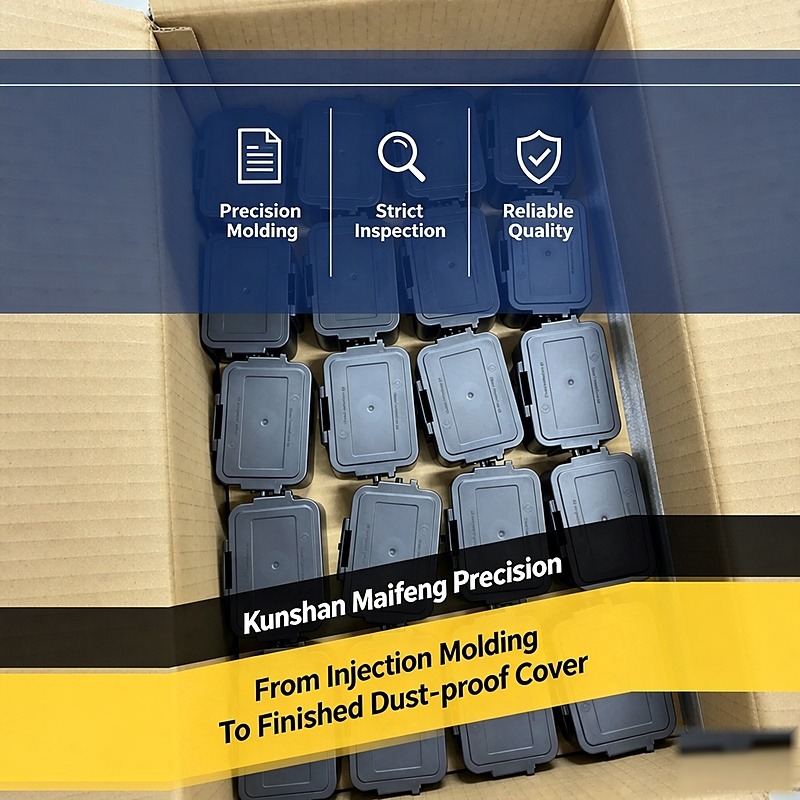
The same approach applies to a family of automotive and industrial plastic parts: dust-proof covers, top covers and housings for electronic modules, connector guards and similar clip-on components. If you already have a 3D drawing and a target material, we can review the structure for moldability, quote the mold and the parts, and run production on our own machines — mold development, injection molding, inspection and packing are all handled in-house.
If you are still at the sampling stage, we can start from your drawing or a physical sample, confirm the material grade and clip design, and supply first articles for assembly trials before the mold is finalized. Logo marking on the cover surface, as shown on this part, can be molded directly into the tool.
Looking for a reliable custom injection molding partner for your automotive plastic parts? Send us your drawing or sample — Kunshan Maifeng Precision provides product structure review, custom mold design and manufacturing, single- and dual-color injection molding and product assembly under one roof, and we are glad to quote your next top cover or dust-proof cover project.

Kunshan Maifeng Precision Industry Co., Ltd. (MIF) has an investment of RMB 35 million and an independent factory of more than 5,000 m². Our manufacturing resources include 36 single- and dual-color injection molding machines from 90 to 700 tons and more than 50 sets of mold manufacturing and processing equipment. Supported by a service, management and production team of over 100 people, we provide product design, mold design and manufacturing, injection molding, and product assembly. Our parent company was established in 2008.
1. Product Design
Product structure design and optimization based on customer drawings and samples.
2. Mold Design
Mold concepts developed around product requirements, material and production needs.
3. Mold Manufacturing
Machining, polishing, assembly and related processes for custom molds.
4. Injection Molding
Single- and dual-color molding capabilities for custom production.
5. Product Assembly













 English
 Chinese